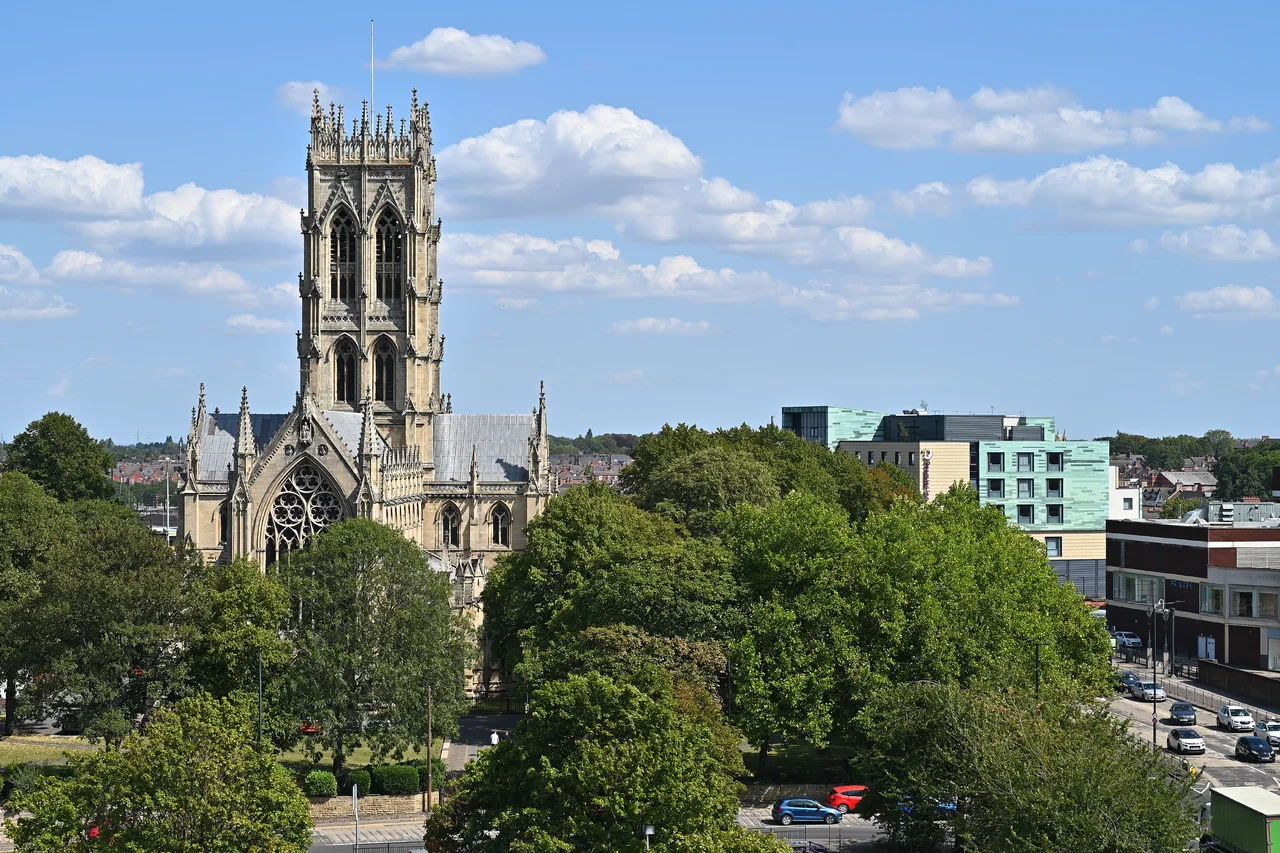

Doncaster Minster
On the last day of February 1853, the medieval church of St George burned down. The fire was thorough. It took the thirteenth-century Early English fabric, the Norman stones embedded in older walls from a church that had burned at the start of the same century, and the medieval library above the south porch. By morning there was almost nothing left to repair. Doncaster decided to build something extraordinary in its place - and hired the most successful Gothic Revival architect in England to do it.
Scott's Most Cathedral-Like
Sir George Gilbert Scott had a workshop running on the scale of an industrial firm. By the time he died he had been responsible for, restored, or designed more than 800 buildings, including the Albert Memorial and the Midland Grand Hotel at St Pancras. Parish churches were the bread and butter of the practice. Yet Nikolaus Pevsner, the German-born architectural historian whose Buildings of England series remains the definitive survey of British architecture, picked Doncaster out as the proudest and most cathedral-like of all the parish churches this fabulously busy and successful architect designed. The foundation stone was laid by the Archbishop of York, Thomas Musgrave, on 24 February 1854. Construction took four years and cost 43,126 pounds, four shillings, and fivepence - a number recorded with the precision of a Victorian ledger.
Cruciform and Perpendicular
Scott laid the church out as a massive cruciform - 169 feet long, 65 feet wide across the nave and aisles - with a central tower in the Perpendicular style rising 170 feet above the crossing. The rest of the church is in the Decorated style, the curvilinear tracery and elaborate window patterns of the earlier fourteenth century. A time capsule was buried under the building containing documents, coins, and a vellum sheet listing the names of benefactors, churchwardens, and clergy. The interior was filled with the work of the leading Victorian craftsmen of the period - and with a Schulze organ of ninety-three speaking stops, five manuals, and eight combination pedals, built by the Paulinzella workshop of the German organbuilder Edmund Schulze. The Schulze is one of the most celebrated organs in England.
The Clock and the Bells
Among the church's treasures is a clock by Dent - the same firm that built the clock in the Palace of Westminster better known as Big Ben. The eight bells in the tower were silent for a year during a 1925-26 repair that cost 2,000 pounds, and then they rang again. One quirk carried over from the medieval church: it had been the custom to ring the bells during the St Leger Stakes, the great horse race held since 1776 at Doncaster Racecourse. When the Reverend Vaughan took up the living, he ended the practice in the first year of his tenure by locking the tower and going for a walk. Whether his parishioners cheered or cursed him is not recorded.
Minster Status and a Living Building
St George's is one of only two parish churches in South Yorkshire with minster status - the other is at Rotherham. Minster is an honorific in modern Anglican use, denoting a church of particular regional importance, often with civic functions. The Doncaster Minster hosts civic services, concerts, and the regular cycle of weekly worship; it belongs to the Major Churches Network, the successor to the Greater Churches Network, which gathers England's large parish churches that operate at near-cathedral scale. From above, the tower remains a fix in the Doncaster skyline - a 170-foot Perpendicular spire on a Decorated cruciform body, exactly as Scott drew it in 1853 in the months after the old church burned.
From the Air
Located at 53.53N, 1.14W in the centre of Doncaster, South Yorkshire. Doncaster Sheffield Airport (formerly EGCN) lies about 5 nm south-east. Leeds Bradford (EGNM) is about 22 nm north-west. The 170-foot Perpendicular tower of the minster is a distinctive vertical landmark in the otherwise low Doncaster skyline, easily picked out from 3,000 to 5,000 ft AGL. The River Don passes a short distance to the north; Doncaster Racecourse, home of the St Leger, lies about 1 nm to the east.
Nearby Stories
- Litton Mill 0.9 km away
- Bradford Murders 1.2 km away
- Battle of Sherburn in Elmet 2.2 km away
- Bolsover Castle 5.6 km away
- Doddington Hall, Lincolnshire 5.8 km away
- Flixborough Disaster 11 km away
- Huddersfield Town Hall 13 km away
- Beverley Bar 19 km away