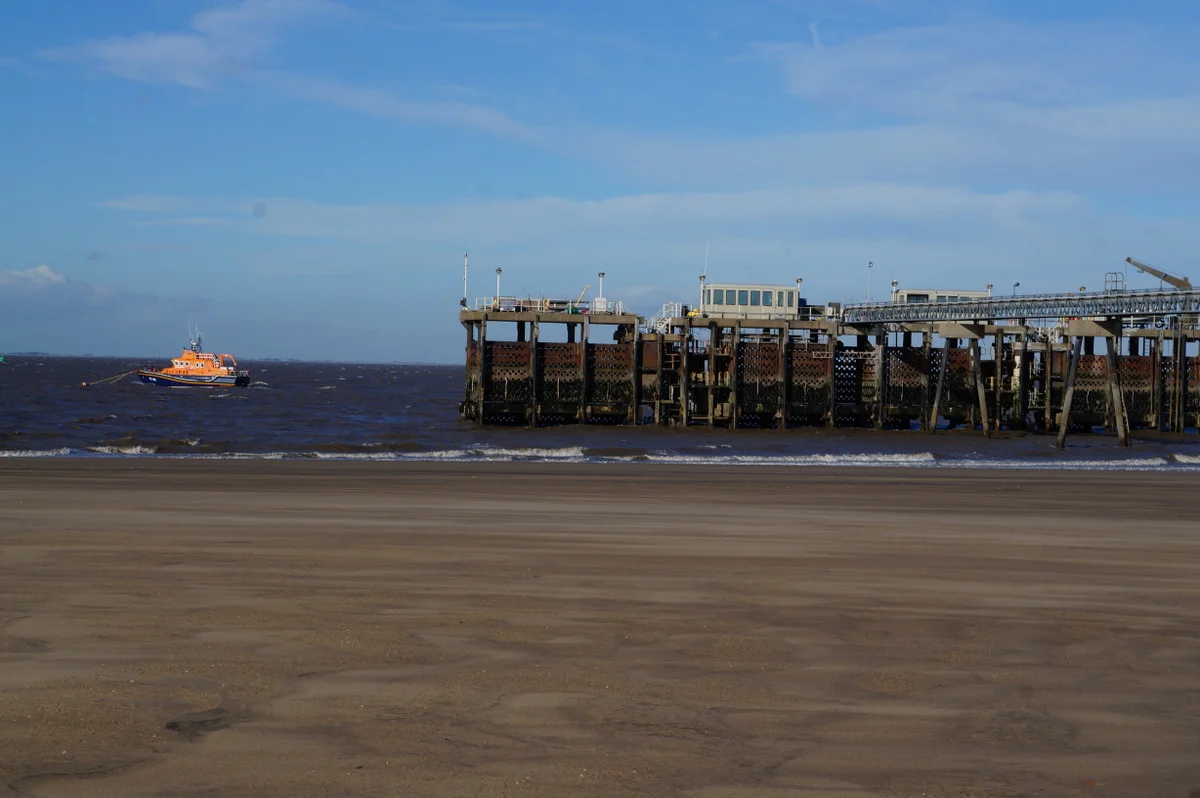

Humber Lifeboat Station
Until very recently, if you wanted to find the only place in the United Kingdom where lifeboat crew were paid a full-time salary, you had to drive three miles down a single-track road across a spit of sand that the sea was actively trying to wash away. That was Spurn Point, where the Humber Lifeboat Station kept its boat from 1810 to 2023. The reasoning was simple. Spurn was too remote and too dangerous to staff by volunteers who lived elsewhere. The crew lived where the boat lived, with their families, in cottages built behind a sea wall, on land that everyone agreed was running out. In June 2023 the RNLI finally moved the boat to Grimsby. On 31 May 2025 they handed the buildings to the Yorkshire Wildlife Trust and closed the chapter.
The Strange Birth of a Lifeboat Station
It started in 1810 in a decommissioned gun battery. Hull Trinity House ran the operation, the local lord of the manor donated the land, and Henry Greathead of South Shields - one of the inventors of the modern lifeboat - built a ten-oared rescue boat. The crew lived five kilometres up the coast in Kilnsea until 1819, when cottages went up next to the boat house. Their boss was the master of the Life Boat House Hotel, who also ran a sideline loading gravel and sand onto passing ships. The crew hated it. In 1811 the master complained to Trinity House about armed locals who came down to load ships at gunpoint - what he called the 'Law of the Dunes.' There was no police force to call. The nearest officials were miles away across the marsh. The lifeboat crew rowed out to save shipwrecked sailors and rowed back to a colony where the rules of the mainland did not entirely apply.
Robert Cross and Brian Bevan
Robert Cross was coxswain for thirty-one years until 1943. In that time he won two gold medals for gallantry, three silver, two bronze, and a George Medal - the most decorated coxswain the RNLI has ever produced. Cross took his lifeboat out into seas where ships were breaking up and brought the crews home, repeatedly, year after year. Brian William Bevan, who came later, did something no other RNLI crew member has done before or since. In just seven weeks between December 1978 and February 1979, Bevan and his crew launched on three rescues so dangerous that the RNLI awarded him the Bronze, Silver, and Gold Medals for Gallantry at the same ceremony. The framed citations describe gale-force ten conditions and waves twelve metres high. The Humber crew had jumped onto a foundering Panamanian coaster, the Revi, as she listed forty-five degrees to port. The master was the last to leap. They made it back to the estuary at half past two in the morning.
Life on the Spit
Until 2012 the crew's families lived on Spurn Head itself, in seven houses built in 1975 to replace the row first put up in 1819. A retaining wall kept the North Sea back from their gardens. Children grew up where their fathers worked. They rode bikes down the pier where the boat was moored - launched not from a slipway, but from open water on the leeward side of the spit, away from the worst of the weather. After 2012 the families moved to Kilnsea and the two crews rotated through six days on, six days off. The spit kept breaching. Coastal erosion kept advancing. By February 2023 a routine inspection found infrastructure failures the RNLI could no longer afford to fix on a peninsula the sea was steadily reclaiming. The boat moved across the estuary to Grimsby that June.
The Names They Carry
Eight hundred lives between 1810 and 1854. Two thousand two hundred and sixty-eight launches between 1911 and 2009, saving more than seven hundred and ninety people. Thirty-three gallantry medals over two centuries. The numbers are abstractions until you read the names of the men who did not come back. John Branton, lifeboatman, lost on service to the brig Cumberland during the wreck on 31 October 1850; he died of exposure the following spring. Captain Michael Hansley Welburn, coxswain, drowned with two of his crew when the lifeboat capsized on 19 November 1855, going to the aid of the schooner Zabuia Deverell. J. Combes. H. Holmes. The Roll of Honour on the station wall held those names because the people who served at Spurn would not let them be forgotten.
Now
The boat - 17-05 Pride of the Humber, on station since 1997 - now works out of Grimsby Docks. The station will gradually shift to a primarily volunteer crew, as every other all-weather station in the UK has done. The empty cottages on Spurn Point belong to the Yorkshire Wildlife Trust, which manages the spit as a nature reserve. Grey seals haul out on the sand where lifeboatmen once cycled down the pier. In January 2026 the Humber crew hosted Guy Martin as a trainee for an episode of his TV programme Proper Jobs - one last broadcast acknowledgement that this corner of England had been doing one of the hardest jobs in the country for two hundred and fifteen years.
From the Air
The original Spurn Point lifeboat station sits at 53.58°N, 0.11°E at the southern tip of the Holderness peninsula, where the Humber meets the North Sea. The current station is at Wharncliffe Road North in Grimsby across the estuary. Recommended viewing altitude is 1,500-2,500 feet AGL to trace the curve of the spit and see the pier where the lifeboat was moored. Nearest airports are Humberside (EGNJ) immediately to the west and the disused RAF North Coates just south along the Lincolnshire coast. Watch for shipping in the deep-water channel and for restricted airspace over the Donna Nook range to the south. Best light is mid-morning easterly, when the sun picks out the sand spit against the dark water of the estuary.
Nearby Stories
- Westermost Rough Wind Farm 2.5 km away
- Silver Pit 5.4 km away
- Beverley Minster 7.4 km away
- Lincoln Cathedral 13 km away
- 2004 Ingoldmells Bus Crash 14 km away
- Humber Bridge 21 km away
- Holkham National Nature Reserve 33 km away
- SMS Blucher 333 km away