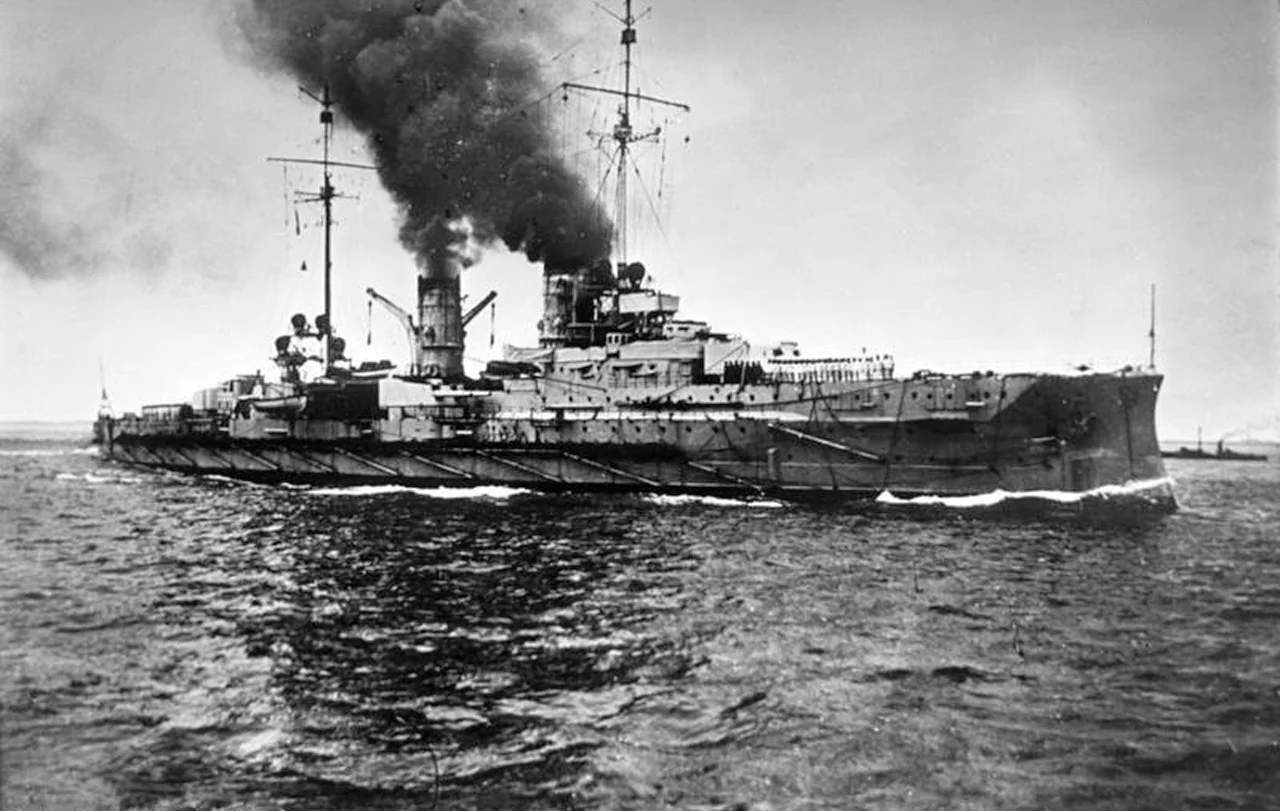

SMS Blucher
There is a photograph almost everyone has seen, whether or not they know what they are looking at. A vast ship is on its side in the North Sea, hull turned to the sky, men climbing across the curve of her plating as small black shapes against the white-painted underside. Smoke trails into the air. The photograph was taken from a British ship on 24 January 1915, and the men in it are sailors of the Kaiserliche Marine — most of whom would not be alive to see it published. The ship beneath them was SMS Blucher, and her sinking became one of the most photographed and most quietly devastating moments of the entire First World War.
An Obsolete Ship at Launch
Blucher was already out of date when she was commissioned on 1 October 1909. Designed in 1905 as Germany's response to a new generation of British armoured cruisers, she had been overtaken by the Royal Navy's revolutionary Invincible-class battlecruisers before her keel was even laid. The Germans knew. They built her anyway, at the Kaiserliche Werft in Kiel — 161 metres long, 15,842 tonnes, twelve 21-centimetre guns in six twin turrets, three triple-expansion engines burning coal in eighteen boilers. She could hit 25.4 knots in trials, the highest speed any reciprocating-engine warship ever reached. None of it was enough. Where the British Invincibles carried 12-inch guns, Blucher carried what amounted to a heavy cruiser's armament dressed up as something more imposing. She was, the historian Aidan Dodson wrote, 'a far better balanced design' than her British equivalents — but balance was not what 1915 demanded.
The Crew Aboard
Her standard complement was 41 officers and 812 enlisted men, with another 76 if she served as a squadron flagship — which she did, repeatedly. These were not faceless statistics. Many had served aboard since her commissioning; many were artillery specialists, because the German Navy had used Blucher for years as a gunnery training ship. They had won the Kaiser's Schiesspreis — the shooting prize — for excellent gunnery among the fleet's large cruisers in 1911. They had families in Kiel and Wilhelmshaven and the Hanseatic ports. When she steamed out of the Jade estuary on 23 January 1915 in the company of Seydlitz, Moltke, and Derfflinger, those families had no reason to think this sortie would be different from any other.
Dogger Bank, 24 January 1915
The Germans did not know that the Royal Navy's Room 40 had been reading their radio codes since the wreck of the Magdeburg had given up its codebooks. Vice Admiral Beatty's battlecruisers were waiting. The contact came at 08:14. As the British squadron worked up to its full 27 knots and gave chase, Blucher could only manage 23 — and Admiral Hipper, the German commander, was forced into a choice no commander wants to make. He could slow his three modern battlecruisers to Blucher's speed and risk losing all four ships, or he could leave her behind. He left her. From 09:52 onwards, four British battlecruisers concentrated their fire on a single ship. Blucher took an estimated 70 to 100 large-calibre hits and several torpedoes. At 13:13 she capsized.
The Number That Will Not Settle
How many died? The figures will not align. Paul Schmalenbach counted six officers from 29 and 275 enlisted men from 999 pulled from the water — 747 lost. The official German archives cited by Erich Goner give 792 dead. British records suggest at least 1,200 aboard and only 234 survivors. The arithmetic refuses to come out the same way twice, which itself tells you something: in the chaos of a ship breaking apart under fire, men disappeared and were not recovered. British destroyers were closing on the survivors in the water when a German zeppelin, L5, mistook the capsizing wreck for a British battlecruiser and began dropping bombs. The rescue ships had to break off. Men who had survived the shellfire and the cold drowned because their own air arm could not tell them from the enemy. Captain Erdmann was rescued and died later of pneumonia in British captivity. Twenty more of his men died as prisoners of war. Each number, however unsettled, is a sailor; each sailor was the centre of a family.
What the Photograph Means
Kaiser Wilhelm II reacted to the loss by ordering the High Seas Fleet to stay in harbour — a decision that, more than any tactical outcome, shaped the rest of the naval war. The British, who had also failed to catch Hipper's faster battlecruisers, called Dogger Bank a victory because they sank Blucher. The photograph circulated everywhere. It was used to sell newspapers and to argue political points and, eventually, to remember. A century on, it is still doing the last of these. The men on that capsizing hull were sailors of an empire that no longer exists, conscripts and volunteers, gunnery instructors and stokers and boys in their first uniform. They had names and dialects and small habits at the mess table. The picture exists not as a trophy but as evidence: of what naval war does to people, and of how thin the difference is between the survivor and the lost.
From the Air
Coordinates 54.333°N, 5.717°E place the engagement zone in the southern part of Dogger Bank, in international waters of the North Sea. From cruising altitude the area is open ocean — no airports for tens of kilometres in any direction. Nearest fields: Bremen (EDDW) to the east, Norwich (EGSH) to the west, Amsterdam Schiphol (EHAM) to the southwest. The wreck of SMS Blucher lies on the seabed somewhere along the engagement track and is a designated war grave.
Nearby Stories
- Gemini Wind Farm 16 km away
- HVDC DolWin1 17 km away
- SM UB-22 32 km away
- Oerol Festival 85 km away
- Maritime Institute Willem Barentsz 116 km away
- Hörnum 127 km away
- Rantum Loran-C Transmitter 161 km away
- Alexander L. Kielland (Platform) 242 km away