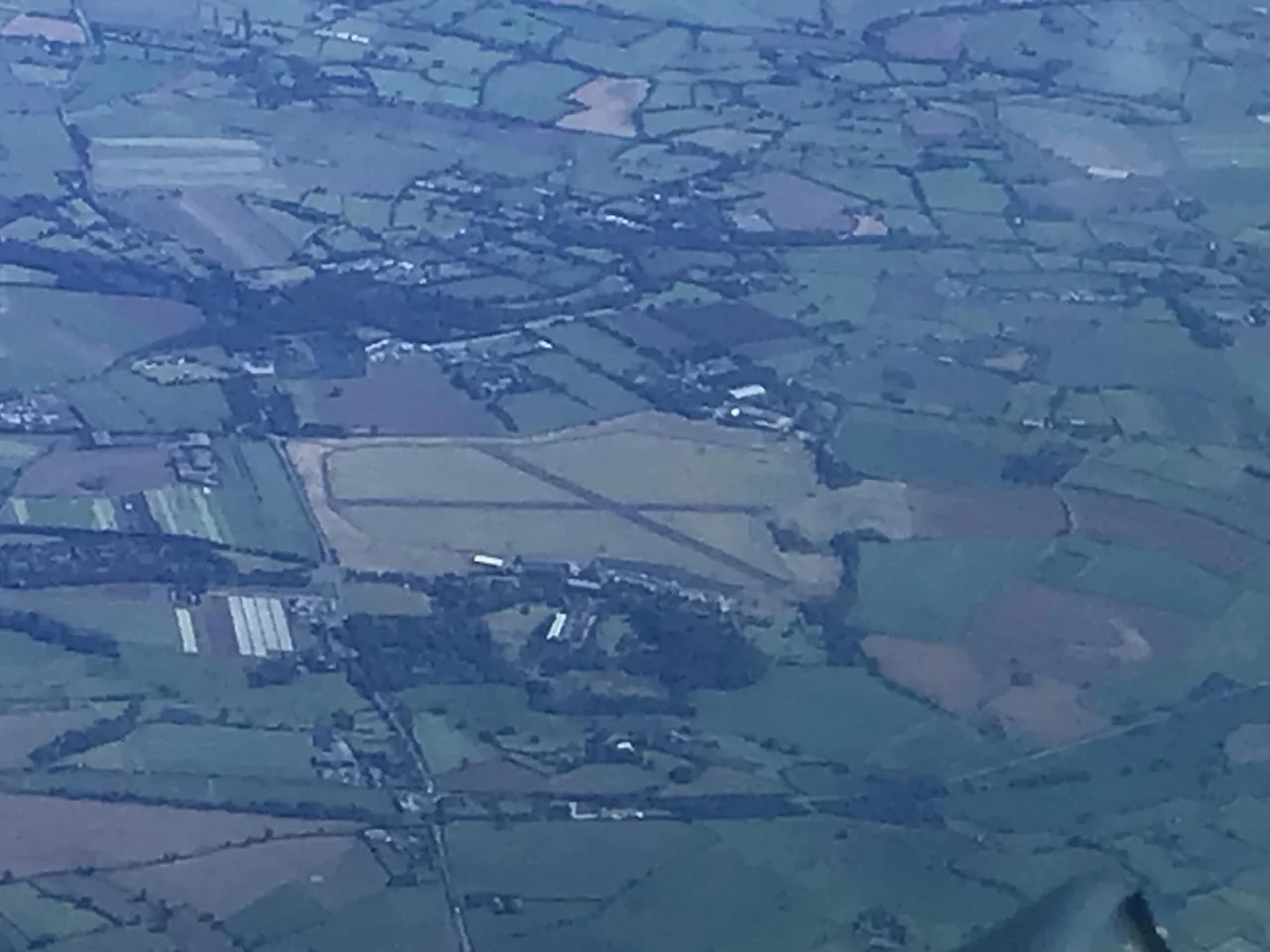

RAF Tern Hill
On a July day in 1940, ten bombs fell on the airfield at Tern Hill in Shropshire. They were small bombs, dropped by a small Luftwaffe raid, and they exploded on a runway already busy with Spitfires preparing for combat. Nobody was killed. Nobody was wounded. The bombs cratered the grass, the ground crews patched the holes, and the Spitfires of Number 611 (West Lancashire) Squadron Auxiliary Air Force - based at Tern Hill since the previous October - continued flying their patrols through the long English summer of the Battle of Britain. The airfield kept training pilots, kept dispersing fighters, and would keep doing so under different uses for the next thirty-six years before passing - still mostly intact - to the Army in 1976.
From Race Stables to Spitfires
The story begins in 1916, when the airfield first opened under the Royal Flying Corps. Number 95 Squadron RFC arrived in October 1917, only to move to Shotwick after three weeks - the kind of constant relocation that characterised wartime training. Three more squadrons arrived on 1 March 1918, and a month later all of them transferred from the RFC into the newly formed Royal Air Force when the two air services merged on 1 April. Two cadre squadrons, Number 87 and Number 19, remained until late 1919. Then, in 1922, the entire site was sold off - and turned into a racehorse stable. The grass strips that had taught young men to fly were grazed by thoroughbreds for thirteen years. In 1935, with rearmament under way, the Air Ministry requisitioned the land back. Three Type-C hangars went up. Number 10 Flying Training School formed on 1 January 1936 and stayed until late 1940, when it was transferred to Canada under the Empire Air Training Scheme.
The Battle of Britain Years
On 10 October 1939 the first fighter squadron arrived: Number 611 (West Lancashire) Squadron AAF, flying Spitfire I aircraft, an Auxiliary Air Force unit drawn originally from volunteer pilots in the Liverpool area. They stayed until December 1940, covering the entire crisis period of summer 1940 when Britain teetered on the edge of invasion. Other squadrons cycled through alongside them. Number 46 Squadron flew Hurricane I detachments from June to September 1940. Number 306 Polish Fighter Squadron arrived on 7 November 1940 with their Hurricanes, staying until April 1941 - one of several Polish units formed in Britain after the fall of France, manned by pilots who had escaped Poland by way of Romania, France, and finally the Channel ports. In May 1941, the Canadians arrived: Number 403 Squadron RCAF, flying multiple Spitfire variants until August. Number 605 (County of Warwick) Squadron AAF moved in briefly with Hurricane IIAs. The last fighter squadron at Tern Hill, Number 131 (County of Kent) Squadron, left in September 1941.
The Maintenance Years
After the fighters left, the airfield turned to training and storage. A maintenance unit had opened on the south-east side of the runway in June 1937 as Number 4 Aircraft Storage Unit, later renamed Number 24 Maintenance Unit. Damaged aircraft came in to be repaired or scrapped. New aircraft came in to be prepared for frontline service. Pilots cycled through the training programmes that had taken over the main runways. From the late 1940s, Tern Hill was part of the first stage of the new Provost and de Havilland Vampire pilot training programme - the Vampire being one of Britain's first operational jet fighters, a strange twin-boomed aircraft that taught a generation of pilots how to handle a turbine engine. The Provost school moved out on 24 July 1961, and almost immediately - on 18 August 1961 - the Central Flying School Helicopter Wing moved in. The new rotor age had begun at Tern Hill, and it has continued in one form or another ever since.
Closure and Survival
The RAF station formally closed in 1976. The technical and administrative buildings, the barracks, the messes, the workshops - all passed to the British Army, who reopened them as Borneo Barracks. The name was later changed to Clive Barracks, after Major-General Robert Clive of India fame, who had been born in nearby Market Drayton. The airfield itself, with its hangars and its runways, stayed with the RAF. It became Tern Hill Airfield, used predominantly as a relief landing ground for the helicopters of Number 1 Flying Training School at RAF Shawbury - the place where student pilots from Shawbury fly to practice circuits, approaches, and emergency procedures away from their main base. The airfield is also home to Number 632 Volunteer Gliding Squadron, which teaches air cadets to fly gliders, continuing a tradition of training young aviators that goes back to the very founding of the field in 1916.
What You See Now
Drive past Tern Hill today and you will see a working airfield, with helicopters in the circuit on most flying days, gliders being winch-launched on summer weekends, and the discreet bulk of the Army barracks behind a screen of trees. The three Type-C hangars from 1935 are still in use - long, low buildings with characteristic arched roofs that have housed everything from Hurricanes to Junos. Some of the wartime perimeter track has been ploughed up, but the main triangular runway layout survives, marked clearly on aviation charts. The airfield does not appear in the dramatic histories of the war. It was a feeder field, a training place, a maintenance depot, a relief landing ground - never the site of a famous action. But thousands of pilots learned the basics of military aviation here, and many of them went on to fly in the Battle of Britain, the Combined Bomber Offensive, the Far East, and Korea. The unspectacular work of training is what kept Tern Hill open from 1916 to today.
From the Air
Located at 52.8711 N, 2.5336 W in north Shropshire, near Market Drayton. Ternhill Airfield (ICAO: EGOE) is active as a relief landing ground for RAF Shawbury and home to gliding operations - expect helicopter and glider activity, contact Shawbury approach for transit. From altitude, the triangular runway layout is distinctive against the surrounding rolling Shropshire farmland. Best viewed at 3,000-5,000 feet AGL. Nearest fields: Sleap (EGCV) 11 nm south, RAF Shawbury (EGOS) 7 nm southwest. The A41 trunk road passes immediately west of the airfield perimeter. Visibility considerations: north Shropshire is prone to morning fog in autumn, particularly in valleys; the airfield itself sits on slightly higher ground that often clears first.
Nearby Stories
- Priory of St. Thomas near Stafford 3.1 km away
- Battle of Tipton Green 3.8 km away
- Peckforton Hills 4.5 km away
- Brindley Water Mill 5.6 km away
- Dolforwyn Castle 6.1 km away
- Caratacus' last battle 9.2 km away
- Moel Famau 9.8 km away
- Llangollen 16 km away