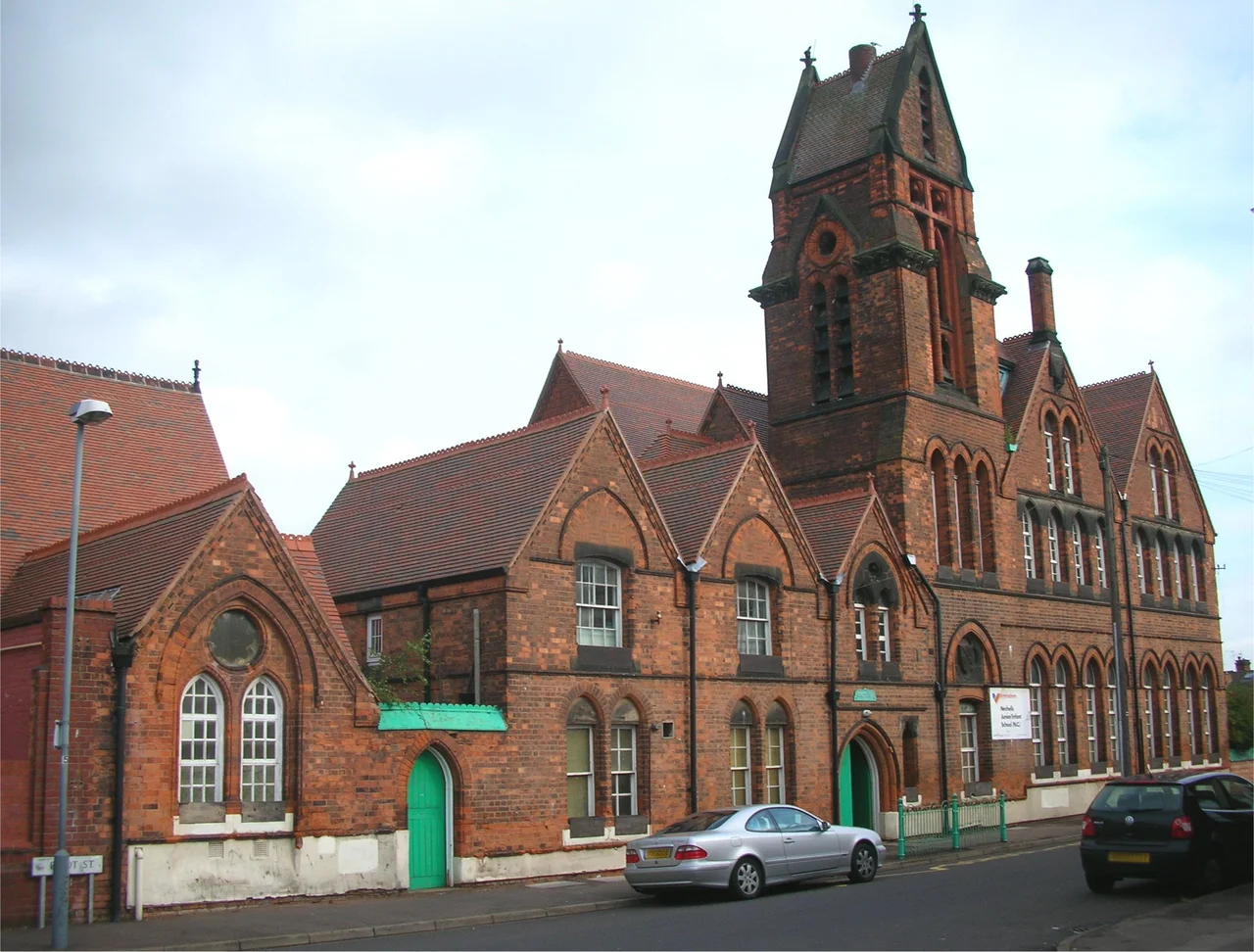

Nechells
On 7 July 2016, a sixteen-foot concrete wall collapsed onto five workers at the Hawkeswood Metal Recycling plant on Trevor Street. Almamo Jammeh, Ousman Diaby, Bangally Dikoureh, Salibo Sillah, and Muhamdou Jagana died beneath the rubble. All five were Gambian men who had built lives in Birmingham. Six years later, in a Birmingham Crown Court trial, two directors of the firm that ran the plant were convicted of health and safety offences, and in 2023 each was sentenced to nine months in prison. Their names rarely appear in tourist guides to Nechells. The wall did not appear there either. Five men died, and the ward where it happened has been quietly absorbing such losses for two centuries.
Land Added by Draining a Marsh
The name first appears in 1180 as Echeles, then Le Echeles in 1290 and Le Necheles in 1322. The philologist Eilert Ekwall traced it back to an Old English phrase meaning land added to a village or estate, with a possible refinement of land reclaimed by draining a marsh. Eight hundred years of speech wore the leading consonant of atten down to a single n that fused with what followed. By Tomlinson's 1758 map, the area was still a triangle of village green surrounded by lanes and a few widely-spaced homesteads. Nechells Green was, briefly, almost rural. Then the nineteenth century arrived.
The Densely Populated Century
Mass immigration from Ireland filled the new terraces. By 1868, a directory described Nechells as a populous suburb with extensive workshops for building railway carriages and a lunatic asylum. The Grand Junction Railway had cut through in 1837 to reach its temporary Birmingham terminus at Vauxhall, and the London and North Western Railway sliced across Nechells Park Road in 1880. St Clement's Church went up in 1859, St Joseph's Catholic Church in 1872, and the red-brick Bloomsbury Library in 1892. By the 1950s, however, the terraces had become slums. Families lived without electricity, running water, or indoor toilets. The gas works produced a continuous unpleasant smell. The Second World War delayed the planned redevelopment by twenty years.
Cars, Coke, and a Battle
In 1893, a twenty-three-year-old engineer named Frederick William Lanchester walked out of the Forward Gas Engine Company's works near Bloomsbury Street and built the first all-British four-wheel petrol car. A small monument in Bloomsbury Village Green now commemorates the achievement. The motor industry was not the only one Nechells launched. Foundry Services Ltd, founded on Long Acre in 1933 by two German Jewish refugees, Eric Weiss and Kossi Strauss, manufactured the fluxes used in iron foundries worldwide. In February 1972, the Saltley gasworks in Nechells became the site of what labour history calls the Battle of Saltley Gate, when striking miners and supporters stopped lorries from carrying coke out of the depot. Police were overwhelmed and the gates closed. The historian recording the event called Nechells an obscure suburb on the eastern side of Birmingham. The name Saltley Gate stuck. The location was Nechells.
Trams to Trolleybuses to a New Line
Bus service to Nechells began in the 1850s. Osborne's railway timetable for January 1858 lists an omnibus from the Town Hall to Nechells Green and Bloomsbury, eight return journeys a day at fourpence a fare, operated by Lamyman and Monk. The tram came next, then in 1922 something stranger. Birmingham converted the Nechells tram route to trolleybus operation, the first such substitution in the United Kingdom and the first anywhere to use double-deck covered vehicles. The trolleybuses ran until 1940, when motorbuses replaced them. The current National Express West Midlands route 66 to Sutton Coldfield is their descendant. When the High Speed 2 rail line is built, it will skirt Nechells on its way to a new Curzon Street station, with a depot and control centre rising on the site of the former Metro-Cammell works.
Star City and the People Who Stayed
On land where two coal-fired power stations once stood, both now demolished, sits Star City. A vast entertainment complex with a thirty-screen Vue cinema, a 22-lane bowling alley, a casino, a hotel, and the Wing Yip headquarters of Britain's largest Chinese food wholesaler. Nechells today is one of the most ethnically diverse wards in Birmingham. Census figures record large Somali, Sudanese, Eritrean, Pakistani, Bangladeshi, and Caribbean populations alongside long-rooted White British families. The 2011 ward population was 33,957. The same statistics show life expectancy notably below the Birmingham average and more than half of local children growing up in poverty. Three Nechells residents, Paul Davies aged twenty, Neil Marsh aged seventeen, and John Rowlands aged forty-six, were among those killed in the 1974 Birmingham Pub Bombings. The ward has done its share of mourning. It keeps going.
From the Air
Coordinates 52.501 N, 1.86 W. An inner-city ward east of Birmingham city centre, bounded by the River Rea and the Birmingham and Warwick Junction Canal. Recommended viewing altitude 1,500 to 3,000 feet AGL. Look for the Star City complex, the distinctive cluster of post-industrial regeneration land north of the Aston Expressway (A38(M)), and the spur where the M6 meets the A38(M) at Spaghetti Junction just to the north. Nearest airports: Birmingham International (EGBB) 5 nm east-southeast; Coventry (EGBE) 14 nm east; Wolverhampton Halfpenny Green (EGBO) 14 nm west. Industrial haze likely; visibility best in winter.
Nearby Stories
- Shepshed 8.5 km away
- Battle of Evesham 11 km away
- Hixon rail crash 12 km away
- Battle of Cropredy Bridge 12 km away
- Wenlock Priory 15 km away
- RAF Shawbury 16 km away
- Market Bosworth 17 km away