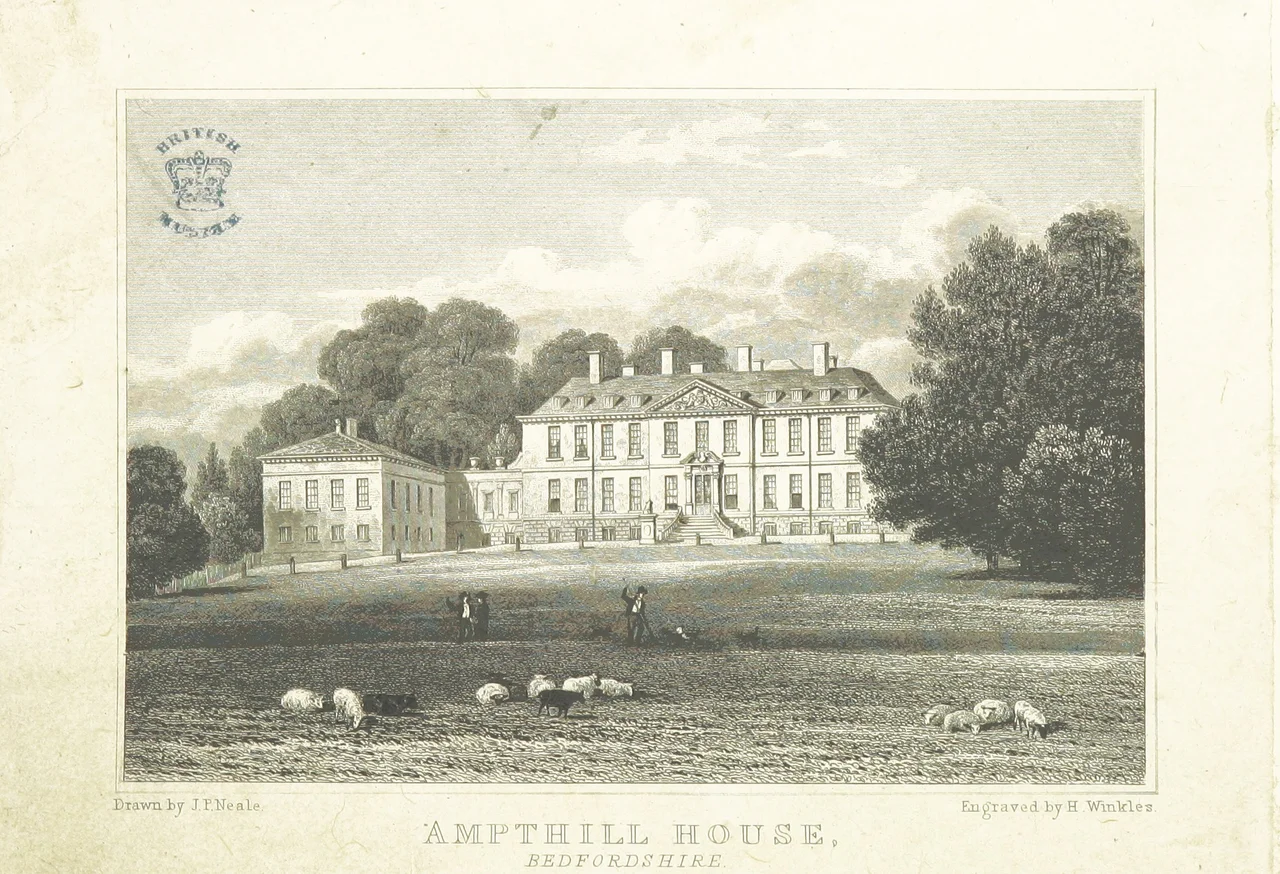
_p1.044_-_Ampthill_House,_Bedfordshire.jpg)
Ampthill Park
On an August night in 1979, an artist named Kit Williams walked across Ampthill Park in Bedfordshire carrying a small ceramic casket containing a golden hare studded with gemstones, found a spot near a stone cross, and buried his treasure. Williams had just finished writing and illustrating a children's book called Masquerade, in which fifteen elaborately painted pictures concealed clues to the exact location of this hare. He had told no one where he was burying it. The book was published in August 1979, sold over a million copies in three years, and triggered a national obsession - amateur cryptographers, professional treasure hunters and ordinary readers all trying to decode the paintings and find the hare. For Williams, the choice of Ampthill Park was deliberate: it was the place where Katherine of Aragon had been held in 1533 while Henry VIII pursued his annulment, and the stone cross near which the hare was buried had been erected in her memory in 1773 with verses by Horace Walpole. The treasure hunt was, among other things, a love letter to a queen who had been written out of her own history. The hare was dug up in 1982, in circumstances that turned out to be more sordid than romantic. The park is still here.
Royal Lodge to Tudor Prison
Ampthill was a royal hunting park from at least the 14th century - dense woodland on a low ridge in the middle of Bedfordshire, well placed for the kings of England to ride out from London for the chase. Sir John Cornwall, who had married Elizabeth of Lancaster - sister of Henry IV - came into possession of the estate in the early 15th century and built Ampthill Castle here, a fortified house befitting a man who had become enormously rich in the French wars. The castle passed through various hands before reverting to the Crown. Henry VIII took to using it as a hunting lodge in the 1520s, and then, more notoriously, used it to hold his first wife. In 1531, Katherine of Aragon was sent to Ampthill while her marriage to Henry was being legally dismantled. Two years later, on 23 May 1533, the formal sentence of annulment was pronounced by Archbishop Cranmer at the priory of Dunstable, less than twenty miles to the south. Katherine refused to accept it. She was moved from Ampthill to a series of increasingly remote houses, and died, still calling herself queen, at Kimbolton Castle in January 1536. Ampthill Castle itself fell into ruin within seventy years of her stay; by 1600 it was unsalvageable, and the elaborate Jacobean rebuild planned in 1605 for James I and Anne of Denmark - with the architect John Thorpe involved - was abandoned before construction began.
The House Capability Brown Knew
The Ampthill Park House that stands today was built between 1687 and 1689 by the Cambridge architect Robert Grumbold, for the Ossory family. A century later, the house was remodelled by Sir William Chambers - the same architect responsible for Somerset House and the Pagoda in Kew Gardens - and the grounds were re-landscaped by Capability Brown, whose work transformed the estate into the rolling pastoral scene that visitors see today. Brown's signature was the artful naturalism of his parks: clumps of trees placed to draw the eye, water shaped to feel inevitable, no fences visible from the house. At Ampthill, his hand is still readable in the contours of the lawns and the placement of the woodland. The estate passed to Lord Holland on the death of Lord Upper Ossory in 1818. Holland and his wife made Holland House in Kensington famous as a salon for liberal politicians and writers - Macaulay, Byron, Sydney Smith. Ampthill was their country retreat. Later residents included Sir James Parke, Baron Wensleydale, and from 1885 Lady Ampthill. The 20th-century architect Sir Albert Richardson lived in the town of Ampthill from 1919 until his death in 1964, a champion of classical architecture in an age of modernism.
Sugarbeet Volunteers and Cheshire Homes
During the Second World War, the army occupied Ampthill Park. A farming camp set up nearby housed volunteers who came to help with the sugarbeet harvest, sleeping in tents pitched in the grounds of the great house. After the war, the estate was sold to Bovril Limited - the meat extract company - and then, in 1955, it was repurposed as a Cheshire Home for disabled adults, part of the network of residential care homes founded by Group Captain Leonard Cheshire VC, the Lancaster pilot turned philanthropist. The Cheshire Home occupied the house for twenty-four years. By the late 1970s, the building was in serious disrepair, and in 1979 the mansion was rescued from dereliction and divided into four large private homes - which is how it remains today. The park itself, listed at Grade II, was opened to the public after the Second World War and is still freely walkable, with paths leading past the stone Katherine of Aragon Cross and the spot where Kit Williams's hare lay buried for nearly three years.
The Masquerade Treasure Hunt
Kit Williams's hare turned out to be a cautionary tale about treasure hunts. The first man to claim it, in February 1982, was a Mancunian named Ken Thomas, who showed up with a metal detector and produced a sequence of clues that did not quite match the ones the book contained. Williams was suspicious but, as he had promised in the book, he handed over the prize. Years later, in 1988, the Sunday Times revealed that 'Ken Thomas' was actually a man named Dugald Thompson, whose business partner was the boyfriend of Veronica Robertson, who had once shared a flat with Kit Williams's former girlfriend. Robertson had learned the approximate burial location during pillow talk years earlier, walked the park with Thompson, and they had used a metal detector to narrow it down. Williams was devastated. The hare was sold at auction in 1988 for around £32,000 and is now in private hands. The book is still in print, and the painters and puzzlemakers who solved Masquerade fairly - principally two physics teachers from Manchester-area schools who arrived at the correct solution just days before Thompson dug up the hare - remain heroes in a small subculture of competitive readers. Ampthill Park, where the whole peculiar story was buried, continues quietly on.
From the Air
Ampthill Park sits at 52.0404°N, 0.5045°W on the western edge of the town of Ampthill, central Bedfordshire. From the air, the park reads as an open green expanse with mature trees and the white stone of the Katherine of Aragon Cross visible on its central rise. Luton Airport (EGGW) lies about 10nm south; Cranfield Airport (EGTC) is roughly 6nm west-southwest. The wider Bedfordshire countryside, including Woburn Abbey's parkland 8nm west, gives the area its character. Best viewed at 2,000-4,000 ft AGL.
Nearby Stories
- Fowlmere Airfield 6 km away
- Canons Ashby House 7.9 km away
- Berkhamsted Castle 10 km away
- Boughton House 11 km away
- Pitt Rivers Museum 18 km away
- King's Ely 18 km away
- North Weald Airfield 18 km away
- Wigston 23 km away