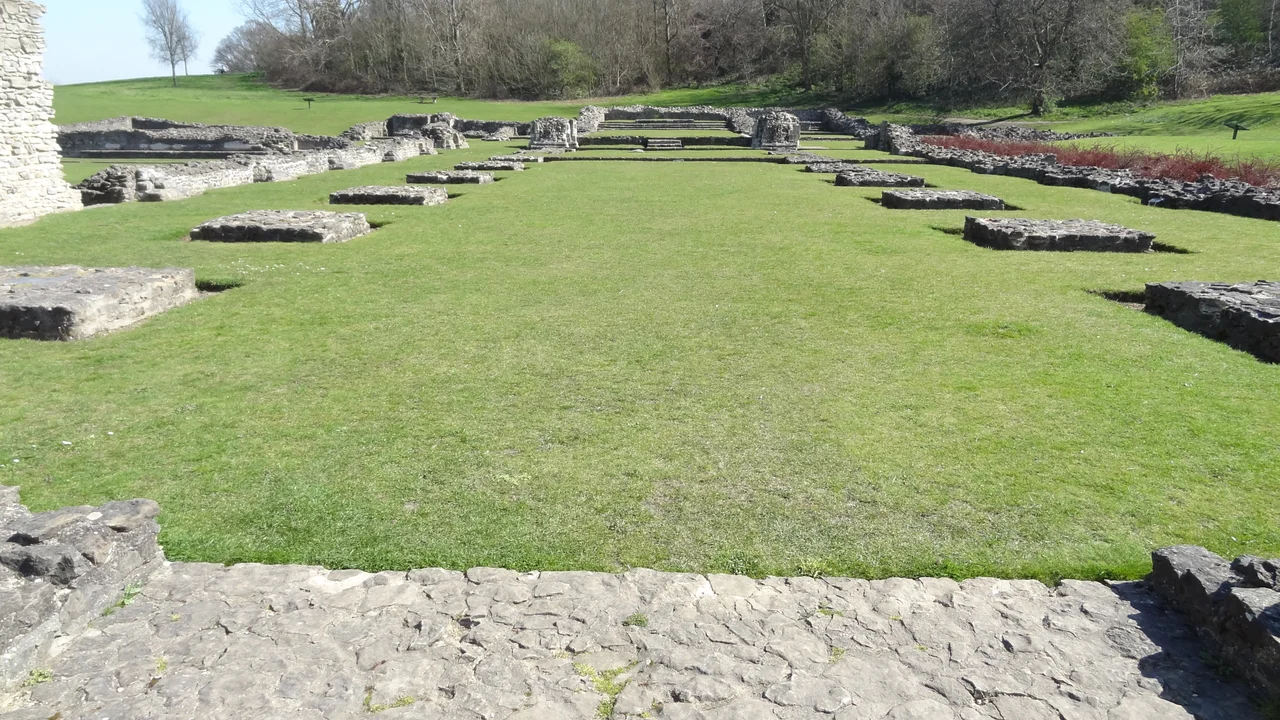

Lesnes Abbey
Richard de Luci helped Henry II in the quarrel with Thomas Becket. The quarrel ended in 1170 with four knights swinging swords inside Canterbury Cathedral, and the Archbishop dead on the flagstones. In 1178, after eight years of carrying that public shadow, de Luci founded an abbey in the marshes east of Greenwich. He retired here in 1179, took the habit, and died three months later. They buried him in the chapter house on 14 July, beneath the cool stone he had paid to raise. The Abbey of St Mary and St Thomas the Martyr was, from the start, an act of penance.
On the Edge of the Marsh
The land at Lesnes had passed to Bishop Odo after the Norman Conquest and was recorded in the Domesday Book of 1086 as Loisnes in the Hundred of Litlelai. By the time de Luci chose it, the abbey was built on a low rise where the ground climbs out of what was then tidal marshland, into the ancient managed woods that still bear the name Lesnes Abbey Woods. The canons here belonged to the Arroussian Order, a slightly more relaxed version of the Augustinian rule. The abbey never grew large. From the very beginning, the brothers struggled with both their own discipline (there are repeated medieval complaints of irregularities, religious and moral) and with the brutal economic burden of draining and embanking the marshland against the Thames. The river took everything they did not maintain.
Wat Tyler's Detour
In June 1381, when England was convulsed by the Peasants' Revolt, a local man named Abel Ker led an uprising in Erith. A group from his town pushed their way into the abbey and forced the abbot, who as a major landlord was a target of the revolt, to swear an oath supporting them. Then they marched on to Maidstone to join the main rebel column under Wat Tyler, which would soon enter London. The abbot survived, but the moment captures Lesnes's awkward position in medieval life: a religious house, but also one of the largest landowners in the area, with all the resentment that brought.
Wolsey's Pen Stroke
Cardinal Wolsey, before his more famous role in suppressing larger monasteries for Henry VIII, was given a licence by the Pope in the 1520s to dissolve small religious houses with fewer than seven inmates. Lesnes was one of his earliest casualties. The abbey closed in 1525, eleven years before the main Dissolution began. The canonry buildings were torn down, all except the Abbott's Lodging, which was incorporated into a farmhouse. Henry Cooke bought the site in 1541. It passed eventually to Sir John Hippersley, who quarried it for stone, and then in 1633 to Christ's Hospital, which held it for nearly three centuries. Some of the abbey's dressed stones, hauled away across the river, are said to have ended up in the construction of Hall Place at Bexley.
The Mulberry on the North Side
On the north side of the ruins stands a single black mulberry tree, Morus nigra, planted in the late 18th or early 19th century. Its trunk has split with age and the tree now leans against an external prop, like an elderly relative who refuses to retire. Children passing on the Green Chain Walk reach up for the dark sweet fruit in late summer. The mulberry is older than most of London around it. It was planted when this was farmland and the abbey was nothing more than a low scattering of stones in a field, lost to memory. In 1909 the Woolwich and District Antiquarian Society began to dig. They traced the boundaries of the church, the cloister, the chapter house where de Luci was buried. London County Council bought the site in 1930 and opened it as a public park in 1931.
What You See Now
The London Borough of Bexley has owned Lesnes Abbey since 1986. The ruined walls have been consolidated and the entire ground plan of the church and cloister is now marked out, low and clear, so visitors can walk what was once nave and transept and chapter house. Around the ruins, an ornamental garden was laid out in the twentieth century. A small cafe operates in season, with an exhibition on the abbey's history. The adjacent Lesnes Abbey Woods are a Local Nature Reserve, and the Abbey Wood SSSI within them is one of the most important geological sites in Britain for fossils of the early Tertiary period. Walk up the wooded slope behind the ruins in spring and the bluebells go on for acres. Walk down and you find a Crossrail station now named for this place, putting Lesnes Abbey within thirty minutes of central London.
From the Air
Located at 51.488 degrees north, 0.129 degrees east, in Abbey Wood, London Borough of Bexley. The ruins sit on rising ground between the Thames marshland to the north and the wooded slopes of Lesnes Abbey Woods to the south. London City Airport (EGLC) is about 5 nautical miles west across the Thames. The Thames Barrier is visible to the northwest, and the M25 Dartford crossings are to the east. Best viewed from low altitude on clear days when the rectangular footprint of the abbey stands out against the grass.
Nearby Stories
- Hampton, London 1.1 km away
- Queenborough Castle 3.2 km away
- Groombridge Place 4 km away
- North Weald Airfield 4.9 km away
- Kings Langley Palace 8.3 km away
- White House Farm murders 11 km away
- Port Lympne Mansion 22 km away
- Amberley Museum & Heritage Centre 31 km away