.jpg)
Hampton, London
Cardinal Thomas Wolsey thought he was building his country house. In 1514 he took a lease on a Hampton estate the Knights Hospitaller had owned for nearly three centuries, and over the next fifteen years he turned it into the grandest private residence in England - more rooms than the king's palace, finer tapestries than the king's tapestries, a kitchen large enough to feed a small army. By 1528 Henry VIII had noticed. By 1530 Wolsey was dead and the king owned the palace. By 1689 William and Mary had hired Christopher Wren to redesign half of it. The village of Hampton, on the north bank of the Thames just east of Sunbury, has spent five hundred years watching kings and queens come and go through the gates of what is still called Hampton Court Palace.
Before the Palace
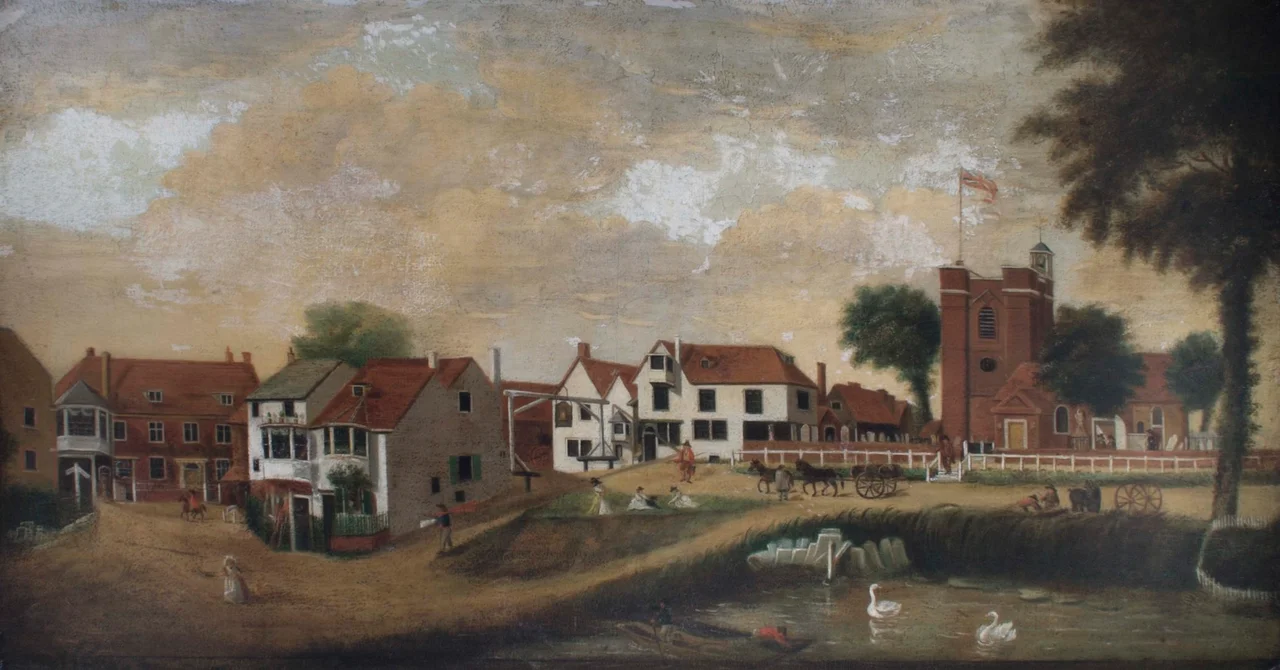
Hampton existed long before any cardinal noticed it. The Anglo-Saxon village clustered around the small hillock where St Mary's Church still stands, at the intersection of the Windsor-Kingston road and the road north to Twickenham. The Domesday Book of 1086 recorded forty-one villagers and four smallholders, about two hundred people in total, working thirty-five hides of land - around four thousand two hundred acres in modern measurement. The manor passed from a Norman crusader named Walter of Saint-Valery to a London merchant in 1217, then to the Knights Hospitaller in 1237. The Knights, returning crusaders who used English estates to fund their headquarters on Rhodes, built a substantial house here, kept sheep and oxen, ran a fish weir on the Thames, and kept pigeons. They held Hampton for nearly three centuries before Wolsey's lease and Henry's appetite changed everything.
The King James Bible Conference
In the Christmas of 1603, the newly crowned James I moved his entire court to Hampton Court Palace to escape an outbreak of plague that had ravaged London through the summer - and had killed ninety-nine of the one hundred and nineteen people who died in Hampton itself that year. The conference of bishops and clerics that James had summoned to debate church reform, postponed by the same plague, was reconvened at the palace in January 1604. The Hampton Court Conference produced two of the most consequential documents in English religious history: a new edition of the Book of Common Prayer, and a commission for a new translation of the Bible. The King James Version, completed by forty-seven scholars working in six committees across England, was published in 1611. The translation was decided here, in the Great Hall, while plague burned itself out in the streets of London thirteen miles to the east.
The Maze
Sometime around 1690, William and Mary's gardeners planted the hedge maze that still confuses visitors today. It is the oldest surviving hedge maze in the British Isles - a third of an acre of hornbeam hedges arranged in a trapezoidal layout, with twisty walks and dead ends, designed to entertain the court of the late seventeenth century. Visitors have been getting lost in it for more than three hundred and thirty years. Jerome K. Jerome made it famous in the 1889 comic novel Three Men in a Boat, in which Harris confidently leads a party into the maze claiming it is 'so simple it is absurd to call it a maze' and is found, hours later, in the centre, surrounded by lost tourists who have followed him under the impression that he knows the way out. The maze still does that. The hornbeams have been replaced over the centuries but the layout has not.
The Waterworks
In 1852 Parliament passed the Metropolis Water Act, which made it illegal for water companies to draw drinking water from the tidal Thames below Teddington Lock. The water below the lock was filthy with London's sewage; cholera epidemics had killed thousands. Three water companies - the Southwark and Vauxhall, the Grand Junction, and the West Middlesex - jointly built new waterworks on the Thames at Hampton, above Sunbury Lock, where the river was still freshwater. The works opened in 1855 and became one of the largest employers in Hampton for more than a century. The water that comes out of taps across south London still passes through these treatment beds. The Italianate brick pump houses are listed buildings; the original beam engines have been preserved. It is the kind of Victorian infrastructure that England builds and then quietly maintains for a hundred and seventy years.
Tagg's Island and the River
The Thames at Hampton bulges around three small islands. Tagg's Island, the largest, was named after Thomas Tagg, a Victorian boat-builder who established the first boatyard on its eastern end in 1866. In 1913 the impresario Fred Karno - born Frederick Westcott, the man who first put Charlie Chaplin and Stan Laurel on stage - bought the island and built the Karsino Hotel, a thousand-room riverside resort with a music hall, a tennis lawn, and Edwardian extravagance everywhere you looked. The Karsino was a flop. Karno lost his fortune; the hotel was demolished in 1971. The island today is a quiet houseboat community, the docks lined with floating homes painted in colours you could not name in a catalogue. Across the channel on Platt's Eyot, the boat-builder John I. Thornycroft built motor torpedo boats during both world wars, including Miss England III, which set the world water speed record in 1932. The boatsheds burned in 2021. The river keeps moving, the same colour it always was.
From the Air
Hampton sits at 51.42°N, 0.36°W, on the north bank of the Thames in the London Borough of Richmond upon Thames, about thirteen miles south-west of central London. From altitude, look for the great bend in the Thames where the river turns north toward Kingston: Hampton Court Palace is unmistakable, a vast red-brick complex with formal gardens, the Long Water, the Privy Garden, and the famous maze on the north side of the palace, all set in the much larger Bushy Park (over a thousand acres) to the north and Home Park to the east. The Hampton Waterworks sit prominently between Hampton and Sunbury, with their distinctive reservoirs and Italianate pump houses. The three islands of Tagg's, Platt's Eyot, and Garrick's Ait are visible in the river. Nearest airports: London Heathrow (EGLL) 8 nautical miles north-west, Fairoaks (EGTF) 8 nautical miles south-west, Biggin Hill (EGKB) 17 nautical miles south-east. Recommended viewing altitude is 2,500 to 4,000 feet AGL, but expect heavy Heathrow traffic - this area sits directly beneath the approach paths to Runways 27L/27R. Check NOTAMs and consider transit clearance through the London Control Zone.
Nearby Stories
- Waltham Abbey 0.7 km away
- Queen Victoria Hospital 1.9 km away
- Hither Green rail crash 3.3 km away
- Ufton Nervet rail crash 4.2 km away
- Kings Langley Palace 5.8 km away
- Magdalen College, Oxford 16 km away
- Hyde Abbey 20 km away
- Amberley Museum & Heritage Centre 28 km away