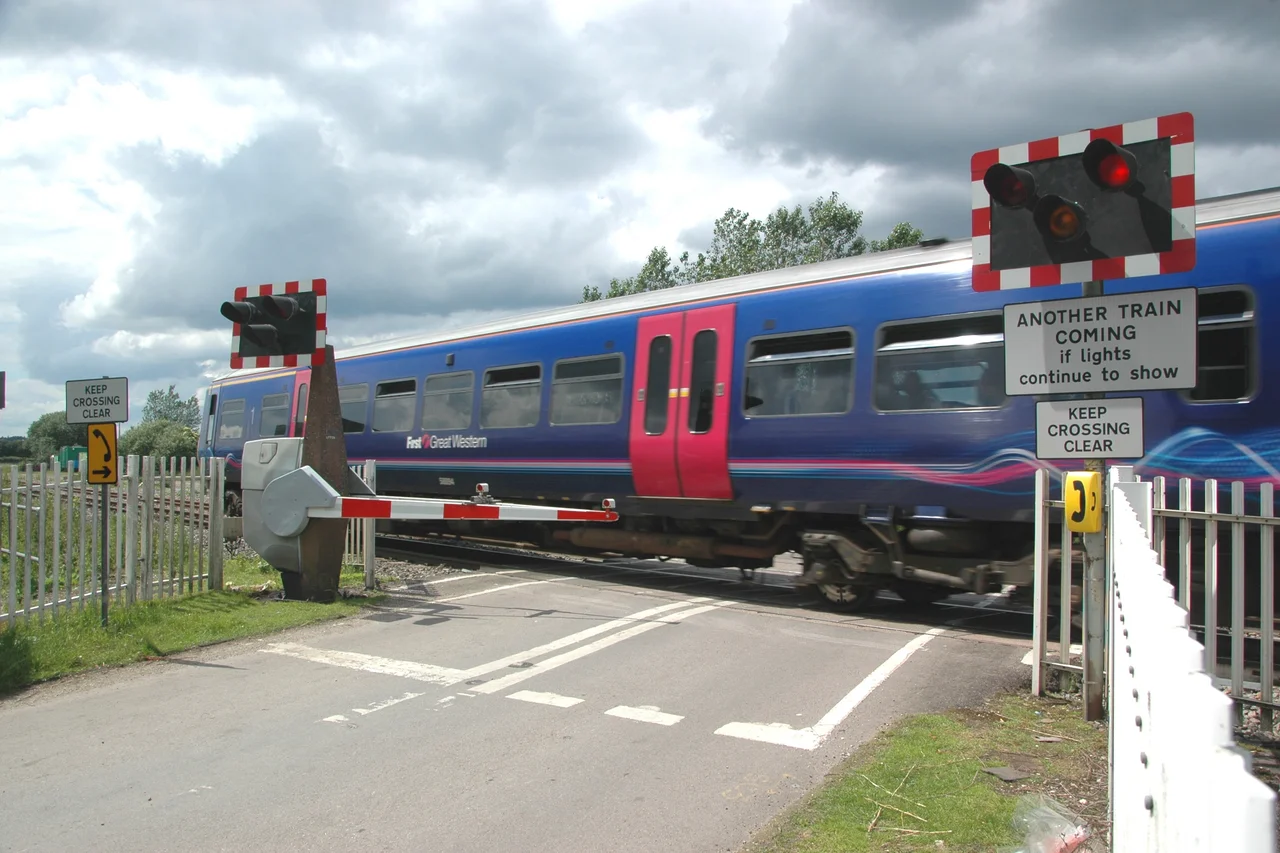

Ufton Nervet rail crash
On the evening of 6 November 2004, an off-duty Thames Valley Police officer pulled up to a level crossing on a quiet Berkshire lane and saw something he could not understand. A man was carefully manoeuvring his Mazda 323 between the barriers on the tracks, then switched off his lights and his engine. The officer flashed his headlights, sounded his horn. The man did not respond. He was a 48-year-old chef from a country hotel called Wokefield Park, and he had spent that afternoon trying four times to telephone an HIV clinic that was closed for the weekend. The 17:35 First Great Western service from Paddington to Plymouth was approaching at 98 miles per hour.
The Crossing
Ufton Nervet level crossing was an automatic half-barrier crossing - the type used in Britain on roads where traffic is light and the line speed does not exceed 100 mph. It sat on Ufton Lane, an unclassified road connecting the A4 between Reading and Newbury to the village of Ufton Nervet, fields on every side. The system was simple. As a train approached, a treadle 1,907 yards from the crossing - the strike-in point - triggered the warning sequence: flashing lights, alarms, and barriers that lowered across the entrances but left the exits clear. At line speed, drivers on the road had 39 seconds before the train reached the crossing. The minimum permitted anywhere in the United Kingdom was 27. The system had worked correctly at Ufton Nervet for years.
Brian Drysdale
Brian Drysdale was 48, a chef at Wokefield Park about seven miles from the crossing. He had reason to believe he had contracted HIV from a relationship in the late 1990s and may have feared he had developed AIDS. On 6 November 2004 he tried four times to reach the clinic that had tested him; the line was closed for the weekend. What he did next he did with care. The forensic investigators who later examined the car found that he had not broken down - the fuel tank still contained petrol. He had parked deliberately, between the lowered barriers, with the engine off and the lights off, and waited. The off-duty officer who happened on the scene tried to use the emergency telephone. At 18:11 the train hit the strike-in point and the warning sequence began. At 18:12 the train, travelling at 98 mph, struck the car. The driver, Stan Martin, had applied the emergency brake two or three seconds before. He had been a train driver for thirty years.
Catastrophe
The car's engine block lodged under the train's leading axle, lifted the wheelset, and twisted the bogie. The flanges climbed the rail. The train ran upright for 91 metres before reaching a set of points at the start of a goods loop, and there it derailed catastrophically. All ten vehicles came off the track. The leading power car came to rest on its side 360 metres beyond the point of derailment. Coach D, the third passenger carriage, folded horizontally around its bogie when it embedded in an embankment. Windows broke. Passengers were ejected through them, including at least two of those who died, possibly four. Six people were killed at the scene: Drysdale, Stan Martin, and four passengers - all four travelling in coaches D and E. A seventh, also a passenger, died in hospital the next day. Among the dead were a nine-year-old child named Louella Main and her mother Anjanette Rossi, both ejected through broken windows. Two passengers who survived helped the injured, found Louella with a faint pulse and a clergyman among the surviving passengers, and brought him back to say a prayer over the bodies. The Royal Humane Society awarded them bronze medals the following year.
What the Inquest Found
Between two and three hundred passengers were on board. Of them, 120 were injured, 71 hospitalised, 18 with serious injuries. Minor injuries were treated initially at the nearby Winning Hand pub. The scene drew 180 police officers, 84 fire crew, 50 ambulance crew, 36 doctors and paramedics. The Rail Safety and Standards Board's preliminary report, published 1 February 2005, found that the automatic half-barrier equipment had been properly maintained and operating correctly. The track had been surveyed by a track geometry car 15 days earlier and met every specification. Stan Martin had driven the train exactly according to procedure. There was nothing the railway could have done. The inquest, held at Windsor Guildhall in October 2007 after a delay over legal aid for the victims' families, returned the verdict that the crash was caused by Drysdale's suicide and that those aboard the train were unlawfully killed. The county coroner described it as "a unique set of circumstances that had resulted in catastrophic consequences."
The Long Argument About Glass
David Main, whose partner and daughter had been killed, said at the inquest, "trains are not safe ... If laminated glass had been fitted they wouldn't have been ejected." The RSSB had already begun research. Its 2007 report concluded that laminated glass would provide "significantly better passenger containment protection in accidents" than the toughened glass then in use - while still allowing rescuers to break windows to extract trapped passengers. Two-point seat belts, the report concluded, would cause more injury than they prevented in most incidents. Later studies came to the same conclusion about three-point belts. The Rail Accident Investigation Branch added in 2007 that the absence of an obstacle deflector on the leading power car, combined with the position of the traction motor and gearbox on the leading axle, had made it almost inevitable that debris would catch beneath the train at a level crossing where the road deck sat level with the rail head.
More Deaths, Then a Bridge
The crossing did not stop killing. Further fatalities occurred there in 2009, 2010, 2012, and 2014, and a near-miss in 2011 when a train passed the crossing at 61 mph with the barriers raised and the warning lights off - an attendant operating the crossing locally had not received the signal to close it. In July 2012 Network Rail announced the crossing was due for renewal. After the tenth anniversary of the original crash and the 2014 fatality, the RMT called for action without further delay. West Berkshire Council approved Network Rail's plans for a replacement road bridge in August 2015. Construction began in April 2016. The bridge opened on 16 December 2016, and the site of the old crossing became a Road Rail Access Point for maintenance vehicles.
Names That Stay
First Great Western renamed power car 43139 Driver Stan Martin 5 June 1950 - 6 November 2004. When 43139 was acquired by ScotRail in 2019, the name was transferred to GWR's 43198, alongside that of Driver Brian Cooper, who had died in the 1999 Ladbroke Grove rail crash. The Ufton Memorial Garden, dedicated "to all those affected" by the collision, was relocated in 2015 when work on the road bridge began and joined with a separate garden remembering Stan Martin. A plaque there reads, "For all those affected by the catastrophic derailment of the First Great Western 17.35 Paddington to Plymouth train on 6 November 2004 ... One event, many realities." If you are in any kind of crisis, you are not alone. In the UK, the Samaritans can be reached free at 116 123, day or night.
From the Air
The site of the former level crossing and the replacement road bridge lie just west of the village of Ufton Nervet at 51.415°N, 1.115°W, beside the A4 between Reading and Newbury. Visible from low altitude on approach to RAF Benson (EGUB) or Farnborough (EGLF). The Great Western Main Line runs east-west across the area; Reading is about 8 miles east, the A4 is the nearest major road, and the area around the crossing is otherwise open Berkshire farmland.
Nearby Stories
- Old Sarum Airfield 6.2 km away
- West Kennet Long Barrow 6.5 km away
- Eton College 7 km away
- Chesham 7.1 km away
- Christ Church, Oxford 8 km away
- Hyde Abbey 11 km away
- Cotswolds 13 km away
- Amberley Museum & Heritage Centre 31 km away