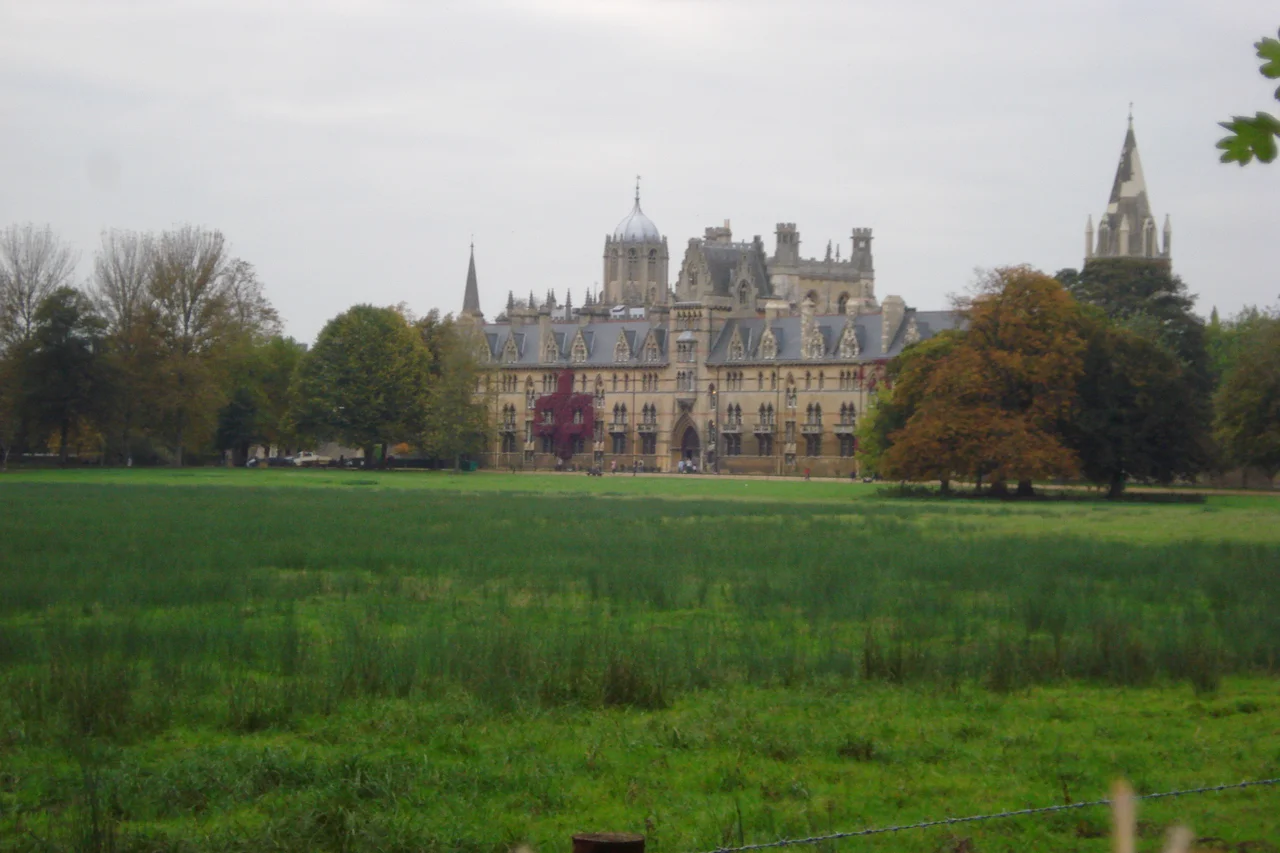

Christ Church, Oxford
Every night at 9:05 pm London time, a bell called Great Tom rings 101 times from a tower designed by Christopher Wren. The bell tolls once for each of the 100 original scholars of Christ Church, plus one extra stroke added in 1664 for good measure. It used to ring at midnight, signaling the close of all college gates throughout Oxford. Because the ringing took 20 minutes, Christ Church's own gates did not close until 12:20 am. Even after the ceremony moved to nine, Christ Church gates kept their 20-minute advantage. The college runs on Oxford time - five minutes behind GMT - and always has.
Founded Twice by a King Who Killed His Cardinal
Cardinal Thomas Wolsey suppressed St Frideswide's Priory in 1525 and started building Cardinal College on the rubble - a magnificent foundation paid for with the dissolution of minor abbeys, intended to be his monument. Four years later Wolsey fell from grace. He died in 1530 on his way to face Henry VIII on treason charges. The buildings were three-quarters complete and stayed that way for 140 years. Henry suppressed the college, then refounded it in 1532 as King Henry VIII's College, then refounded it again in 1546 as Christ Church. By this time Henry had broken from Rome and grown rich on the dissolution of the monasteries. He made the partially demolished priory church the cathedral of his new Diocese of Oxford, and joined cathedral and college into a single institution. There is nothing else like it. Christ Church is the only academic institution in the world that is also a cathedral - the seat of the Bishop of Oxford, who is the only English bishop not to serve as the visitor of his own cathedral. That role belongs to the reigning monarch.
Charles I, a Cannonball, and the Civil War
When Civil War broke out, King Charles I made the Deanery his palace and held his Parliament in the Great Hall. On the evening of 29 May 1645, during the second siege of Oxford, a Parliamentarian gun firing from Marston a couple of miles to the northeast dropped a nine-pound iron ball against the north wall of the Hall. It did not break through. The Hall still stands. So does the dean's residence, the grand 16th-century Deanery in the main quadrangle - Tom Quad, the largest in Oxford, with its central pond and fountain topped by a small statue of Mercury. The bronze koi carp who lived in that fountain was named George. It was a gift from the Empress of Japan, and lived for years until the college temporarily relocated all the fish in September 2022 for pond maintenance. The current resident animals are two ducks named Tom and Peck, after the college's two principal quads.
The Prime Ministers' College
Thirteen British prime ministers studied at Christ Church - the highest number of any Oxbridge college. The list includes William Gladstone, Sir Robert Peel, Anthony Eden, Lord Rosebery, and Alec Douglas-Home. Add in foreign leaders and the count climbs further: Zulfikar Ali Bhutto of Pakistan, S. W. R. D. Bandaranaike of Sri Lanka, Bilawal Bhutto Zardari more recently. King Edward VII passed through, as did King William II of the Netherlands. William Penn, who founded Pennsylvania, was a Christ Church man. The college produced John Locke, the philosopher who shaped political liberalism. It produced John Wesley, who shaped Methodism. It produced Robert Hooke, who discovered cells. Albert Einstein was a research fellow. Two Nobel Prize-winners, Martin Ryle and John Gurdon, studied here. So did the Winklevoss twins, before they sued Mark Zuckerberg. The mathematics tutor Charles Dodgson, who wrote under the name Lewis Carroll, lived here all his adult life and met the dean's daughter Alice Liddell in the Deanery garden.
Wonderland, Hogwarts, and the Cathedral Choir
Tom Quad and the Great Hall are among the most filmed spaces in England. Parts of Brideshead Revisited and Alice in Wonderland were filmed here. The Great Hall provided the model and the visual reference for the Hogwarts dining hall in the Harry Potter films - though for production reasons the Hogwarts hall is actually a set rebuilt at Leavesden Studios. The Golden Compass and Wonka also shot scenes inside the college. The cathedral choir, founded in 1526 when Cardinal Wolsey appointed John Taverner as its first director, has been continuously active for five centuries. Twelve adult singers and sixteen boys from the Christ Church Cathedral School fill the small cathedral with Evensong six nights a week during term. The choir was all-male until 2019, when alto Elizabeth Nurse became the first female lay clerk. Howard Goodall, the BBC composer who wrote the themes for Mr. Bean and The Vicar of Dibley, is the choir's patron, and they have recorded his music alongside his television themes.
Cattle, Balloons, and Da Vinci Drawings
Beyond Tom Quad lies Christ Church Meadow, 175 acres of open ground that runs all the way down to the river. The meadow is open to the public and is grazed by English Longhorn cattle - a rare native breed kept in central Oxford for the sake of tradition and grass management. James Sadler ascended from the meadow in October 1783 in the first hot air balloon ascent in Britain, a few weeks after the Montgolfier brothers astonished Paris. Tucked inside the college is the Christ Church Picture Gallery, opened in 1968 - the bequest of General John Guise in 1765 had given the college roughly 300 paintings and 2,000 drawings, including works by Leonardo da Vinci, Raphael, and Michelangelo. It was the first public art gallery in Britain, predating the National Gallery by sixty years. Walk back across Tom Quad after dark, listen for the bell, and remember: 101 strokes, one for every original scholar, and one extra because someone in 1664 thought it should be a hundred and one. The gates stay open until 12:20.
From the Air
Located at 51.7502N, 1.2559W on the south side of central Oxford, where St Aldate's meets Christ Church Meadow. Tom Tower (designed by Christopher Wren) is a prominent visual landmark, as are the cathedral's spire and the open green expanse of Christ Church Meadow stretching to the Thames. Best viewed from low altitude (1,500-3,000 feet AGL). Nearest airports: London Oxford Airport (EGTK, 6 nm north-northwest) and RAF Benson (EGUB, 11 nm south). London Heathrow (EGLL) lies 38 nm southeast. From the air, the dark roof of the Great Hall and the cluster of college buildings around Tom Quad are unmistakable against the open meadow.
Nearby Stories
- St George's Chapel, Windsor Castle 7 km away
- RAF Honeybourne 7.8 km away
- Sulgrave Manor 8.9 km away
- Cotswolds 9 km away
- Chesham 9.4 km away
- Avebury 11 km away
- Donnington Castle 12 km away
- Ampthill Park 14 km away