
Sulgrave Manor
Lawrence Washington built his house in a Northamptonshire village in the middle of the sixteenth century, paid for in the wool trade that had made his county rich. He could not have imagined that, four hundred years later, his great-great-great-grandson would lead an army against the king of England, or that the house itself would survive into the twentieth century as a symbol of reconciliation between the country Washington was born in and the country he founded. The wool trade collapsed. The Washingtons moved on. The west wing fell down in the 1780s. By 1900 the building was a derelict farmhouse. What rescued it was a former American president's idea, a fundraising campaign blessed by a British king, and a hundred years of peace between two nations that had once tried very hard to destroy each other.
From Washington to Sulgrave
The family had moved south in stages over four centuries. They began in the twelfth century at Wessyngton in the north-east of England - the village that is now Washington, Tyne and Wear - holding their land from the Bishop of Durham in exchange for property at Hertburn. In the fourteenth century they moved to Warton in Lancashire. In the fifteenth, to Sulgrave in Northamptonshire. By then the family had abandoned the spelling of the village they were named for and adopted a simpler form. Lawrence Washington, the man who built the manor, did well in the wool trade that had been the engine of Northamptonshire's medieval economy. Between 1540 and 1560 he erected a three-bay Tudor hall house of limestone rubble, the kind of solid middle-rank gentleman's seat that filled the English countryside in the reign of Elizabeth I. His great-grandson, another Lawrence, was born there in 1602 - and would father a son named John, who would emigrate to Virginia in 1656 and become the great-grandfather of the first president of the United States.
Down to a Farmhouse
The Washingtons let Sulgrave go in the seventeenth century. The estate passed through other hands, was leased to a succession of farmers, and quietly degraded. The west wing was demolished around 1780 because no one needed it any more. By the early twentieth century, the surviving fabric was a working farmhouse with a leaking roof and forgotten history. Nobody in the village paid it much attention. In Virginia, meanwhile, the great-grandson of the man born here in 1602 had led the Continental Army to victory at Yorktown, served two terms as president, and died in 1799 a national legend. The American republic he helped found would fight his ancestors' country again in the War of 1812 - the conflict that produced the Treaty of Ghent, signed on Christmas Eve 1814, and an enduring peace between Britain and the United States.
An Idea Worth Saving a House For
In 1911, Theodore Roosevelt - by then a former president himself - proposed that the centennial of the Treaty of Ghent should be marked with a permanent memorial to a hundred years of peace between the two English-speaking nations. Other monuments were proposed. Other sites were considered. The one that took hold was Sulgrave: the ancestral home of George Washington, decaying in the English countryside, a perfect emblem of the shared history that had survived the revolutions and the wars. A transatlantic fundraising campaign, blessed by King George V, purchased the manor in 1914 for $42,500. The First World War interrupted the work. In 1920 the architect Sir Reginald Blomfield began the restoration. He rebuilt the lost west wing - the one demolished around 1780 - in order to recover the symmetry of the original Tudor design, then laid out a formal garden as a setting worthy of the building.
The Quiet Anglo-American Pilgrimage
The Pevsner architectural guide to Northamptonshire describes Sulgrave Manor as 'a mecca for American visitors,' and that is exactly what it has been for a hundred years. School groups, tour buses, descendants of Virginia planters and Massachusetts merchants, the occasional U.S. ambassador - all have made the trip to a small village near Banbury to see the house that the first president's family built. The National Society of the Colonial Dames of America still helps fund it. The Sulgrave Manor Trust runs it. Mount Vernon, Washington's Virginia plantation, made a video tour of it. The central porch and east wing are still original sixteenth-century work, limestone rubble that has weathered four hundred and seventy winters. The fireplace in the Great Chamber is the one Lawrence Washington built. The Blomfield-replaced screen and reconstructed west wing are obvious to a trained eye but feel of a piece with the rest. The garden, listed Grade II in its own right, follows Blomfield's plan.
A Memorial That Survived Underfunding
Late in the twentieth century, money problems threatened the house again. The peace memorial of 1914 had been a generous gesture but no one had set up an endowment to maintain it forever. Quiet emergencies, fundraising drives, and the persistent support of American organizations have kept the lights on. Historic England now lists the manor and its attached brewhouse as Grade I, along with Manor Cottage. The gardens carry their separate Grade II listing. Northamptonshire's wool wealth is long gone. The Washingtons of Sulgrave left no descendants in the village. What remains is a Tudor hall house, restored once, repaired many times, kept alive because two countries decided that even old enemies could agree to remember something well.
From the Air
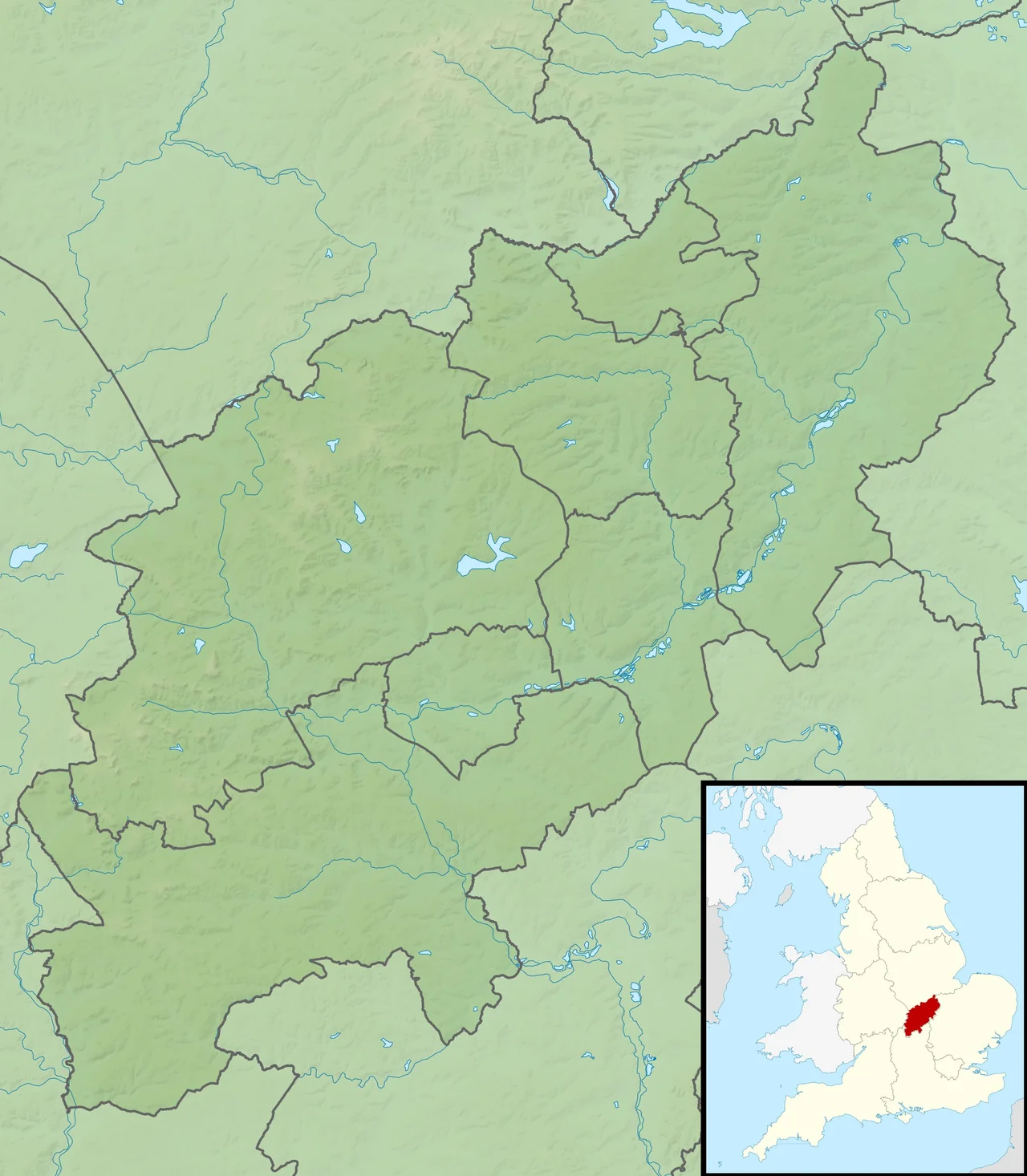
Sulgrave Manor stands at 52.106°N, 1.183°W in south Northamptonshire, about seven miles northeast of Banbury and near the border with Oxfordshire. From altitude, look for the small stone-roofed village of Sulgrave amid the patchwork of pasture and the meandering brook that joins the Cherwell to the west. London Oxford Airport (EGTK) is twenty miles south and Sywell Aerodrome (EGBK) sits eighteen miles to the northeast. The M40 motorway corridor to the south is a useful visual reference.
Nearby Stories
- Solihull 3.5 km away
- Boughton House 4.9 km away
- RAF Honeybourne 7.2 km away
- Blenheim Palace 9.1 km away
- Chedworth Roman Villa 12 km away
- Coombe Abbey 13 km away
- Berkhamsted Castle 14 km away
- Ampthill Park 16 km away