
Chedworth Roman Villa
In 1864, a gamekeeper named Thomas Margetts was digging in a Gloucestershire field, trying to recover an escaped ferret, when his shovel chipped into something hard and patterned. He had punched through the roof of a corridor in one of the largest Roman villas in Britain. Chedworth Roman Villa is tucked into a sheltered fold of the Cotswold hills above the River Coln, north-east of Cirencester. It has surprised archaeologists ever since. The biggest surprise came in 2020, when a mosaic in Room 28 was dated by stratigraphy: it had been laid after 424 AD. That was decades after the Roman legions left Britain. Someone at Chedworth, perhaps a Romano-British aristocrat still living the old life, was still hiring mosaic craftsmen long after the empire was officially over.
The Wealthy Country of Corinium
Chedworth was one of about fifty Roman villas clustered in the Cotswolds, and twenty-two of them sit within a ten-mile radius of this single site. The reason was a town called Corinium Dobunnorum, today's Cirencester, founded as a fort around 50 AD and grown by the second century into the second-largest town in Roman Britain. Veteran soldiers retired here on land grants. Roman governors made their headquarters here. Wealth concentrated. The Cotswolds, with their good drainage and grass-fattening pastures, became Britain's villa country, and along the Roman road called the Fosse Way the great country houses rose. Chedworth chose its spot deliberately: a sheltered, shady terrace, screened from the worst winds, above a natural fresh-water spring that solved the household's water problem before a single stone was laid.
Sixty Rooms Around a Spring
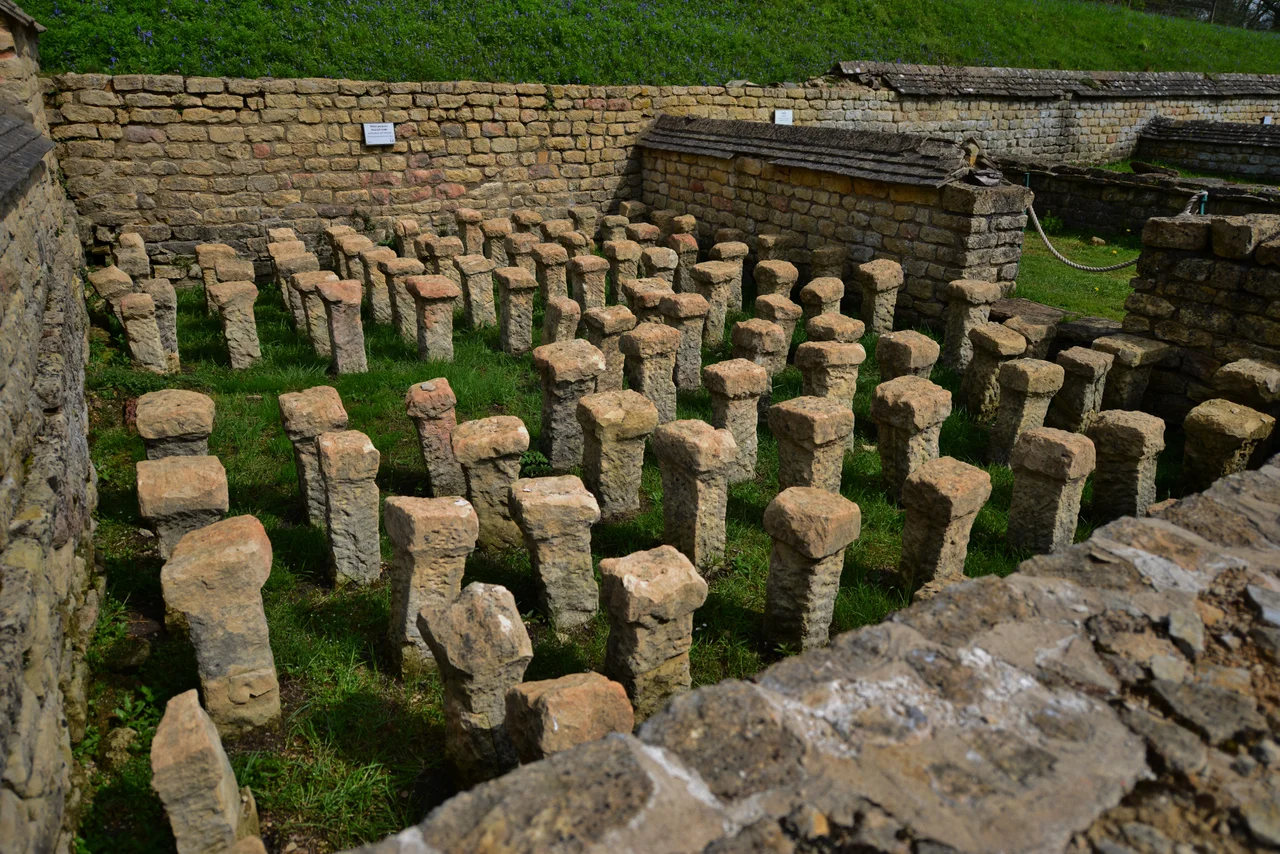
By the fourth century the villa wrapped around three sides of a courtyard, with a working farm on one side and the elite household on the other. The west wing held a triclinium, a Roman dining room, with one of the finest geometric mosaics in Britain underfoot. There were two complete bath suites, one for damp heat and one for dry, both essential to a Romano-British gentleman's idea of civilisation. Around the spring in the north-west corner the family built a nymphaeum, an apsidal shrine to the water-nymphs whose two-metre rear wall still stands, made of the original Roman masonry. There was also a separate Romano-British temple about 800 metres south-east, where excavators found coins, hexagonal tiles, fragments of pillars and glass tesserae. Historians have spent more than a century arguing whether Chedworth was a religious sanctuary with attached hostel or an ordinary villa rustica. Most now think it was the villa, lived in by a Romano-Briton who was very rich indeed.
The Mosaic That Should Not Exist
Conventional histories say Roman Britain collapsed around 410 AD when the legions withdrew. Money stopped circulating. Town walls were no longer maintained. Latin and the old lifeways faded into Anglo-Saxon Britain. Then in 2020 the National Trust announced that the mosaic in Room 28 had been laid after 424 AD. The dating came from coins, pottery, and the relationship of the mosaic to nearby walls. A second mosaic in the neighbouring Room 30 may be from the same period. What this means is that someone at Chedworth in the mid-fifth century, with the empire gone and the Saxon migrations underway, was still spending serious money on imported skills, hiring craftsmen who knew the old patterns and could lay tens of thousands of tesserae to the standards of a high Roman house. Concentrated wealth funded Roman lifestyles in Britain for at least fifty years longer than anyone had thought. Eventually, even Chedworth's owners gave up: a later workshop was installed directly on top of the mosaic floor, and crude hearths were built from pieces of the villa's own architecture, scratching out a living among the ruins of their grandparents' world.
Saved by a Ferret
After Margetts's discovery in 1864, the local landowner James Farrer excavated the site between 1865 and 1867 and opened it to the public almost immediately, with a Victorian shelter over the main mosaics. The National Trust acquired Chedworth in 1924. Professor Ian Richmond reinterpreted parts of the villa in the late 1950s and 60s, but died in 1965 before publishing his findings, and several rooms were reburied to protect them. In 2011 Feilden Clegg Bradley Studios designed a new £2.2 million cover building that opened in 2012. Inside, walking on raised walkways above the mosaics, you can see the geometric meander patterns of the triclinium floor still alive with colour. A mathematical algorithm has even been developed to reconstruct, on paper, the parts of the patterns that time has erased.
From the Air
The villa sits on a hillside terrace above the River Coln, screened by woodland, about ten miles south-east of Cheltenham. The cover building is a distinctive low contemporary structure, all timber and zinc, set into the trees. The dry-stone walls and pasture of the Cotswolds spread around it; the Fosse Way runs roughly north-east to south-west a mile to the west. Cirencester, the Roman Corinium, lies eight miles south.
From the Air
Located at 51.8198 N, 1.92464 W, near Chedworth village, Gloucestershire, in the Cotswold Hills above the River Coln. Best viewed at 2,500 to 4,500 feet AGL. Nearest GA airfields: Cotswold Airport (EGBP, formerly Kemble) to the south-west, Gloucestershire Airport (EGBJ) to the north-west. The whole Cotswold escarpment, Cirencester and the Roman Fosse Way are clearly visible in good weather.
Nearby Stories
- Evesham Abbey 6.7 km away
- Windmill Hill, Avebury 8 km away
- Blenheim Palace 8.8 km away
- Bristol Temple Meads 10 km away
- Donnington Castle 11 km away
- Battle of Cropredy Bridge 11 km away
- St Briavels Castle 13 km away
- Hereford Cathedral Library 18 km away