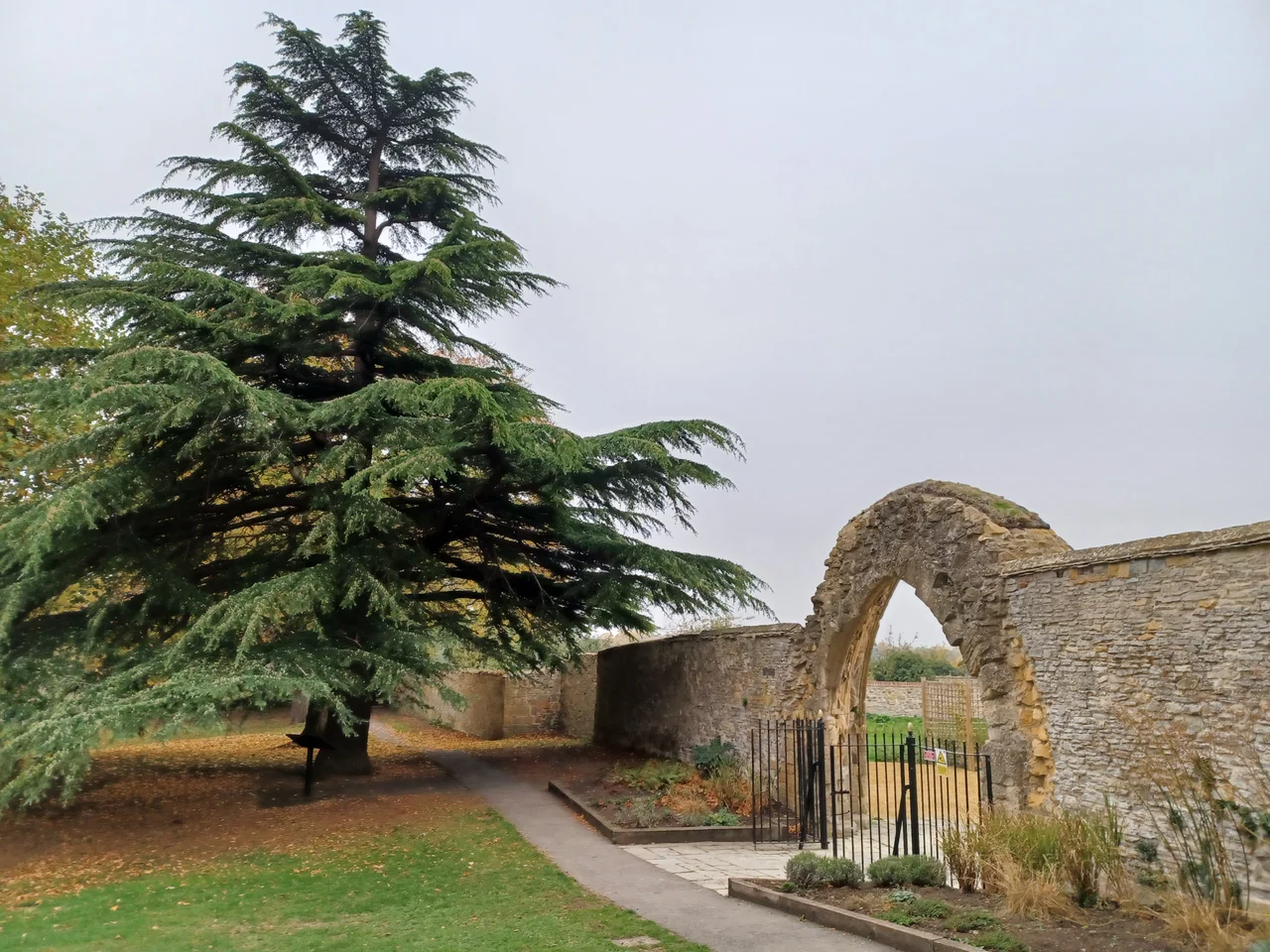

Evesham Abbey
A swineherd named Eof claimed he had seen the Virgin Mary in a clearing of the Worcestershire forest. He reported it to Egwin, third bishop of Worcester, who came to the spot, saw the same vision, and resolved to build a monastery there. So runs the founding legend of Evesham Abbey, set down by the abbey's own chroniclers and consecrated, by the best surviving evidence, around the year 709. The site they chose was a tongue of land curling inside a deep bend of the River Avon - a green peninsula that would carry monks, kings' burials, a battle, and finally ruin for the next eight centuries.
From Eof's Vision to Norman Wealth
Egwin's foundation grew slowly into a Benedictine house of unusual richness. The story of its survival through the Norman Conquest hinges on Abbot Aethelwig, who in 1066 read the political weather quickly and made his peace with William the Conqueror before the new king's soldiers reached Worcestershire. The abbey kept its lands. By the high Middle Ages it was one of the wealthiest in England. Pilgrims came to honour the relics of Saint Egwin, Saint Credan, Saint Wigstan of Mercia, and the Frisian missionary Saint Odulf, whose body had been brought to Evesham in the 11th century. Successive abbots built and rebuilt: a great church with twin towers, a chapter house, an almonry, an enormous gatehouse on Merstow Green, and the bell tower of Abbot Clement Lichfield, completed in the 1530s on the very eve of dissolution.
4 August 1265
Simon de Montfort, 6th Earl of Leicester, was the leader of the baronial revolt against Henry III. He had won at Lewes the previous year, captured the king, and ruled England in all but name through a parliament that included, for the first time, elected representatives from the towns. By the summer of 1265 his support was draining away. Trapped inside a bend of the Avon at Evesham, his army half the size of his enemy's, he watched the royalist banners approach and is said to have remarked: 'God have mercy on our souls, for our bodies are theirs.' The future Edward I had ordered twelve picked men, led by the Marcher baron Roger Mortimer, to find de Montfort and kill him personally. They did. His son Henry de Montfort died first, then Simon himself, dismounted and surrounded. Roger Mortimer struck the killing blow. After the battle his body was mutilated; his head was sent to Mortimer's wife at Wigmore Castle. The monks of Evesham gathered what they could and buried him near the high altar. Within weeks pilgrims were coming to the grave.
The Cult of a Defeated Earl
England had killed Simon de Montfort. England then began to venerate him. Within months of the battle, accounts of miracles at the abbey grave were being copied between monasteries. The crown was alarmed enough to forbid the cult by royal decree; the cult continued in defiance. He was never formally canonised, and the church's official ledger always recorded him as a rebel - but for the better part of a century, ordinary people prayed to Earl Simon as a saint. Henry de Montfort was buried beside him. Today an altar-like memorial slab, dedicated in 1965 by the Archbishop of Canterbury on the seven-hundredth anniversary of the battle, marks the place. The high altar is gone; the building above it is gone; the slab lies on the open grass of what is now a public park.
One Tower Standing
In 1540 the abbey surrendered to the Crown's commissioners during Henry VIII's dissolution of the monasteries. They demolished it with the thoroughness applied to most of the great Benedictine houses. The church, the cloisters, the dormitories, the refectory - all came down for their lead and dressed stone. Only Clement Lichfield's bell tower was spared, possibly because it had only just been built and the demolition crew ran out of time or appetite. The tower stands 110 feet high above the precinct today, a Grade I listed object so striking that J. M. W. Turner came in 1793 to paint it and the parish church beyond, framing one through the arched opening of the other. Edward Rudge spent two decades from 1811 digging up the abbey foundations; his finds were published in Vetusta Monumenta with watercolours by his wife Anne.
What Remains, and What Is Returning
Walk the precinct now and the great spaces are marked in low stone outlines on the lawn: here the nave, here the transepts, here the chapter house, here the high altar with its memorial slab. The 14th-century gateway survives, incorporated into a house at 53 and 54 Merstow Green. Abbot Reginald's wall, parts of which date to around 1120, still divides the park from the road. The 15th-century almonry is a museum now. In 2017 the Evesham Abbey Trust took ownership of much of the site, and a £1m grant from the National Lottery Heritage Fund paid for conservation work and a set of interpretive gardens completed in 2023. Eight bells still ring from Clement Lichfield's tower, the largest weighing nearly 26 hundredweight, sounding the note D across the Avon meadows.
From the Air
Evesham Abbey lies at 52.091 degrees N, 1.947 degrees W, inside a sharp meander of the River Avon on the south-east edge of the town. Best viewed from 2,500-3,000 feet on a south-westerly run. The 110-foot bell tower is the single tallest object in the abbey park, immediately recognisable. Gloucestershire Airport (EGBJ) lies 17 nautical miles south-west; Birmingham Airport (EGBB) is 20 nautical miles north; the M5 motorway runs 10 nautical miles to the west. The Vale of Evesham's regimented orchards and fruit-growing fields make a striking patchwork around the town from the air in spring blossom.
Nearby Stories
- Woodstock Palace 3.4 km away
- Chedworth Roman Villa 4 km away
- Bournville 5.2 km away
- Battle of Cropredy Bridge 6.3 km away
- Halifax V9977 Crash, Welsh Bicknor 8.7 km away
- Much Wenlock 25 km away
- Market Bosworth 27 km away