.jpg)
Old Sarum Airfield
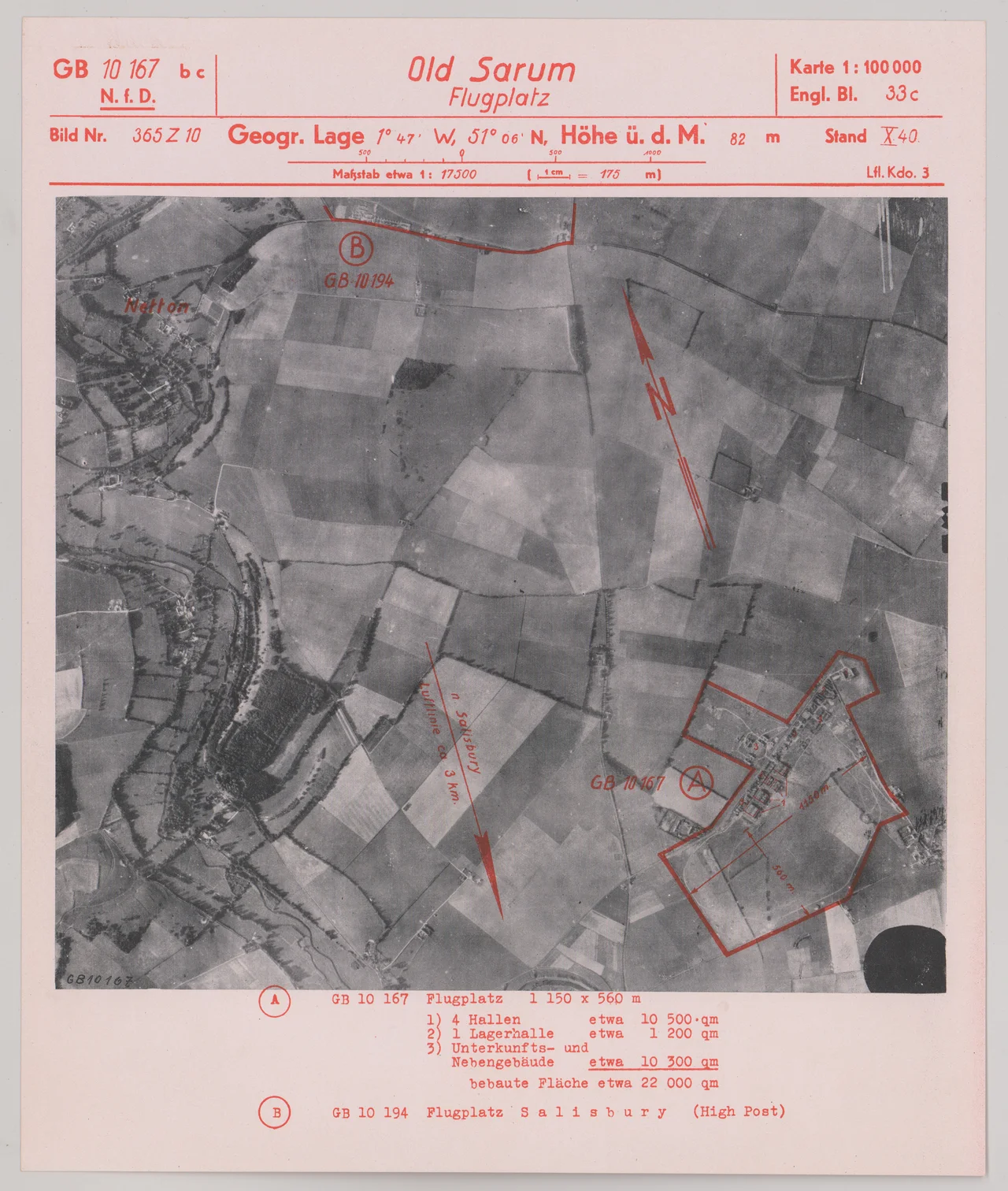
Open the throttle on a grass strip just east of an Iron Age hill, and you are doing roughly what Royal Flying Corps trainees did here in 1917. Old Sarum Airfield was sited that year beneath the great hump of Old Sarum - the abandoned medieval city perched on a much older hillfort - because the rapidly expanding RFC needed somewhere to train new aircrews for the bomber squadrons being thrown across the English Channel. The first hangars were wooden sheds; the buildings that quickly followed are still here. Walk past Hangar 1 today and you are looking at one of the most complete suites of First World War technical and hangar buildings anywhere in Britain.
Born on the Day the RAF Was
The airfield opened in August 1917, briefly known as 'Ford Farm' before settling on the name of the hill nearby. Within months it was preparing day bomber squadrons for France. Then on 1 April 1918 - the day the Royal Flying Corps merged with the Royal Naval Air Service to create the Royal Air Force - the No. 11 Training Depot Station was formed at Old Sarum. After the war, when most training airfields were closed, Old Sarum was kept on. In January 1921 the School of Army Co-operation moved here from Stonehenge Aerodrome, settling in for two decades of teaching pilots and Army officers how to talk to each other. A 'Special Duty Flight' worked with the Experimental Gas School at nearby Porton Down from about 1926. In June 1938, 16 Squadron became the first unit anywhere to equip with the Westland Lysander - the high-wing army cooperation aircraft that would become an icon of clandestine SOE flights into occupied France.
From Battle of Britain to D-Day
When the Second World War came, two of the first Canadian flying units to reach Britain - 110 and 112 RCAF Squadrons - made their first home at Old Sarum. As fighter pilot losses climbed during the Battle of Britain, army cooperation trainees were stripped out of the school and rushed onto Hurricane and Spitfire training units. The airfield itself escaped lightly under the Luftwaffe's airfield campaign, but one hangar was burnt out in a raid on the night of 11/12 May 1941, with two aircraft destroyed. In 1944, planning for D-Day pulled in every facility the field could provide. Old Sarum became part of the 2nd Tactical Air Force Concentration Area: thousands of RAF ground personnel passed through, seven tented camps went up in the surrounding countryside, and a force of over a thousand fitters waterproofed roughly 25,000 invasion vehicles. By 6 June there were 34 aircraft on the field from 658, 659, and 662 Squadrons waiting to be called forward to France.
Helicopters, Optica, and a Long Civilian Era
Post-war, Old Sarum became one of the first places in Britain where helicopters were taken seriously as a military tool. The RAF element of the Helicopter Development Unit formed here on 1 June 1961 with Bristol Sycamores and Westland Whirlwinds. The Joint Helicopter Development Unit absorbed it in 1965; the Joint Air Transport Establishment took over in 1968. The Army took the field over from the RAF in December 1971, but flying drained away through the 1970s, and from 1979 it was no longer a military base. In 1982 the airfield was sold to Edgley Aircraft Ltd on a 999-year lease for the design and test flying of the Edgley Optica - an odd, helicopter-like observation aircraft with a transparent bubble nose. Optica's manufacturer went insolvent in 1986; Matthew Hudson bought it, rebranded it Brooklands Aerospace, and the field carried on with flying clubs and training schools.
Closure, Fires, and an Uncertain Future
Old Sarum Flying Club ran from 1992, peaking at around 800 members and twenty aircraft, including a 1943 Boeing Stearman. The Boscombe Down Aviation Collection moved its museum into Hangar 1 in July 2012, displaying replica Royal Aircraft Factory B.E.2Bs, a Westland Scout, and the front section of a Lancaster bomber. Salisbury District Council designated the airfield a conservation area in 2007 after an earlier attempt was thrown out by the High Court. But the commercial maths kept getting harder. In July 2019, after a five-year planning battle with Wiltshire Council over the owners' proposal to build 462 houses on the perimeter, Old Sarum Airfield Ltd announced it would close. The 'SOS - Save Old Sarum' campaign fought to keep it open. The field closed on 31 October 2019, then reopened only by prior arrangement. Storm Isha tore most of the roof off Hangar 3 in January 2024; a fire destroyed the rest in April 2025. The future of one of Britain's most intact First World War flying fields is, as of this writing, unresolved.
From the Air
Old Sarum Airfield (EGLS) lies at 51.10 N, 1.78 W, two nautical miles north-northeast of Salisbury. The grass strip sits below the Iron Age earthworks of Old Sarum hill. Operations require prior arrangement; Aerodrome Traffic Zone sits inside the MoD Boscombe Down (EGDM) MATZ, with circuits flown to the south. Nearby airfields: Boscombe Down 4 nm northeast (military, PPR), Compton Abbas (EGHA) 18 nm south. From 1,500 feet, look for the cathedral spire to the south, the chalk uplands of Salisbury Plain stretching north and west, and the Roman road that still marks the airfield's northern boundary.
Nearby Stories
- Winchester Castle 6 km away
- Newbury, Berkshire 9.9 km away
- 1988 Poole Explosion 10 km away
- Norris Castle 10 km away
- West Kennet Long Barrow 11 km away
- Maiden Castle, Dorset 12 km away
- Glastonbury Festival 13 km away
- Bristol Temple Meads 16 km away