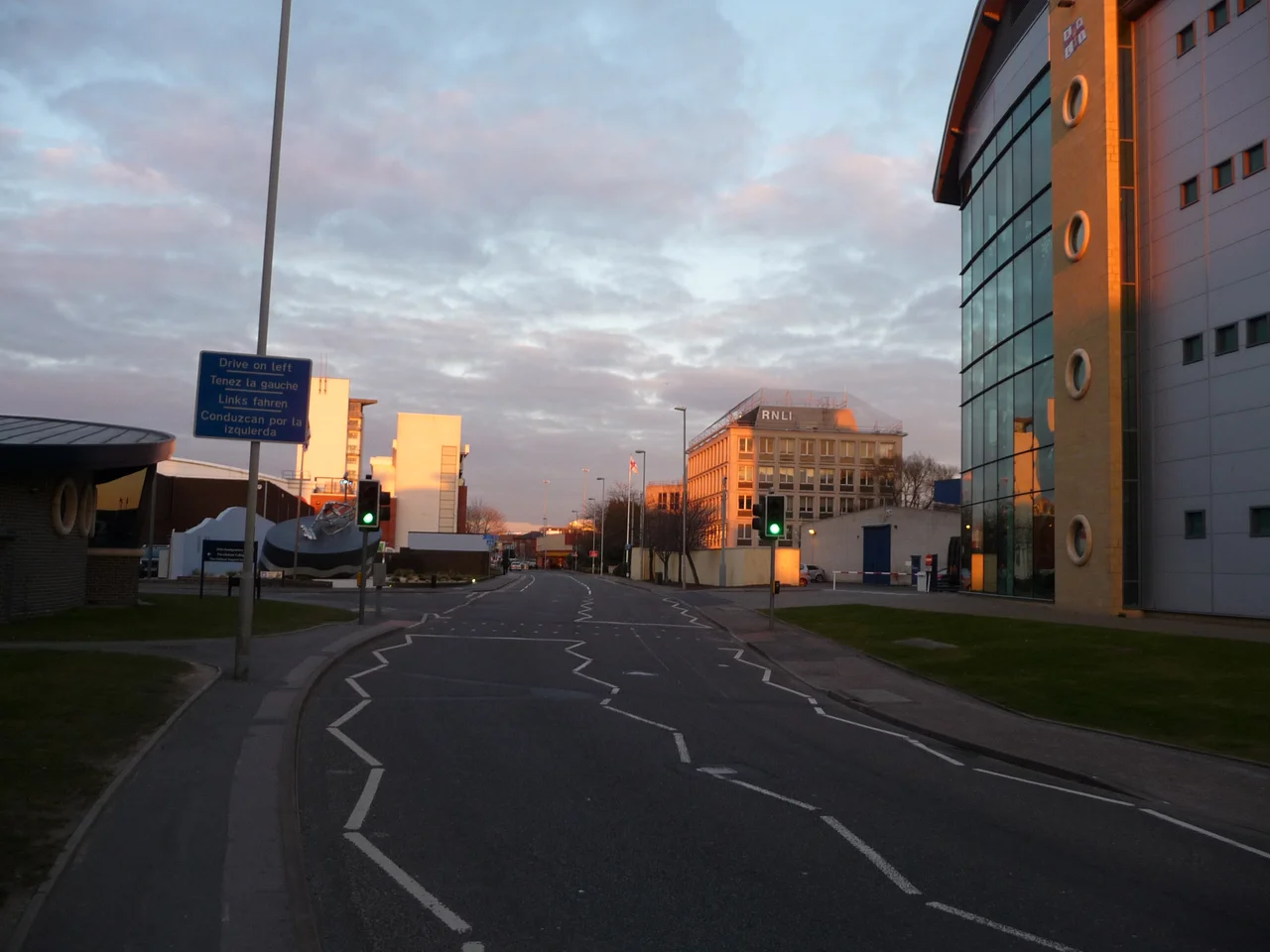

1988 Poole Explosion
At about 7:30 on the evening of 21 June 1988, the first emergency calls went out from West Quay Road in Poole. A fire had broken out in an oxidising storeroom at the BDH chemical plant, less than half a mile from the centre of the old town. By 7:45 the evacuation had already started. Tower blocks emptied, terraced streets were searched door to door, and people streamed toward the Arts Centre, the Sports Centre and the Arndale Centre in what would become the largest peacetime evacuation in British history since the Second World War. Three thousand five hundred people left their homes that night. Flaming drums of solvents were launching from the burning warehouse and falling on neighbouring streets. By the next morning, with the worst over, the survivors counted themselves astonishingly lucky. Nobody had been killed.
Forty Years on West Quay Road
British Drug Houses had been making chemicals in Poole for four decades by 1988. The West Quay Road plant, built in 1982, sat between the Port of Poole and the residential streets of Poole Old Town. Pharmaceuticals, laboratory reagents, industrial solvents: the kind of substances every modern economy needs, stored in barrels and bottles in warehouses few people noticed walking past. The Health and Safety Executive had inspected the West Quay Road facilities fifteen times between 1979 and 1988. The fire that began that summer evening started in a storeroom holding oxidisers, the chemicals that feed combustion. It spread to the next room, which held flammable liquids. From there it spread very quickly.
The Evening of the Fireball
Witnesses described flames a hundred feet high. Drums of liquid, still flaming, were thrown into the air by the heat and pressure and came down on streets fifty metres away. Off-site damage extended to a hundred metres. A yellow-brown plume of smoke rose over Poole Old Town, drifting in the evening light above the rooftops of streets people had walked home along an hour before. Station Manager Gordon Hughes took charge of the evacuation, ordering a one-square-mile cordon around the town centre. A hundred firefighters worked the scene. Fourteen people were taken to Poole General Hospital, most for smoke inhalation and minor injuries. The Queen Mary pub on West Street, almost next door to the plant, took heavy fire damage but stayed standing. Street furniture melted. Traffic lights melted. Windows broke for streets around.
What Did Not Happen
The investigators who walked through the wreckage in the cool of the next morning found drums of cyanide that had not exploded. They might have. They very nearly had. The wind, blowing offshore that night, had carried the toxic smoke out across Poole Bay rather than into the streets where the evacuees were sheltering. The analysis of what had burned showed hydrogen chloride in the plume, a gas that attacks lungs and eyes and would have caused mass casualties if it had drifted inland. The Health and Safety Executive, on the scene by morning, said the devastation made it virtually impossible to determine the cause. Pollution of Poole Harbour, the great natural harbour just beyond the plant, was a separate worry. The damage was extraordinary. The death toll was zero. Senior officers used the word luck.
The Inquiry, and What Came After
John Ward, the Conservative Member of Parliament for Poole, pressed for a public inquiry. The Parliamentary Under Secretary of State for Employment, Patrick Nicholls, confirmed instead that the Health and Safety Executive would conduct a full investigation. The findings were presented at a press conference on 17 October 1988. In November of that year, Gordon Hughes became only the second person ever to receive the Chief Officer's Commendation for his work organising the evacuation that probably saved hundreds of lives. The fire had a long tail. In 1997, BDH closed the West Quay Road plant entirely. Half of the local workforce lost their jobs. The factory was demolished.
What Stands There Now
The site is no longer a chemical works. It is the Royal National Lifeboat Institution's national headquarters. The Poole Lifeboat Station now occupies the West Quay Road ground, alongside the RNLI's main administrative buildings and the Lifeboat College, which opened in 2004 to train volunteer crews from across Britain and Ireland. Where flaming drums once arced into the air over Poole Old Town, lifeboat crews now learn the skills that pull people from the sea. The transformation is not subtle. The street that hosted the largest peacetime evacuation since the war now hosts the people whose job is to rescue everyone else.
From the Air
The site sits at 50.72 degrees North, 1.99 degrees West, on West Quay Road in Poole, on the northern shore of Poole Harbour. Bournemouth (EGHH) is 5 nm east, Southampton (EGHI) is 20 nm east-northeast. The Lifeboat College and RNLI buildings now visible at the site are unmistakable from the air, white modern blocks beside the harbour and the deep-water ferry channel. Poole Old Town and the Quay are immediately east.
Nearby Stories
- Maiden Castle, Dorset 2.1 km away
- Battle of Portland 6.1 km away
- Carisbrooke Castle 7.1 km away
- Winchester Castle 11 km away
- Wardour Castle 13 km away
- Fleet Air Arm Museum 14 km away
- HMS Warrior (1917) 22 km away
- D-Day: The Longest Day 157 km away