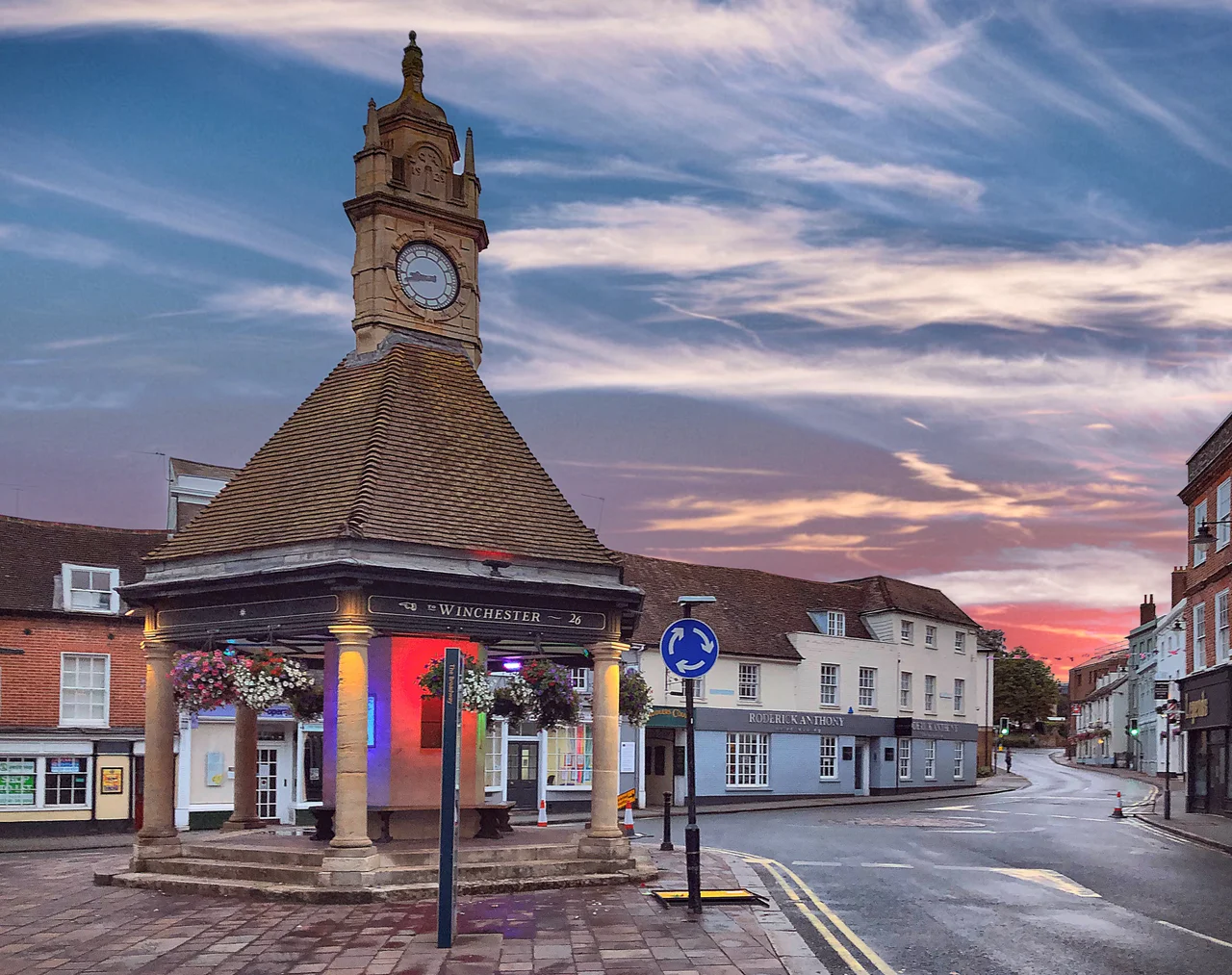

Newbury, Berkshire
On 1 April 1983, around forty thousand women linked hands around a nine-mile perimeter fence in West Berkshire. They were encircling RAF Greenham Common, the airbase that had just been equipped with American ground-launched nuclear cruise missiles. The Greenham Common Women's Peace Camp had been there since 1981. They would stay until the year 2000. Just over the boundary fence, on the edge of the market town of Newbury, was a town that had been arguing about who passes through it for most of a thousand years. Two English Civil War battles. The Speenhamland Poor Relief System. The London-to-Bath coaching trade. Vodafone. Newbury has spent a millennium being a place where things happen and other things go through.
The New Borough
Newbury was a deliberate creation. After the Norman Conquest, when most English manors lost value, the manor of Ulvritone in the Kennet valley suddenly multiplied in worth, and a new borough appeared with the name to match: Newbury, the new burh. The Domesday Book of 1086 records land for twelve ploughs, two mills, woodland enough to feed twenty-five pigs, and fifty-one private parks rendering seventy shillings and seven pence. The town sat where the road from London to Bath crossed the River Kennet, and where the cloth trade later thrived under the legendary merchant Jack of Newbury, who at his peak in the early 1500s ran what may have been England's first true factory. The Newbury Coat legend, a 1811 bet that a gentleman's suit could be tailored from wool taken off a sheep's back at sunrise and worn by the gentleman at sunset, fixed the town in folk memory.
Two Battles in Wash Common
The English Civil War made Newbury famous in a way no market town would have wished. The First Battle of Newbury was fought at Wash Common on 20 September 1643 between the Earl of Essex's Parliamentarians and King Charles I's Royalists. It was confused, exhausting, and inconclusive, but the Royalists withdrew. The Second Battle of Newbury, fought a year later on 27 October 1644 at Speen, was a Parliamentarian attack on a Royalist force led personally by the King. It too ended without decisive victory, but the nearby Donnington Castle was reduced to a ruin in the months that followed, and the local cloth trade, already failing, collapsed under the disruption. The Falkland Memorial outside town marks the spot where Viscount Falkland, fighting for the King at the first battle, was killed by a Parliamentarian musket ball.
Coaches, Canals, and the Speenhamland System
Eighteenth-century Newbury rose again as the perfect halfway stop on the two-day coach journey from London to Bath. The Speenhamland area on the north edge of town filled with coaching inns of competitive grandeur. The George & Pelican advertised stabling for three hundred horses. A theatre was built for travellers' entertainment. In 1795, in a meeting of local magistrates at the George and Pelican, the Speenhamland System was devised. Magistrates tied parish poor relief to the price of bread, ensuring labourers received enough to survive. The system was both compassionate and economically corrosive; employers paid below subsistence wages because the parish topped up the difference. The Speenhamland System spread across southern England and became one of the central case studies in nineteenth-century debates about welfare. The Kennet Navigation reached Newbury in 1723. The Kennet and Avon Canal opened the through-route to Bristol in 1810. Then the Great Western Railway opened in 1841, twenty-five kilometres north of Newbury, and the coaching trade died almost overnight. Newbury became, in its own self-description, a backwater.
The 1943 Bombing
At 4:43 in the afternoon on 10 February 1943, a single Dornier Do 217 of the Luftwaffe's KG40 unit, on a nuisance raid from Holland, followed the railway line west from London and dropped eight high-explosive bombs on Newbury without warning. The Senior Council School was destroyed. So were St Bartholomew's Almshouses. The altar of St John's Church was the only part of that building left standing; the rest was rebuilt after the war. Fifteen people were killed and another forty-one were injured, twenty-five seriously. Another 265 dwellings were damaged, many beyond repair. Newbury had no time to sound a siren. It was a small attack in the arithmetic of total war, and an enormous wound for a small town.
Greenham, and After
After the war, the airfield at Greenham Common became one of the United States Air Force's main bases in Britain, with the longest military runway in the United Kingdom. In 1979 NATO agreed to base ground-launched cruise missiles in Europe, and Greenham was one of two British sites chosen for them. The first peace camp arrived on 5 September 1981, set up by Welsh women who had walked from Cardiff. The protest grew. The encirclement of the base in April 1983 by around forty thousand women, joining hands around the entire perimeter fence, became one of the iconic moments of the late Cold War. The camp outlasted the missiles. The Intermediate-Range Nuclear Forces Treaty saw them removed by 1991. The base finally closed in 1993. The runway was broken up and most of the concrete went into the foundations of the Newbury bypass. The land was returned to heathland and reopened to the public in 2000. The last peace camp protesters left that same year. The Greenham Control Tower is now a café and museum. The old GAMA cruise missile bunkers can still be seen, low concrete shapes in the heather.
Modern Newbury
Newbury came back into prosperity in the 1980s when the British electronics firm Racal located its new telecommunications company in the town. That company became Vodafone. The £129 million Vodafone headquarters opened on the outskirts in 2002, employing more than six thousand workers and replacing the sixty-four scattered buildings the company had previously occupied around town. Newbury Racecourse, opened in 1905, hosts the Coral Gold Cup in late November and summer concerts on race days. Watership Down, the actual chalk hill that Richard Adams used as the setting for his 1972 novel about rabbits, lies a few miles south. Adams was born in Newbury. So was Michael Bond, the creator of Paddington Bear. So was the broadcaster Keith Chegwin. The 18th-century Northcroft Lido, one of the last lidos in Britain, still opens for summers in Northcroft Park. The town is, after everything, a market town in the Kennet valley with twin towns in five different countries and a strong opinion about welfare reform first formed in 1795.
From the Air
Newbury sits in the Kennet valley at 51.40°N, 1.32°W in West Berkshire. Elevations range from 72 metres in the valley to 200 metres in the surrounding hills, with Walbury Hill at 297 metres just south, the highest point in south-east England. Visual landmarks include the M4 motorway running east-west three miles north of town, the A34 running north-south, the long straight scar of the former Greenham Common runway just south-east, Donnington Castle ruin to the north, and Newbury Racecourse east of town. Nearest GA airfields are EGTB Booker (Wycombe) 22 nautical miles north-east, EGLK Blackbushe 18 nautical miles south-east, and EGVN Brize Norton 22 nautical miles north-west (military, restricted). Most of the area is in Class G outside controlled airspace.
Nearby Stories
- Old Sarum Airfield 6.2 km away
- West Kennet Long Barrow 6.5 km away
- Eton College 7 km away
- Chesham 7.1 km away
- Christ Church, Oxford 8 km away
- Hyde Abbey 11 km away
- Cotswolds 13 km away
- Amberley Museum & Heritage Centre 31 km away