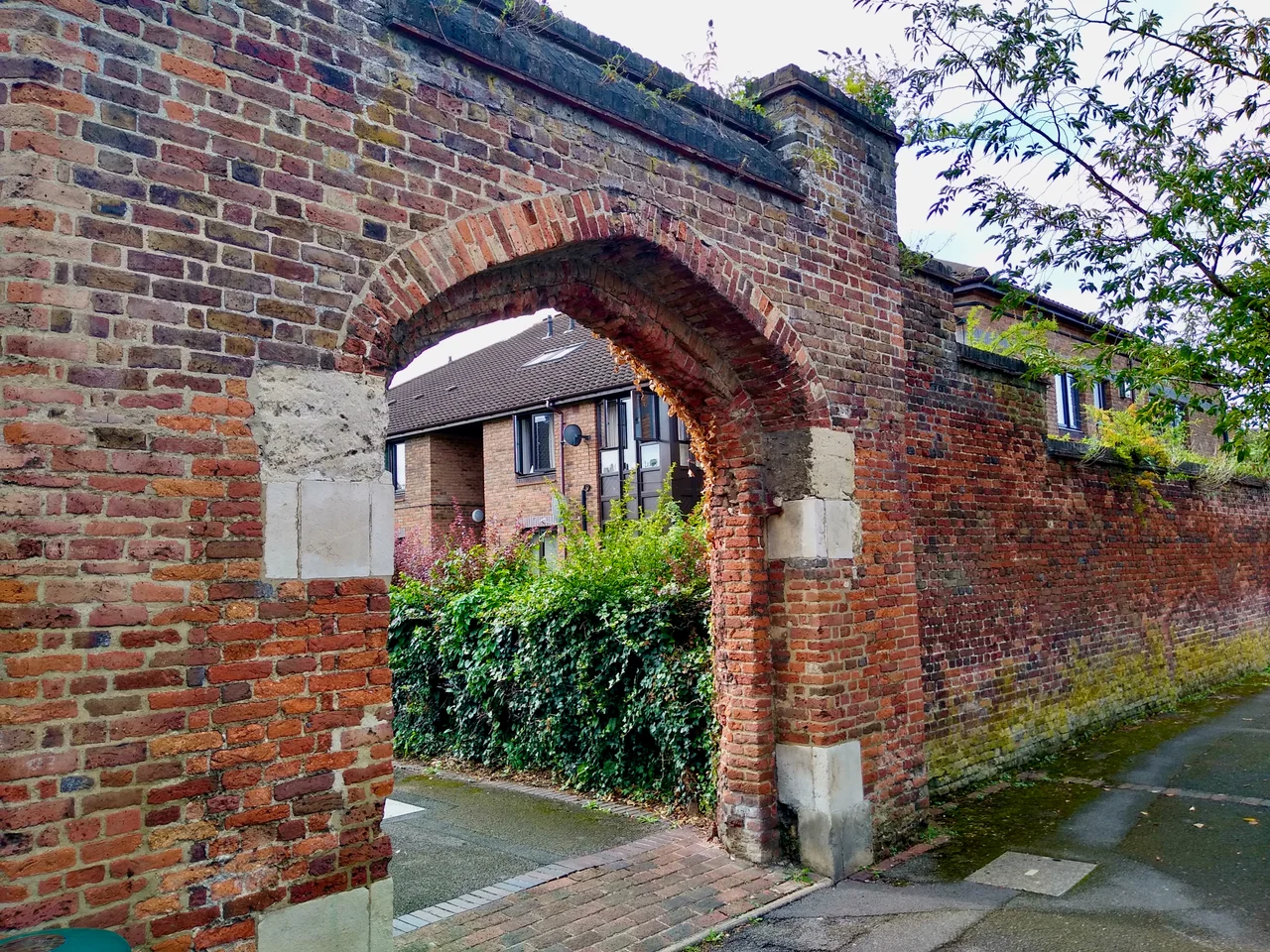

Oatlands Palace
Henry VIII married Katherine Howard at Oatlands on 28 July 1540. He was forty-nine, increasingly lame, and a special ramp had been built at the palace so he could mount his horses without dismounting his dignity. She was perhaps seventeen. The palace where they wed sprawled across fourteen hectares in three quadrangular courtyards, built from foundation stones plundered from the wreckage of Chertsey Abbey after the Dissolution. Today none of it remains above ground. A 1964 excavation traced the outline of what was once one of England's grand royal residences, and the four-star Oatlands Park Hotel - a Victorian rebuild on slightly different ground - occupies the hill where its successor mansion once stood. To understand Oatlands you have to look at fields and imagine.
Bricks from a Broken Abbey
When Henry VIII acquired the old moated manor at Oatlands in 1538, he wanted a palace fit for his fourth wife, Anne of Cleves. The stone came from Chertsey Abbey, which had been dissolved and dismantled two years earlier in the Protestant Reformation's accounting of monastic wealth. Tudor builders raised three courtyards around the existing fifteenth-century manor house. An inventory described Anne of Cleves's bed: crimson cloth of gold and silver curtains, purple velvet seams, and 108 embroidered badges of Anne and Henry with their crowned arms on the canopy. She slept in it briefly. Henry married Katherine Howard at Oatlands two years later. Katherine Parr - wife number six - wrote her brother William from the palace a week after her own wedding in 1543. Mary Tudor retreated here in 1555 when her phantom pregnancy ended and her court realised there would be no heir. The same rooms saw six women cycle through the role of queen.
Anne of Denmark's Boredom
James I's wife Anne of Denmark took possession of Oatlands in August 1611 and set about making it her own. She built a silkworm house with her heraldry painted on the window. She planted a vineyard. She hired Inigo Jones to design an ornamental gateway between the Privy Garden and the park, the gardener John Bonnall to bring in "new and rare fruits, flowers, herbs, and trees," and the painter Paul van Somer to paint her with her horse, her hunting dogs, an African servant, and the new gateway in the background. She furnished her bedchamber with satin panels laced with coloured silks and Italian gilt chairs. Then she wrote to her husband that she was "weary of Oatlands, of my mares, of my deer, of my dogs, and of my vineyard." The complaint reads as honestly as anything anyone has ever written about royal country life. The luxury was suffocating; the diversions were not enough.
Henrietta Maria and a Smuggled Princess
Oatlands passed to Charles I's wife Henrietta Maria as part of her marriage settlement. She brought part of her art collection here, employed John Tradescant the elder to remake the gardens, and in August 1635 staged a pastoral masque on the grounds. In 1637 rumours spread that she was sickening with tuberculosis - a disease that meant near-certain death three centuries before penicillin - and she was drinking donkey's milk at Oatlands as a remedy. The Civil War found her infant daughter Princess Henrietta living at the palace in 1646. The governess, Lady Dalkeith, smuggled the child out of England that summer and across to France, where she would grow up to marry the brother of Louis XIV. Three years later, with Charles I executed and the monarchy abolished, the Commonwealth government sold Oatlands to a man named Robert Turbridge for about £4,000. He demolished the palace and sold the bricks to Sir Richard Weston of Sutton Place. A century and a half of royal architecture, reduced to building materials.
Haydn at the Hunting Lodge
One outlying building survived the demolition - probably a hunting lodge, well away from the palace site. After the Restoration it housed William Boteler, one of Cromwell's ten major-generals, infamous for his harshness toward Catholics, Quakers, and royalists. Through the eighteenth century the property passed through various hands, including the Earls of Lincoln, before returning to the Crown. In 1790 Prince Frederick, Duke of York and second son of George III, leased it. In November 1791 he hosted Joseph Haydn for two days. The composer played music for four hours each evening and recorded the visit in his second London notebook. Three years later the house burned down. It was rebuilt in the Strawberry Hill Gothic style, fashionable for ruins both real and imagined. In 1856 the rebuilt house was adapted as a hotel - the South Western, later renamed Oatlands Park - and that is what stands today. During World War I the British government commandeered it as a hospital for New Zealand troops wounded in France, which is why one of Walton-on-Thames's main streets is now called New Zealand Avenue.
From the Air
From above, the Oatlands estate reads as a green island of mature trees and Victorian gables surrounded by twentieth-century suburbia. The hotel sits on the high ground; the original palace footprint lies downhill, between the hotel and the centre of Weybridge, beneath what is now residential street layout. The Grade II-listed former entrance gateway still stands, the last visible relic above ground. The river Thames winds north and west, with Hampton Court Palace a short distance downstream. Heathrow's flight paths cross overhead constantly. Bringing a Cessna in low along the river toward Weybridge, you can see the shape of the old estate in the way the streets bend around what used to be its walls. The palace itself is gone, but the geometry of its gardens still steers the modern town.
From the Air
Located at 51.3754 N, 0.4514 W near Weybridge, Surrey. The Oatlands Park Hotel marks the post-palace mansion site; the Tudor palace footprint lies downhill, between hotel and town centre. Best viewed at 1,500-2,500 feet AGL. Nearest major airport: London Heathrow (EGLL), 8 nm north. Fairoaks (EGTF) lies 4 nm west and serves general aviation. The Thames is visible 2 nm north. Class D airspace requires London approach coordination at lower altitudes.
Nearby Stories
- Waltham Abbey 0.7 km away
- Queen Victoria Hospital 1.9 km away
- Hither Green rail crash 3.3 km away
- Ufton Nervet rail crash 4.2 km away
- Kings Langley Palace 5.8 km away
- Magdalen College, Oxford 16 km away
- Hyde Abbey 20 km away
- Amberley Museum & Heritage Centre 28 km away