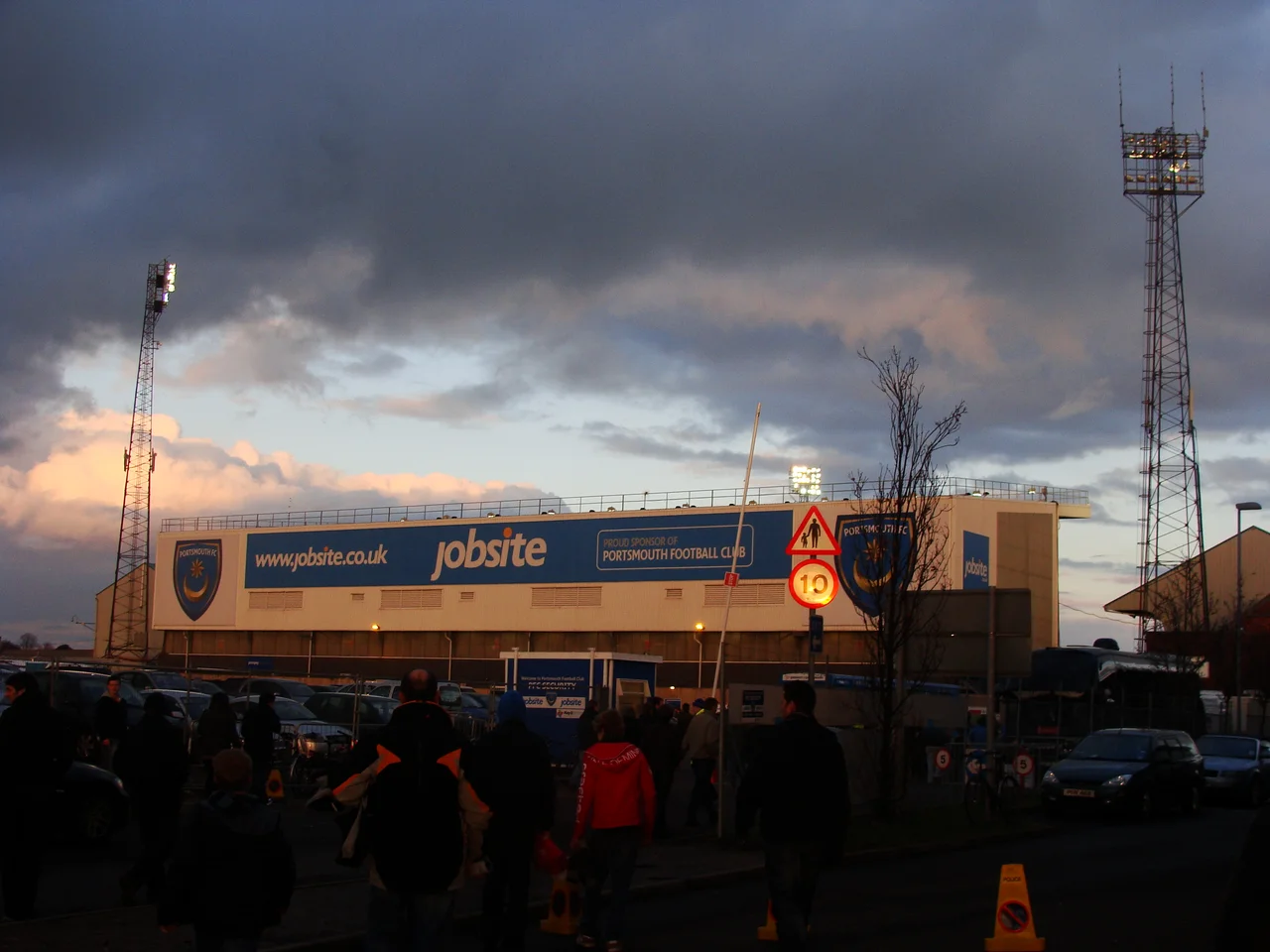

Fratton Park
On Saturday 6 September 1899, four thousand one hundred and forty-one people walked across a former potato field on the eastern side of Portsea Island to watch a friendly between Portsmouth and Southampton. Portsmouth won, 2-0. The gate took in 141 pounds, fourteen shillings, and ninepence. The football ground had been open for less than a month. It had been deliberately misnamed: built in the village of Milton, but called Fratton Park, so that supporters arriving by train would believe it was within a quick walk of Fratton railway station rather than the actual one-mile trudge across town. It is the only professional English football ground that is not on the mainland of Great Britain. It has been Portsmouth Football Club's home, and only home, for 126 years.
The Old Girl
Portsmouth fans call it 'The Old Girl.' The broadcast media calls it 'Fortress Fratton' or, sometimes, just 'PO4,' after its postcode. The ground was designed by Major Alfred H. Bone, a Portsmouth-based architect, surveyor, and one of the six founding directors of the club. He gave it the cheerful low-tech architecture of late-Victorian football: stands of varied designs and sizes pressed close around an east-west pitch in a tight rectangle. The pitch runs the wrong way for sunlight, east to west rather than the standard north-south. The crowd has always been close enough to the touchline to read the boot studs. The maximum capacity once reached 58,000 after the North Stand was rebuilt in 1935, but the all-seater conversion of 1996 has long since brought it down to a snug 20,867. On a busy night the Old Girl sounds, from outside, like a much larger ground.
Leitch's Stand
The South Stand was rebuilt in 1925, designed by Archibald Leitch, the Glasgow architect who built more of British football's classic grandstands than anyone else: Ibrox, Goodison Park, Anfield's Kop, Tottenham's old White Hart Lane. Leitch's distinctive criss-cross 'X' trusses ran along the front of Portsmouth's South Stand for sixty years, until the Bradford City fire of 1985 forced them to be hidden behind cladding. The original stand contained wooden planks behind the metalwork; in the aftermath of the disaster, hiding combustible material was a reasonable safety reflex. In 2022 the South Stand was rebuilt as a single tier and Leitch's trusses were uncovered again. They are still there, partly obscured by the new lower tier, but unmistakeable. Football's first floodlit Football League match was played at Fratton Park on 22 February 1956, when Newcastle United beat Portsmouth 2-0 under lamps fitted to the roofs of the North and South stands. Four pylon towers replaced them in 1962 and stood until 2019, when the corroding northern pair was finally taken down.
Pompey's Year
On Saturday 17 May 2008, Portsmouth beat Cardiff City 1-0 at Wembley to win the FA Cup. Nwankwo Kanu scored in the 37th minute. Harry Redknapp lifted the trophy. It was Redknapp's first major honour in a 25-year managerial career. The next day, an estimated 200,000 people lined the streets of Portsmouth for the victory parade. Within two years the club was in administration with debts that became a textbook case for what English football had become. The club has been demoted, relegated, refloated, owned by Russian, French-Israeli, Saudi, and American hands, and at one point briefly owned by its supporters via the Pompey Supporters Trust, which on 10 April 2013 saved the club from liquidation in the High Court of Justice. Seven years after the FA Cup, Portsmouth were playing in League Two, the fourth tier of English football. The Old Girl absorbed all of it without flinching. The Tornante Company, owned by Michael Eisner, the former Disney chairman, bought the club in 2017. Eisner began the long-delayed Fratton Park refurbishment work that finally got underway in 2019.
The Boilermakers' Hump
Football grounds get their character from the people who occupied them, and a corner of Fratton Park is still called the Boilermakers' Hump. It was the north-east corner terrace that joined the old North Terrace to the Milton End, taller than its neighbours and named for the men of the Portsmouth Dockyard who specialised in building and maintaining the steam boilers for Royal Navy warships. They worked hard. They drank hard. They would sneak out of the dockyard in the afternoon - in the days before floodlit evening kick-offs - and head straight to the ground without changing, drunk and dirty, claiming their corner. Other supporters left them to it. The Hump lost its distinctive height in 1949 when the Milton End was raised to match it; the north-east floodlight pylon went up on top of it in 1962. Today the Hump has been refurbished and split with a metal fence between home and away supporters. The name has outlasted the boilers, the dockyard's iron-clads, and the trade itself.
Bombs, Pavilions, and the Pompey Pub
In November 1940 a Luftwaffe bomb hit Southampton's home ground, The Dell, leaving an eighteen-foot crater that flooded the pitch through a damaged underground water culvert. Southampton briefly played their home games at Fratton Park, an arrangement that the city's mutual loathing has never quite forgotten. The mock-Tudor pavilion at the Frogmore Road entrance, designed in 1905 by Alfred Bone in the same vernacular as Craven Cottage, still survives; its octagonal clock tower was removed in 1925 to make room for Leitch's South Stand. Next door at 44 Frogmore Road is The Pompey, a Brickwoods Brewery pub built in 1900 by the Portsmouth architect Arthur Cogswell for John Brickwood, the club's first chairman, knighted in 1904. The pub closed in 1988 and was bought by the club; it has been a shop, a media centre, a hospitality suite, a ticket office. The Pompey pub sign still hangs on the back of the Fratton End stand, depicting the Portsmouth player Brian Lewis in the 1972-73 home kit. A bronze statue of Jimmy Dickinson, the club's most-capped player, was unveiled at the north-west corner of the ground in September 2023.
What Stays
Several different boards have proposed moving Portsmouth away from Fratton Park since the early 1990s. The waterfront site by the dockyard would have interfered with the Royal Navy's new aircraft carriers and the deep-water channel into the harbour. The Horsea Island scheme to the north went up in 2008 and was paused by the financial crash in 2009. The supporters who saved the club have always wanted to stay where they are. The pitch was a parallelogram for the first 98 years, became a trapezoid in 1997 when the new Fratton End was built, and was finally relaid as a proper rectangle in 2015. Three pieces of nineteenth-century football culture survive here that almost nowhere else has kept: a ground on an island; a stand designed by Archibald Leitch with the X-trusses still visible; and a crowd close enough to the pitch to hear the players breathe. None of it is what the modern game would build. All of it is what the modern game has lost.
From the Air
Fratton Park sits at roughly 50.796°N, 1.064°W on the eastern side of Portsea Island, Portsmouth, with a postcode of PO4 8RA. The ground is the only professional English football ground not on the British mainland; Portsea Island is connected to the mainland by the A3 and M275 motorway bridges across the narrow Portsbridge Creek. From the air, the stadium is a tight rectangle of four stands of differing heights pressed close around the pitch, just inland from the A2030 (Eastern Road) that runs along the eastern shore of the island. Fratton railway station sits about a mile to the west. The Solent and the Isle of Wight lie to the south. Nearest civil airfields are Southampton (EGHI) about 14 nm to the northwest, Bournemouth (EGHH) about 35 nm to the west, and Shoreham (EGKA) about 30 nm to the east on the Sussex coast.
Nearby Stories
- 1958 BOAC Bristol Britannia Crash 6.1 km away
- The Salisbury Museum 10 km away
- Hampshire 11 km away
- Amberley Museum & Heritage Centre 24 km away
- Charterhouse School 25 km away
- HMS Warrior (1917) 33 km away
- Operation Donnerkeil 74 km away
- D-Day: The Longest Day 138 km away