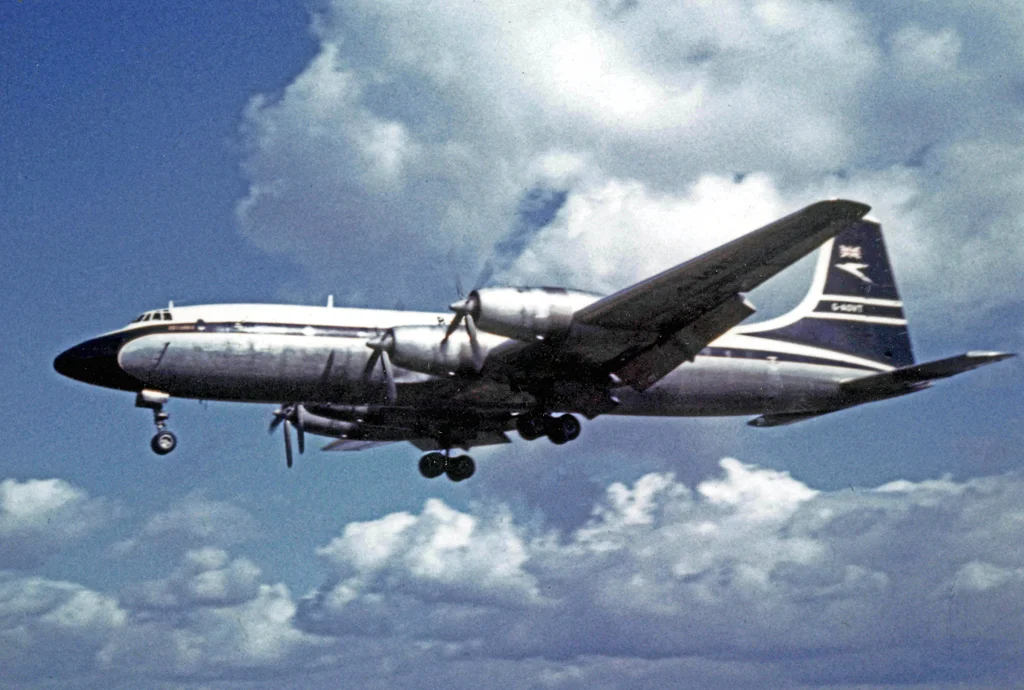

1958 BOAC Bristol Britannia Crash
On the morning of 24 December 1958, much of southern England disappeared. Fog had settled across the airfields, runways and motorways from the Channel to the Cotswolds, the kind of dense Christmas Eve fog that grounded most aircraft and stranded most travellers. G-AOVD, a BOAC Bristol Britannia 312 with five crew and seven passengers aboard, lifted off from Heathrow at 10:10 on a test flight to renew its certificate of airworthiness. None of the twelve people on board would reach home for Christmas. Two of the crew and all seven passengers were killed when the aircraft flew into a ploughed field near Christchurch in Dorset, less than two minutes after the crew thought they were beginning a routine descent.
What the Crew Believed
The Britannia was a long-range turboprop, the pride of British aviation, capable of crossing oceans and continents. Its altimeter was a three-handed design: small hand for ten thousands of feet, slightly larger for thousands, large for hundreds. Reading it correctly required concentration. Misreading it by ten thousand feet was, the investigators would later conclude, terrifyingly easy. At about 11:55 am, having completed the airworthiness checks, the crew requested clearance to descend from 12,000 feet to 3,000 feet for an approach to Hurn Airport, a likely diversion from fogged-in Heathrow. The captain and first officer believed they were beginning the descent from 11,500 feet. They were at 1,500 feet. The fog below them looked exactly like the cloud layer they thought they were flying above.
11:58 am
Three minutes after the descent began, Hurn Airport lost contact with the aircraft. G-AOVD crossed a road in the parishes north of the airport, brought down telephone lines and trees, and came to rest in a ploughed field. The fog was so thick that nobody saw it happen. Residents in Winkton, Sopley and Bransgore heard the sound of a low-flying aircraft and then a crash, and began telephoning the emergency services. The air raid siren at Burley summoned the volunteer firemen. The initial report from Hurn had the wrong area; only when the village reports came in did the search swing toward Winkton. The first appliance to find the wreckage spotted broken telephone poles dragged into a field, then followed the debris on foot. The rescuers heard the injured co-pilot before they could see him in the fog.
The Rescue, by Lantern and Foot
Christchurch in 1958 had no four-wheel-drive fire engine. The crew had to coax an eight-ton appliance across a ploughed field already churned by rescue activity and aviation fuel, which delayed them. A second appliance sent to Sopley could not be radioed because it carried no radio; it found its way only by encountering other vehicles heading toward the crash. The crew chief at Winkton sent a runner to the local public house to fix a rendezvous, since pubs were one of the few places with a working telephone. Searching on foot through the fog, the firemen reached the remains of the cockpit and began cutting the co-pilot free. As more emergency services arrived they fanned out across the field. Two more survivors were eventually found. Three people, out of twelve, lived. Nine did not.
The Altimeter
The investigation concluded that the aircraft and its systems had been functioning normally. The crash was classified as controlled flight into terrain: a perfectly serviceable airliner flown into the ground by pilots who believed they were ten thousand feet higher. The three-handed altimeter had a known weakness, and this was not the first time a crew had read one wrong. The official response was immediate. Within nine months, the Ministry of Transport had directed that all three-pointer altimeters in British registered aircraft operating above 20,000 feet be replaced before September 1959. An interim safety warning was issued describing the risk of misreading the instruments, particularly when the crew's scan had been interrupted during a climb or descent. Altimeters were soon required to display a cross-hatch or chequered flag whenever the indicated altitude dropped below 1,500 feet, a visual cue meant to make the kind of error that killed G-AOVD's passengers obvious at a glance.
What Christchurch Changed
The lessons taken from the night in the ploughed field were not only about cockpit instruments. All fire appliances in Christchurch would be fitted with radios from then on, ending the kind of silent searching that had hampered the rescue. When four-wheel-drive fire appliances became available, Christchurch was among the first rural stations to be allocated one. The Bristol Britannia, sometimes called the Whispering Giant for the quiet of its turboprops, continued to fly across the world for years afterwards. But the altimeter that lived in its cockpit was already history by the autumn of 1959, and the families of the nine who died on Christmas Eve had reshaped, in a small but permanent way, how every airliner over Britain would tell its pilots how far above the ground they were.
From the Air
The crash site lies at 50.77 degrees North, 1.77 degrees West, in the fields between Winkton, Sopley and Bransgore north of Christchurch, Dorset. Bournemouth Airport (EGHH, formerly Hurn) is the closest field, roughly 3 nm south. Southampton (EGHI) lies 18 nm east. The area is low-lying coastal heath and farmland; fog like that of December 1958 still settles here on cold winter mornings.
Nearby Stories
- Maiden Castle, Dorset 2.1 km away
- Battle of Portland 6.1 km away
- Carisbrooke Castle 7.1 km away
- Winchester Castle 11 km away
- Wardour Castle 13 km away
- Fleet Air Arm Museum 14 km away
- HMS Warrior (1917) 22 km away
- D-Day: The Longest Day 157 km away