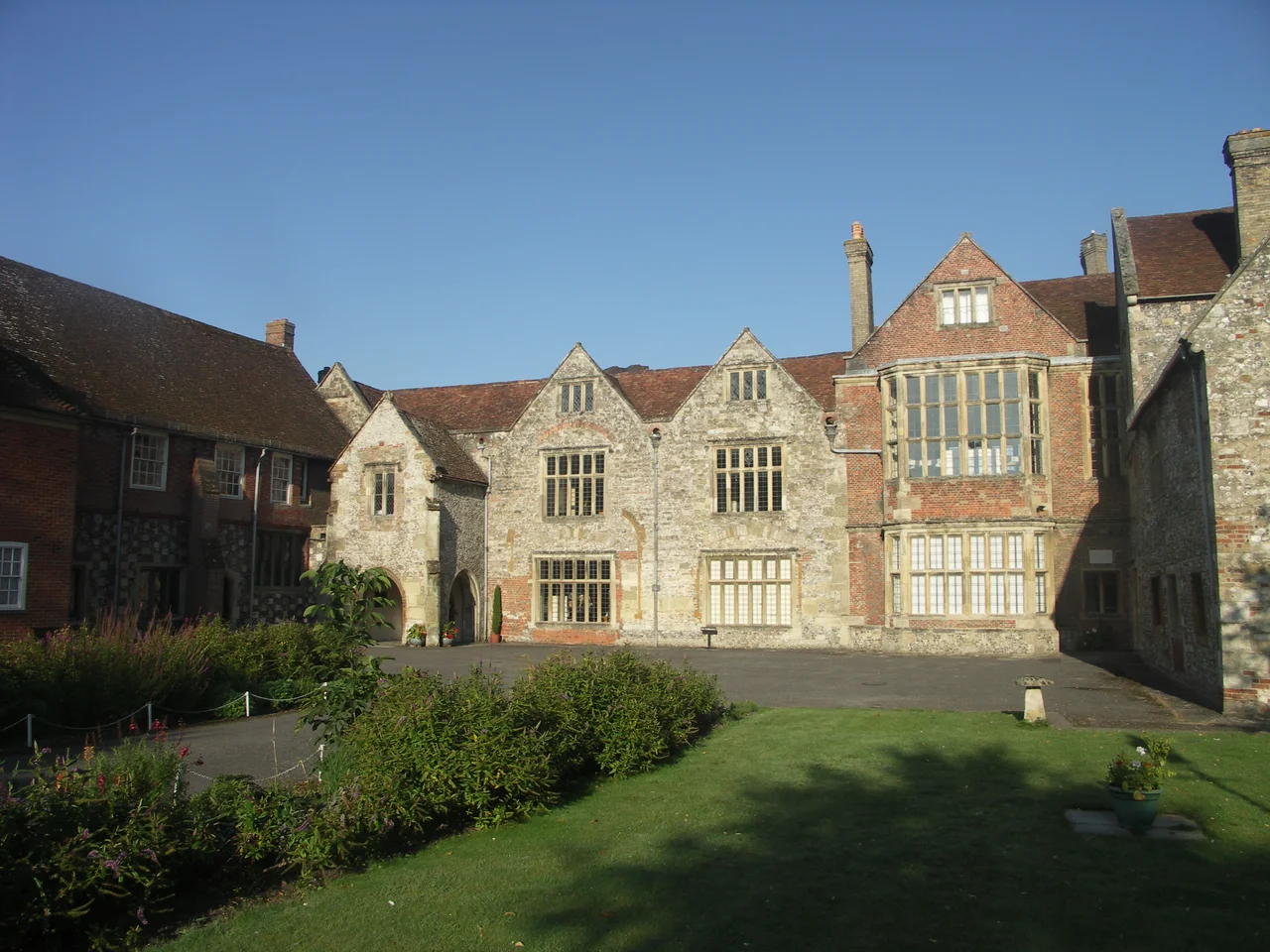

The Salisbury Museum
For at least eighty years, a dirty grey stone sat by the front door of Lake House at Wilsford-cum-Lake, a few miles north of Salisbury. People wiped their boots on it. Children sat on it. Sting and Trudie Styler, who eventually bought the house, walked past it daily. Nobody knew it was a meteorite, possibly the largest ever to fall on the British Isles, almost certainly placed in a Bronze Age burial mound, then dug out by a Victorian antiquarian and used as a doorstop. That stone now sits, properly labelled, in The Salisbury Museum across from the cathedral.
The King's House
The museum lives inside The King's House, a Grade I listed building in Salisbury Cathedral Close. King James I was entertained here in 1610 and again in 1613, which is how the building got its name. Three storeys of mullioned windows and ornate plaster ceilings face directly across the lawn to the west front of Salisbury Cathedral, so visitors arrive having already walked through one of England's most famous medieval cityscapes. Inside, an oak-balustraded staircase climbs past a window bearing the arms of Henry Frederick, Prince of Wales, James I's eldest son, who never lived to be king. The museum itself is older than this address. It was founded in 1860 on St Ann Street by Dr Richard Fowler, FRS, and only moved to The King's House in 1981, swapping a townhouse for a palace.
The doorstop from space
Professor Colin Pillinger, the planetary scientist best known for the Beagle 2 Mars lander, had been studying a small meteorite from the Danebury Iron Age hill fort in Hampshire. He suspected it might be related to the stone at Lake House, recently confirmed by the Natural History Museum to be an iron-rich meteorite weighing roughly 90 kilograms. The two turned out to be unrelated, but Pillinger kept going. The Lake House meteorite, he concluded, had fallen around 30,000 years ago and been preserved by ice age cold. Sometime in the Stone or Bronze Age, prehistoric people pulled it from the ground and built it into a burial mound. In the 19th century the Victorian antiquarian Edward Duke, who excavated barrows for sport, almost certainly unearthed it. A photograph from the 1880s shows it sitting on the doorstep when the brewer Joseph Lovibond, twice Mayor of Salisbury, owned the house. The stone went on public display on 10 September 2012.
The Wessex Gallery
In 2012 the Heritage Lottery Fund awarded the museum just under 1.8 million pounds to build a new Archaeology of Wessex gallery. It opened in 2014, telling the story of Salisbury Plain from the first hunters at Blick Mead through the Norman Conquest. The star object is the Amesbury Archer, a man buried around 2300 BCE about three miles from Stonehenge, whose grave goods made him the wealthiest known burial of his era in Britain. Isotope analysis of his teeth showed he had grown up in the Alps. The Pitt Rivers Wessex Collection sits alongside him, along with the Wardour Hoard of more than a hundred late Bronze Age and early Iron Age tools, found by a metal detectorist near Wardour Castle in 2011.
Painters who came to look
Salisbury has been pulling artists south for two hundred years. The summer exhibitions in the upstairs galleries chronicle the parade. In 2011, on the bicentenary of John Constable's first visit, the museum gathered more than forty of his Salisbury oils, watercolours and drawings, including the famous Salisbury Cathedral from the Meadows. In 2015 came the watercolours J.M.W. Turner made in Wessex as a young man, curated by Ian Warrell. The 2017 show, Ancient Landscapes, was the most pointed of all: William Blake, Barbara Hepworth, Paul Nash, each responding to the same flat grass and circle of stones a few miles up the road. Down a different staircase, the museum's Rex Whistler archive, more than a thousand items rescued by a 350,000 pound National Heritage Memorial Fund grant in 2013, fills out the picture of a regional artistic capital that punches well above its weight.
From the Air
Coordinates 51.0643 N, 1.80014 W. The museum sits inside Salisbury Cathedral Close, directly across the lawn from the west front of Salisbury Cathedral, whose 404-foot spire is the tallest in Britain and one of the most recognizable landmarks on the southern English skyline. From altitude, look for the cathedral spire on the western edge of Salisbury, with the Close walls forming a green square around it. The River Avon curves to the west. Nearest airports: Bournemouth (EGHH) is 24 nm south; Boscombe Down (EGDM) is 8 nm northeast; Old Sarum (EGLS), a grass strip, lies 2 nm north.
Nearby Stories
- Winchester Castle 6 km away
- Newbury, Berkshire 9.9 km away
- 1988 Poole Explosion 10 km away
- Norris Castle 10 km away
- West Kennet Long Barrow 11 km away
- Maiden Castle, Dorset 12 km away
- Glastonbury Festival 13 km away
- Bristol Temple Meads 16 km away