
Charterhouse School
In May 1611, a wealthy bachelor named Thomas Sutton bought the London Charterhouse - the dissolved Carthusian monastery near Smithfield - and announced he would turn it into a charitable foundation. He had made his money on coal seams discovered near Newcastle. Seven months later he was dead, his will under attack from would-be heirs. The will held. By the next year the foundation was open: eighty old gentlemen given a home, forty boys given an education. Four centuries later, those forty boys have multiplied into a school of more than a thousand on a Surrey hill - and football, as the world plays it, came from those cloisters.
Sutton's Bequest
Thomas Sutton was born in Knaith, Lincolnshire, in 1532. He leased two estates near Newcastle upon Tyne and discovered coal underneath them - a windfall that made him one of the richest commoners in England. He moved to London, prospered further in trade, and in May 1611 acquired the old London Charterhouse from the Earl of Suffolk. He endowed it as the Hospital of King James, naming it for the new Stuart sovereign, and in his will - executed only seven months later, on 12 December 1611 - he laid out the rules. Eighty male pensioners would be sheltered there: gentlemen by descent in poverty, soldiers who had borne arms by land or sea, merchants ruined by piracy or shipwreck, or servants to the King or Queen. Alongside them, forty boys would be educated. The will was contested in court and upheld. Among the school's later notable physicians was Henry Levett, an Oxford graduate who joined in 1712, was widely esteemed for his medical writings - including an early tract on the treatment of smallpox - and was buried in Charterhouse Chapel.
Move to the Hill
By the 1860s Sutton's foundation had outgrown the city. The Clarendon Commission of 1864, set up to investigate the nine great English public schools, reported on conditions, and in 1872 headmaster William Haig Brown moved the school out of Smithfield to a sixty-eight-acre site outside Godalming, on a wooded hill. Philip Charles Hardwick designed the new main buildings; Lucas Brothers, who had also built the Royal Albert Hall and Covent Garden Market, raised them. The first three boarding houses opened: Saunderites (pronounced sarnderites, not sornderites), named after Dr Saunders, headmaster from 1832 to 1853 and whose house it once was; Verites; and Gownboys, the scholars' house, where the boys had once worn gowns and been treated as senior to the rest. The names of the housemasters became the names of the houses. As more houses were built along what is now Charterhouse Hill - Weekites, Daviesites, Girdlestoneites, the last still nicknamed Duckites after the unusual walk of a housemaster who retired more than a century ago - the school grew, and its peculiar internal vocabulary, Lingua Carthusiana, grew with it.
How Football Got Its Pass
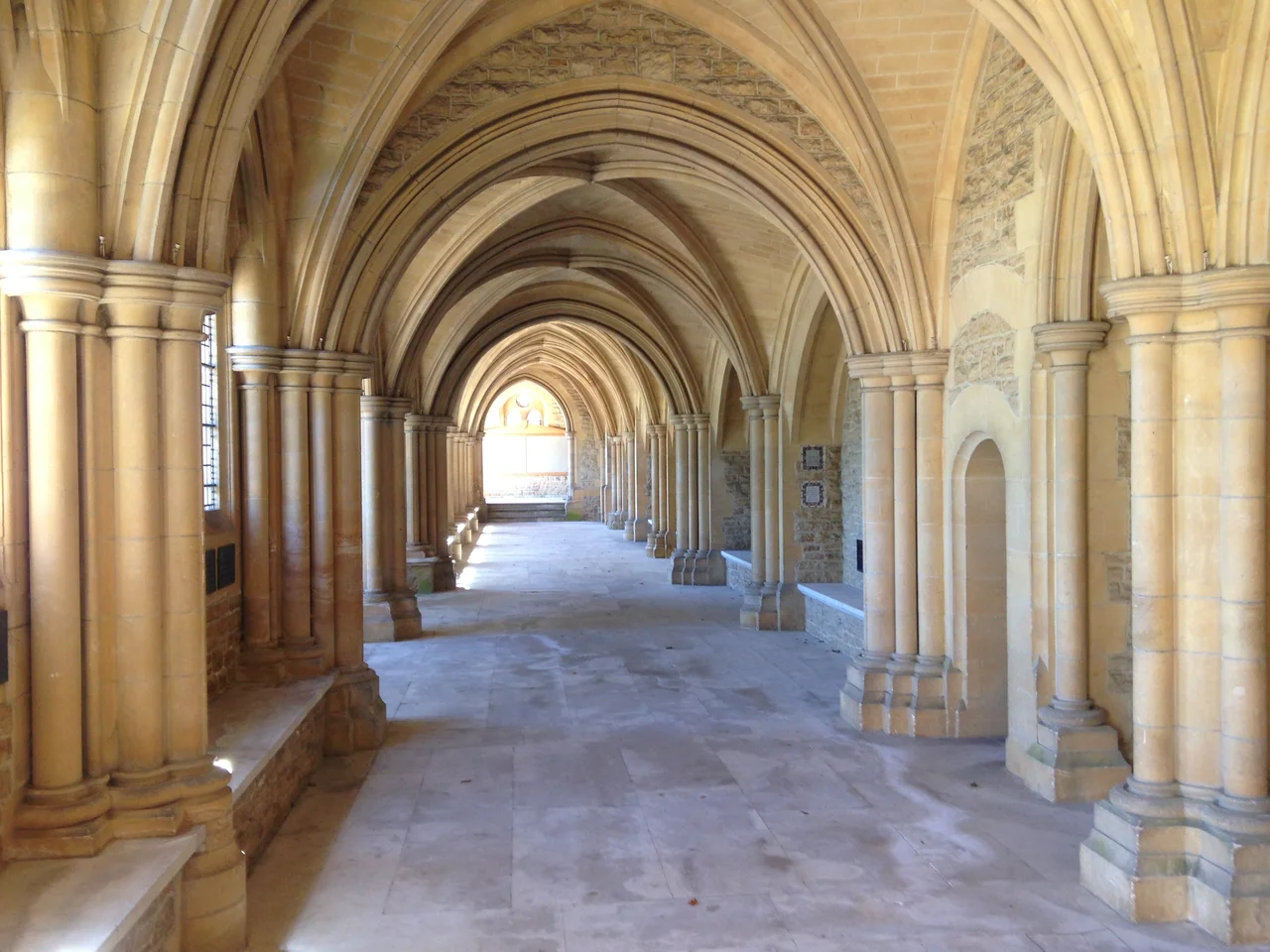
In the 1840s, Charterhouse boys had nowhere to play football except the cloisters of the old London buildings. So did the boys at Westminster. Cloister football could not be the rough, handling game developing at Rugby and elsewhere; it had to be controlled, played close to the ground, dependent on neat footwork. When the rules of association football were drawn up in the 1860s, Charterhouse and Westminster representatives argued for a passing game, in particular for a rule that allowed forward passes - what was called "passing on." Eton, Shrewsbury, and Harrow favoured a dribbling game with a tight off-side rule. Dingley Dell, the most active non-school team in pre-FA London, played Charterhouse eight times between February 1860 and February 1863. By 1867 the Football Association had chosen the Charterhouse and Westminster approach, adopting a looser off-side rule that permitted forward passing. The modern game - the one that runs through the boots of Lionel Messi and the lungs of Liverpool fans - was a direct consequence of two schools whose pupils had been confined to playing in stone corridors.
Memorial Stone and Telephone Box
The First World War took almost seven hundred Old Carthusians. Sir Giles Gilbert Scott - the architect best known for designing the red telephone box - was commissioned to build a new memorial chapel, consecrated in 1927, that remains the largest war memorial in England. Around three hundred and fifty further names have been added since, for the Second World War and other conflicts. The buildings have a habit of doubling as something else: the chapel and South African Cloisters played the House of Commons in seasons four and five of The Crown, and Peterloo used the chapel as the House of Lords. Foyle's War, The Mystery of Edwin Drood, An Ideal Husband, Jupiter Ascending, and Vampire Academy have all filmed at Charterhouse. The grounds now run to over two hundred acres and include the Halford Hewitt Golf Course, the Sir Greville Spratt athletics track, and a herbarium - designated GOD in the international Index Herbariorum - whose collections are now being digitised at UC Berkeley.
An Honest Reckoning
Excellence and discomfort have lived side by side here. Roy Hattersley, who visited for the Guardian in 2007, called the school "academically and pastorally, near to beyond criticism" while also concluding that his ambition to abolish private education in the 1970s remained "totally justified." In 2018 Cathy Newman, who attended Charterhouse on a scholarship, said she had been humiliated and sexually harassed during her time there; other former pupils described initiation rituals and groping incidents. Rebecca Willis added that racism had driven some Asian children to leave. The school has since asked alumni to share their concerns. A physics teacher convicted in 2015 of possessing extreme pornography was barred from teaching for life by a 2017 prohibition order, after a misconduct panel found he had had a sexual relationship with a former pupil. The fees themselves attract their own scrutiny - £48,038 a year for full boarders in 2025-26 - and in 2005 the school was among fifty independent schools fined for an information-sharing arrangement that, after a recent change in the law, had become an illegal cartel.
Carthusians, New and Old
Charterhouse began accepting girls into the sixth form in 1971, then announced in 2017 that it would go fully co-educational from age thirteen. The first Year 9 girls arrived in September 2021. By September 2023 there were girls in every year group. Weekites, once a boys' house, completed its transition to fully girls' in 2025, and Girdlestoneites - or Duckites - went co-educational in 2023. Two new boarding houses were opened ahead of the 2021-22 academic year by Jeremy Hunt, a former pupil. Former pupils are still called Old Carthusians; current pupils, Carthusians, after the Carthusian monks whose dissolved London monastery Thomas Sutton bought four centuries ago. The forty boys he educated have become a school where Lord Liverpool, three Victoria Cross holders, and generations of footballers, soldiers, and politicians have shaped, for better and for worse, the country around them.
From the Air
Charterhouse School sits on a hill above Godalming at 51.197°N, 0.622°W. Visible from low altitude on approach to Farnborough (EGLF) or Fairoaks (EGTF). The chapel's Gilbert Scott spire is the most obvious landmark; the school's two hundred acres of grounds, including the cricket ground and golf course, give it a distinctive footprint visible from the air. Godalming town and the River Wey lie immediately to the south.
Nearby Stories
- Silvertown Tunnel 0.6 km away
- Uxbridge 5.3 km away
- Amberley Museum & Heritage Centre 8.8 km away
- Hever Castle 9.9 km away
- Russian Memorial, Lewes 11 km away
- Portchester Castle 16 km away
- Ufton Nervet rail crash 20 km away
- Abingdon-on-Thames 24 km away