.jpg)
Silvertown Tunnel
The tunnel boring machine had a name: Jill, after Jill Viner, the first female bus driver in London. She started cutting south from Silvertown towards Greenwich in September 2022, an 11.87-metre cutting head grinding through the silt and gravel under the Thames at a careful, methodical pace. Two and a half years later, on 7 April 2025, the Silvertown Tunnel opened to traffic. There was no opening ceremony. Transport for London simply switched on the toll gantries at 6 am and started charging. Within hours the protests had begun.
Why East London Needed Another Tunnel
The arithmetic was simple. Downstream of Tower Bridge there were four road crossings of the Thames - the Rotherhithe Tunnel from 1908, the two bores of the Blackwall Tunnel from 1897 and 1967, and the Dartford Crossing some 16 miles further east. The Blackwall northbound tunnel had a 4-metre height restriction that turned away every lorry above it. The Rotherhithe had similar problems. The Dartford was permanently congested. The result was that east London's daily traffic squeezed through a Victorian tunnel and its 1960s replacement, with delays that became routine and pollution that became chronic. Since the 1960s, every proposed solution had failed - the Thames Gateway Bridge, cancelled by Boris Johnson in 2008, was the most recent in a long line. The Silvertown Tunnel was supposed to break the cycle: a 1.4-kilometre twin-bore route from west Silvertown on the north shore to a portal beside the existing Blackwall Tunnel on the Greenwich Peninsula, with dedicated lanes for buses and lorries, designated as the A1026.
The Cost of Convenience
The price tag started at £1 billion in the 2015 consultation. By March 2020 it had climbed to £1.2 billion. In 2021 a Private Finance Initiative of £2.2 billion was secured to cover construction and 25 years of maintenance - after which the tunnel would transfer to TfL at zero cost. The Riverlinx consortium - Cintra, BAM, Macquarie Capital and SK E&C - won the design-build-finance-maintain contract in November 2019. Construction began in March 2021. Jill, the Herrenknecht earth pressure balance machine, finished the southbound bore in February 2023 and the northbound in September the same year. The contractors completed ahead of schedule. Then came the question that would shape everything else: who pays?
Tolls That Bought a Backlash
Tolls began the morning the tunnel opened. Cars: £4. Motorcycles: £3.50. Larger vehicles: £8.50. Same rates applied to the previously free Blackwall Tunnel from the same day, which solved one political problem - why charge for the new tunnel but not the old one - and created several others. Charges run from 6 am to 10 pm; the tunnels are free overnight. Taxis, Blue Badge holders, wheelchair-accessible vehicles, and zero-emission private hire cars are exempt. Discounts went to low-income drivers in twelve boroughs and small businesses in Tower Hamlets, Newham and Greenwich. Within weeks, the nearby Woolwich Free Ferry was carrying around 1,800 extra vehicles a day, as drivers re-routed to avoid the charge. Critics had warned this would happen. Green Party councillor Caroline Russell had argued for years that the tolling structure would lock future mayors into keeping traffic levels high enough to service the debt - the opposite of the carbon-neutral 2030 vision that Greater London Authority documents kept describing.
The Mass Trespass
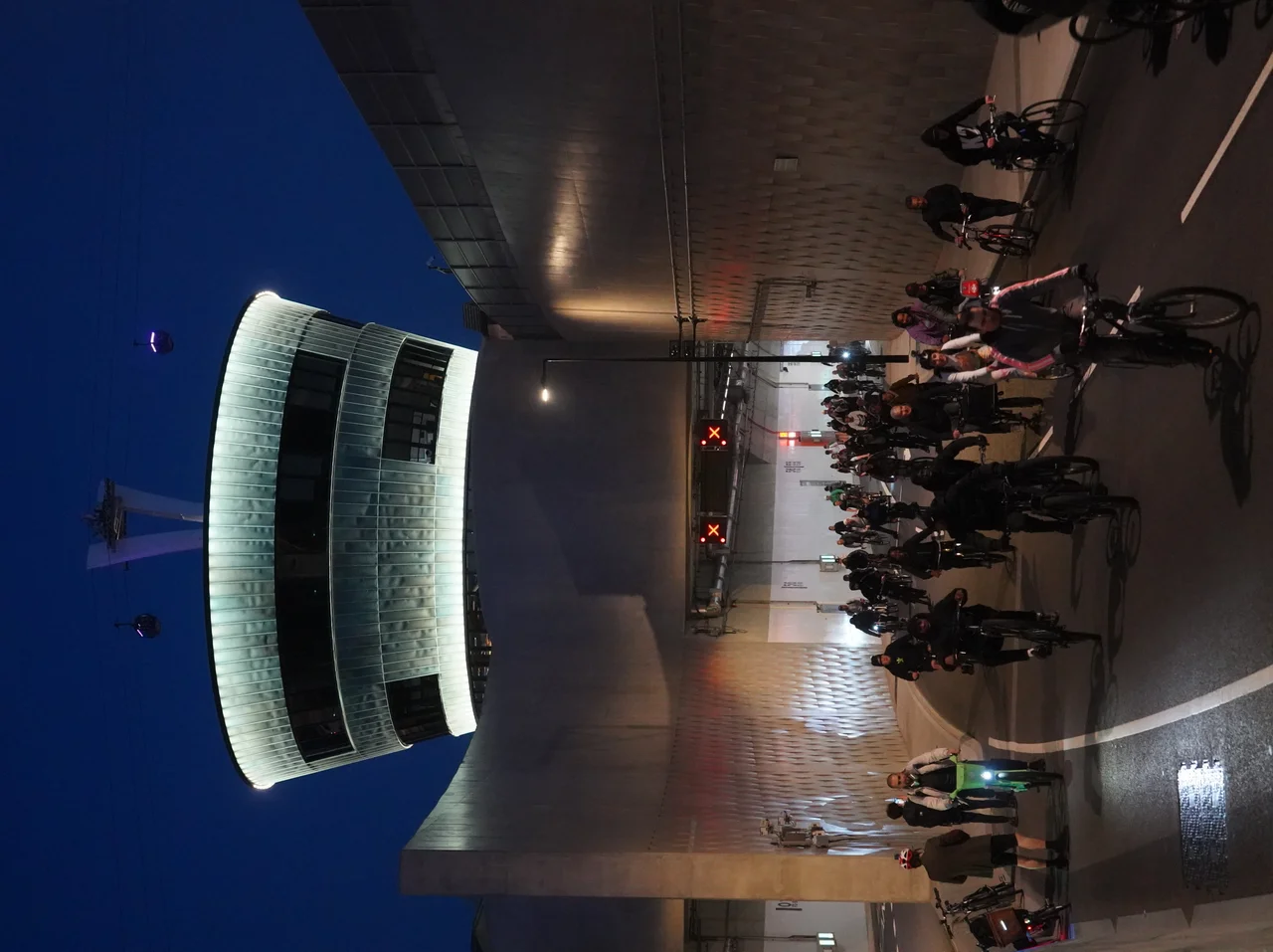
On 25 April 2025, eighteen days after the tunnel opened, approximately 1,000 cyclists rode into the southbound bore as part of a Critical Mass ride. The tunnel has no pedestrian or cycle access - a shuttle bus service for cyclists is provided instead, which campaigners regarded as a deliberate insult to active travel. The ride lasted about ten minutes. TfL kept the tunnel closed for over an hour, citing safety. The trespass made every national news bulletin. It also crystallised the long argument: a £2 billion road tunnel built for cars in a decade when London was supposed to be moving away from cars; a project championed by both Boris Johnson (Conservative, who cancelled the bridge that could have served pedestrians) and Sadiq Khan (Labour, who pushed the tunnel through despite his own party's environmental backbench); a tunnel that opened the same week the Climate Change Committee published another warning about urban transport emissions.
Opposition Across the Spectrum
Few infrastructure projects unite politicians the way the Silvertown Tunnel did. Andrew Boff and Zac Goldsmith opposed it from the Conservative side. Siân Berry, Jonathan Bartley and Caroline Russell from the Greens. Lyn Brown, John McDonnell, Rokhsana Fiaz and Matthew Pennycook from Labour. Ed Davey and Munira Wilson from the Liberal Democrats. The opposition coalition argued the tunnel would generate more traffic, not relieve it - a classic finding of transport economics that funded roads tend to fill themselves up. Friends of the Earth lobbied Tower Hamlets Council to reject the planning permission. Extinction Rebellion protesters locked themselves to a drilling rig in July 2020. Fifty-two academics and campaigners wrote a joint open letter to the transport secretary and the mayor in April 2021 asking for an emergency review. The tunnel was built anyway. It now carries hundreds of thousands of vehicles a month. Whether London's air, its climate plan, and its democratic process are better or worse for it is a question that will be asked at every mayoral election for the next twenty-five years - which is, coincidentally, exactly the length of the toll concession.
From the Air
The Silvertown Tunnel runs beneath the Thames at 51.50°N, 0.01°E, connecting west Silvertown on the north bank to the Greenwich Peninsula on the south. The portals are highly visible from the air - the dRMM-designed control buildings are striking modern structures, and the northern entrance sits beside Royal Victoria Dock with City Hall just to the north. The O2 Arena is immediately south of the Greenwich portal. London City Airport (EGLC) is 1 mile to the east. Best viewed from 1,500-3,000 feet, ideally on approach or departure from City.
Nearby Stories
- Waytemore Castle 2 km away
- Prittlewell Royal Anglo-Saxon Burial 4.2 km away
- Sevenoaks 5.6 km away
- Central line (London Underground) 6.4 km away
- River Lea 9.7 km away
- Surrey 11 km away
- Mercury Theatre, Colchester 14 km away
- Faversham Munitions Explosion Memorial 14 km away