.jpg)
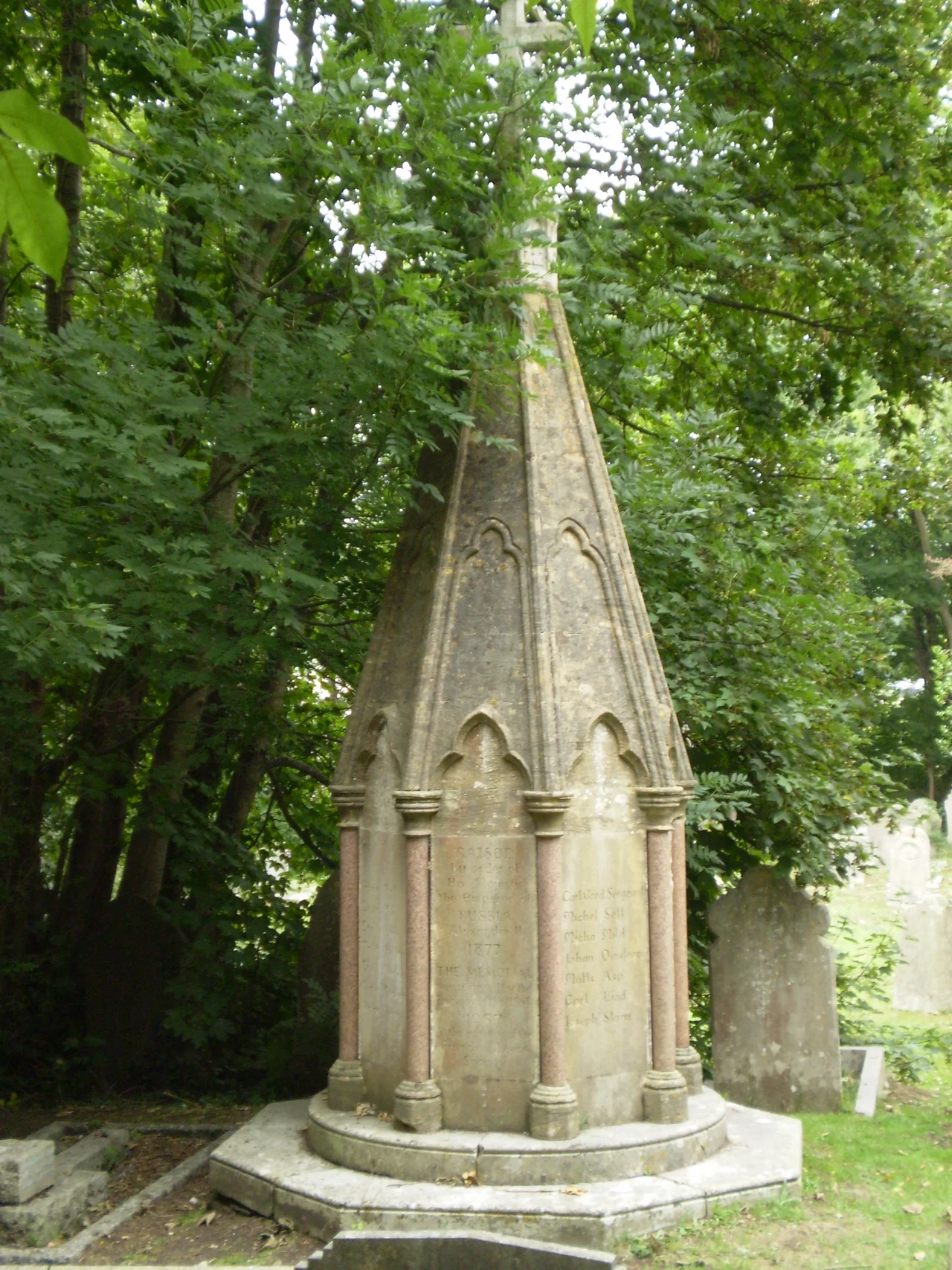
Russian Memorial, Lewes
Their names are difficult to read now, weathered into the sandstone of an obelisk standing in a churchyard a few hundred yards from where they died. Abraham Lindfors. Erik Kivi. Matts Mort. Twenty-eight names in all, mostly Finnish, mostly young. They were Russian soldiers in technical terms - the Grand Duchy of Finland was then part of the Russian Empire - but they were Finns by birth, by language and probably by allegiance, conscripted from villages around the Baltic into a regiment that found itself defending an island fortress against the British Royal Navy in the summer of 1854. They were captured, brought halfway across Europe, and died in an English town from tuberculosis and the damp of an old county gaol. In 1877 the Tsar paid for the obelisk that still marks the place.
How Finns Came to Lewes
Britain declared war on Russia in March 1854. The Crimea was the main theatre, but a second front opened in the Baltic, where the Royal Navy was alarmed by the size of the Russian Baltic Fleet. In June a naval attack on the great Russian fortress of Bomarsund, in the Åland Islands off the southwest Finnish coast, was repulsed. A second assault with French support succeeded in August. The fortress was levelled and the garrison taken prisoner. The officers were Russian. The men - some 340 of them, members of the Fusilier Grenadiers - were Finnish conscripts. They were shipped to England, and the soldiers were locked up in the old County Gaol at Lewes, which had been pressed back into service as a naval prison. The officers, having given their parole, were billeted with local families.
An Awkward Hospitality
The Russian and Finnish officers were a curiosity for Lewes society. "Several of the leading gentlemen of the county" called on them, left their cards, took them riding on the South Downs; the officers were "delighted with the salubrity of the air." Their freedom of movement was not without cost - the local newspaper reported that they were "frequently subjected to annoyance, insult, and even personal violence from the low characters who loiter in the streets," though local magistrates dealt severely with such offences. The enlisted men, locked in the prison, were set up with a workshop where they could make wooden toys to sell to the public for pocket money. Many of those toys ended up in Lewes nurseries; some no doubt still survive in Sussex attics. Not everyone approved of this hospitality. A letter to The Times spoke of "general disgust" at the courtesies being shown to enemy combatants. The men in the gaol meanwhile pushed back against the conditions, and after a group refused exercise unless three comrades in solitary confinement were released, a protest escalated into armed rebellion; twenty-five of the ringleaders were transferred to a prison ship at Sheerness.
Twenty-Eight Deaths
Tuberculosis took most of them. The damp old gaol, the close confinement, the unfamiliar food and the English winter combined to break men who had grown up in fishing villages and forests around the Gulf of Bothnia. By September 1855 fifteen prisoners had died. By the time peace came in 1856 the total stood at twenty-eight. They were buried in the churchyard of St John sub Castro, on a slope below the medieval town walls, in graves that quickly went unmarked. When the surviving officers and men were finally repatriated, the Lewes townspeople turned out to see them go. The parting, by all accounts, was "genuinely sorrowful." The commanding officer wrote a public letter of thanks to the Senior Constable expressing the prisoners' gratitude for "the hospitality of many, and urbane treatment from all," and for their farewell after a civic ceremony the streets filled with people watching them leave for the boats.
The Tsar's Obelisk
Twenty-one years later, in 1877, Tsar Alexander II of Russia commissioned a memorial to the twenty-eight men buried at Lewes. The design was by Philip Currey and the stonework by John Strong, a local mason, executed in a neo-Gothic style suited to the parish churchyard setting. It rose as a tapered sandstone obelisk on a stepped base, the twenty-eight names carved on its faces. Alexander II - the Tsar who emancipated the Russian serfs in 1861, who would be assassinated by a revolutionary's bomb in 1881 - here made an unusual diplomatic gesture: a Russian emperor publicly honouring his soldiers who had died as prisoners in a British town. The obelisk was listed at Grade II by English Heritage on 29 October 1985, recognised as a small but significant monument among the 1,162 Grade II listed buildings of the Lewes district.
A Song Sung in Lewes
There is a popular Finnish folk song called Oolannin sota - the Crimean War song - which is still sung in Finland today. It evolved from an earlier ballad called Ålandin sota laulu (the Åland war song), and the words tell the story of Bomarsund, of capture, of imprisonment in faraway Lewes. The lyrics are thought to have been written by one of the Finnish prisoners during his time in the Sussex gaol. The song carries his memory home along a route his body never travelled. In 2007 the writer Stephen Plaice and the composer Orlando Gough used the story as the basis for an opera, The Finnish Prisoner, which incorporates a setting of Oolannin sota in its score. Twenty-eight men lie under the grass of an English churchyard, in graves now centuries beyond any direct memory. The names are still there on the obelisk, the song still sung in Finland, the diplomatic ledger between a Tsar and a Sussex town settled in stone.
From the Air
Located at 50.88°N, 0.01°E, in the churchyard of St John sub Castro, on the northern slope of Lewes just below the old town walls. The church and its small graveyard sit in a residential quarter east of Lewes Castle. The obelisk is a tapered sandstone monument, modest in scale but visible against the dark yew trees of the churchyard. Nearest airfield is Shoreham/Brighton City (EGKA) about 24 km west. Best viewed from the ground; from the air, look for the cluster of grey-roofed houses on the north slope of Lewes just north of the railway viaduct.
Nearby Stories
- Chiddingstone Castle 4.4 km away
- Kent 4.6 km away
- Camber Castle 5.4 km away
- Surrey 13 km away
- Amberley Museum & Heritage Centre 13 km away
- Swanage Lifeboat Station 113 km away
- Le Paradis Massacre 137 km away
- Wellington Clock Tower 150 km away