
2021 Salisbury Rail Crash
On the evening of 31 October 2021, a South Western Railway service approaching Salisbury Tunnel Junction failed to stop at a red signal. The wheels were sliding on a thin film of crushed autumn leaves baked onto the railhead - a recurring phenomenon British railwaymen call 'low railhead adhesion.' The driver applied service braking, then full emergency braking; the train's automatic protection system added its own emergency demand. Nothing made enough difference. Inside Salisbury Tunnel, just over a mile northeast of the station, the SWR service collided with the rear of a Great Western Railway train. Thirteen people, including one of the drivers, were taken to hospital. It was the first collision between two moving in-service passenger trains in Britain since the Ladbroke Grove crash on 5 October 1999.
Two Lines, One Junction
Salisbury Tunnel Junction is where the Wessex Main Line, coming up from Southampton, meets the West of England Main Line running between London Waterloo and the West Country. Both routes funnel into a single bore before reaching Salisbury station. The 17:08 GWR service (1F30) was a four-carriage train made up of two Class 158 units, 158762 and 158763, threading through the junction at around 20 mph. The 17:20 SWR service (1L53) was a single three-carriage Class 159, unit 159102, approaching from the London direction on the converging line. Its driver had passed a double-yellow signal at 90 mph on a falling gradient of 1 in 169, then shut off power. Brakes were applied a mile past the signal. The wheels began to slide almost immediately.
Leaves on the Line
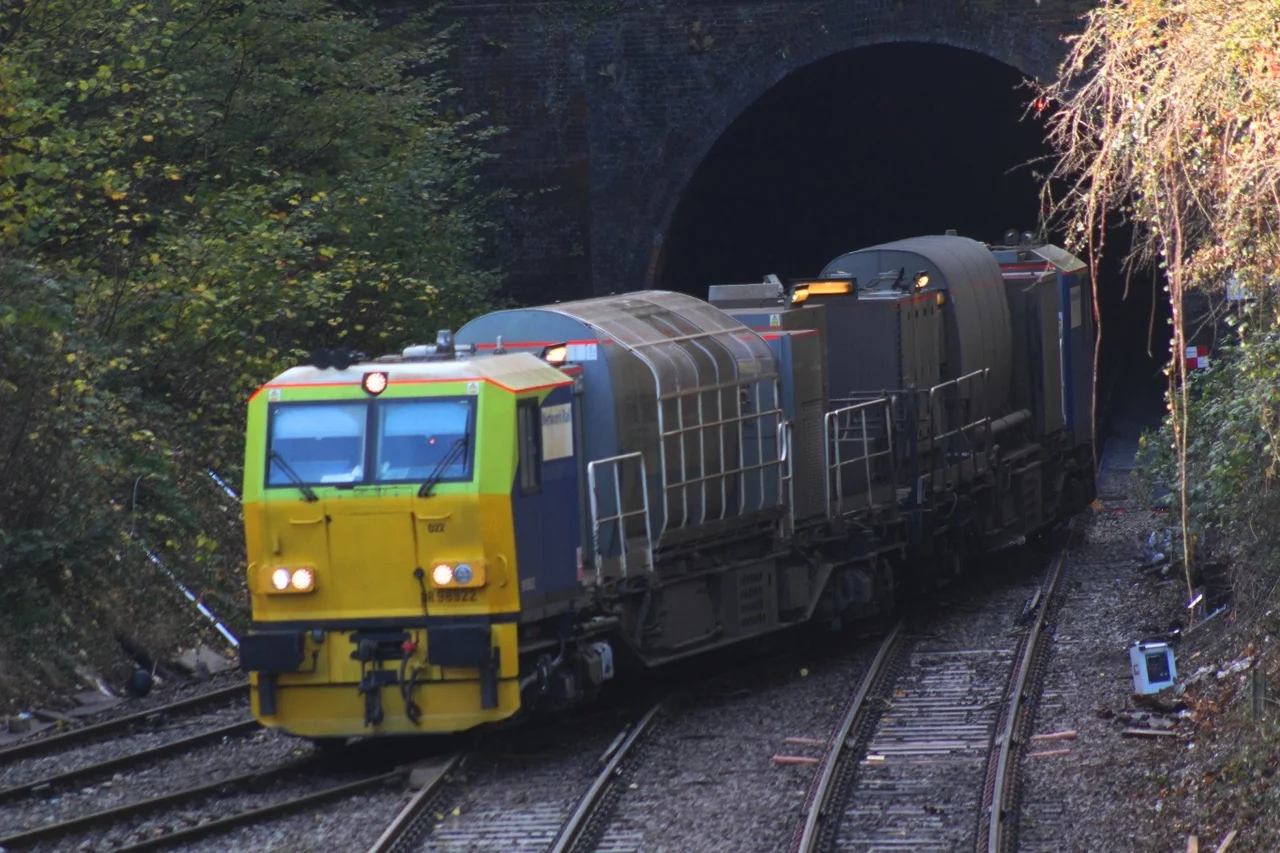
British railways have wrestled with autumn leaf mulch for decades. Crushed leaves form a black, slick residue under steel wheels - effectively microscopic lubrication on a surface that depends on friction to brake. The standard countermeasure is a Rail Head Treatment Train, which sprays high-pressure water and applies a sand-based traction gel. The West of England Line had not had one over it since 29 October, two days before the crash, although one had been scheduled to run before the accident. The On Train Data Recorder later showed the SWR driver had made an emergency brake application twelve seconds after the initial brake demand; the Train Protection and Warning System, sensing the train was over 34.5 mph approaching a red signal, demanded its own emergency stop - which the driver was already attempting. The train was still travelling at 52 mph when it struck the GWR service.
The Response and the Recovery
Wiltshire Police, the South Western Ambulance Service, and Dorset and Wiltshire Fire and Rescue all converged on the tunnel. Dorset and Wiltshire declared a major incident. The National Police Air Service and HM Coastguard sent helicopters. Of the 197 passengers and five crew on board the two trains, fourteen were taken to hospital. The SWR driver was the most seriously hurt and was flown to Southampton General Hospital with what BBC News described as 'life-changing' injuries. Of the others taken to hospital, three were later discharged after admission and nine were treated and sent home. Recovery work was difficult - the lead unit of the GWR train, 158762, had to be removed by rail on 4 November; one of the remaining carriages was lifted out by crane. Class 59 freight locomotive 59003 was used to drag the rest out of the tunnel. The A30 London Road, closed throughout, reopened on 9 November. The line reopened on 16 November, after heavy track refurbishment at the junction.
Lessons in a Confused News Cycle
Some of the early reporting got the facts wrong - badly. Rail magazine editor Nigel Harris later observed that 'the only facts in the story were the location and services involved,' and rail historian Christian Wolmar singled out a senior Network Rail figure for going on BBC Radio 4 the morning after the crash without correcting circulating errors. The Rail Accident Investigation Branch, by contrast, was praised for publishing an initial bulletin only three days after the accident. The final RAIB interim report laid out the sequence in plain terms: the train approached SY29R at 90 mph, the brakes were applied, the wheels slid, the TPWS demanded more, and the collision happened at between 52 mph and the speed inferred from the data recorder. The 1906 Salisbury rail crash, a curve taken at excessive speed, killed 28; the 2024 Talerddig collision in Wales involved low rail adhesion again. The work of preventing the next one is continuous.
From the Air
Salisbury Tunnel Junction sits at 51.08 N, 1.79 W, in a chalk cutting about a mile northeast of Salisbury station. The nearest airfield is the now mostly inactive Old Sarum (EGLS), 2 nm to the north; Boscombe Down (EGDM) is about 5 nm northeast. From 1,500 to 2,500 feet, follow the railway lines running northeast from Salisbury Cathedral's spire (still the tallest medieval spire in England). The junction is where the line from London curves down to meet the Southampton route, just before both bores enter Salisbury Tunnel.
Nearby Stories
- Winchester Castle 6 km away
- Newbury, Berkshire 9.9 km away
- 1988 Poole Explosion 10 km away
- Norris Castle 10 km away
- West Kennet Long Barrow 11 km away
- Maiden Castle, Dorset 12 km away
- Glastonbury Festival 13 km away
- Bristol Temple Meads 16 km away