.jpg)
Ealing Abbey
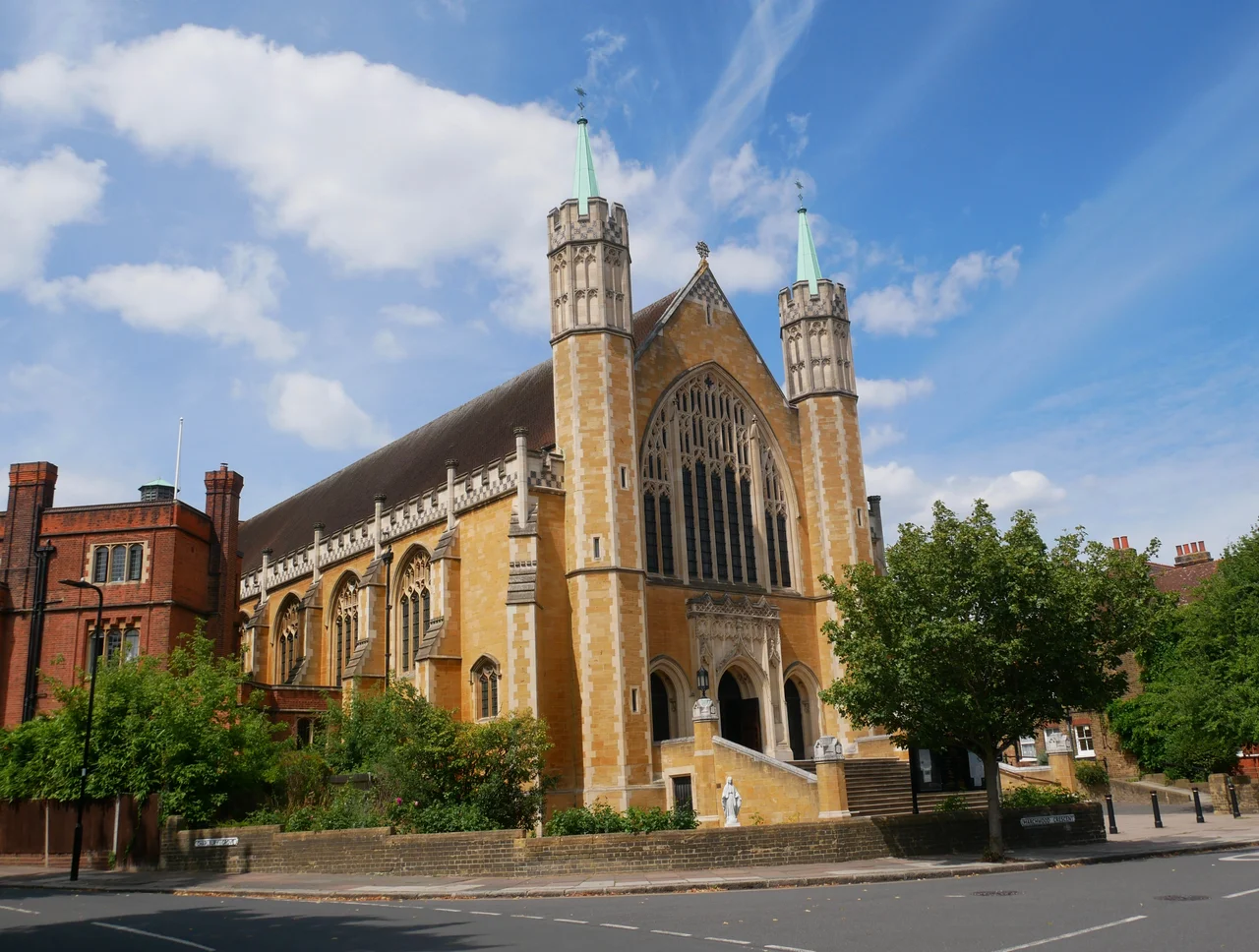
Castlebar Hill rises gently in west London, where the city begins to thin into suburbs. In 1897 a small group of Benedictine monks from Downside Abbey in Somerset arrived to found a parish there. They had no church, no monastery, only a plot of ground and the assignment from the Archdiocese of Westminster. By 1899 two or three bays of a new nave were open. By 1915 the sanctuary and Lady Chapel were complete. The building was the architect Frederick Walters's design, a long hammerbeam nave painted with the monograms IHC and SB. In 1955 Pope Pius XII raised the priory to the rank of abbey, the only Benedictine abbey in London. Its history is one of patient construction, bomb damage, careful restoration, and one of the most serious institutional failures in modern English monasticism.
The Long Build
Frederick Walters designed the Abbey Church in the Gothic Revival style. Construction was incremental, decade by decade, as funds and patience allowed. The west end and four western bays were completed by 1934 under Walters's son Edward John, finishing what the father had begun. The single hammerbeam roof of the nave is painted with the monograms IHC, an early Christian abbreviation for Christ, and SB for St Benedict, to whom the shrine is dedicated. The large west window, the Coronation of the Virgin attended by the heavenly host, came from Burlison and Grylls, the firm that supplied many of England's late Victorian and Edwardian church windows. The abbey grew slowly outward and downward and upward from this central spine.
Two Bombs in 1940
In 1940 the church was struck twice by German bombs during the Blitz. The first destroyed the organ chamber and the War Memorial Chapel, where the names of First World War dead had been carved. The second hit the east end, taking out the sanctuary and choir. Only two stained glass windows survived, both damaged. The monastic community continued to celebrate the Divine Office in what remained of the church for nearly two decades before restoration could be undertaken. Work began in 1957 and was completed in 1962, with the church now enlarged and the transepts completed by Stanley Kerr Bate. The Monks Choir beyond the crossing and a new Lady Chapel were added in 1996 to 1998 to the designs of Sir William Whitfield. The bombs had erased a generation of the building. The rebuilding added another.
John Main and Christian Meditation
Among the monks who lived at Ealing was John Main, who arrived in 1959. Main had previously served in the British Colonial Service in Malaya, where he encountered a Hindu swami who taught him a form of mantra meditation. The practice troubled him as a Catholic, but years later, after entering the Benedictine order, he rediscovered it in the writings of the fifth-century desert monk John Cassian. Main developed a method of Christian meditation based on the repetition of a single word, drawing on this ancient tradition. He lived at Ealing in two periods, from 1959 to 1970 and again from 1974 to 1977. His teaching is now carried on worldwide by the World Community for Christian Meditation. The scholar David Knowles also lived here from 1933 to 1939, conducting research for his magnum opus, The Monastic Order in England, before becoming Regius Professor of Modern History at Cambridge.
Reckoning
A major work of the Abbey has been the teaching and administration of St Benedict's School, founded as Ealing Priory School in 1902. That work brought the Abbey into one of the most serious reckonings of the modern English Catholic Church. In November 2008 Father David Pearce was charged with sexual offences against children at the school. He pleaded guilty in 2009 to abuse going back to 1972 and was sentenced to eight years, later reduced to five. The Charity Commission examined the conduct of the monastic community as trustee of the school's trust and found it had failed to take adequate measures to protect children. In March 2011 the former Abbot Laurence Soper was arrested on similar charges. He fled abroad, was eventually arrested in Kosovo in 2016, and after a ten-week trial was convicted in December 2017 on nineteen counts of child sexual abuse and sentenced to eighteen years. Many children had been harmed by people who should have protected them; the abuses had been concealed for decades.
The Institute and the Plainchant Choir
Out of the catastrophe came governance reform. Abbot Shipperlee commissioned Lord Carlile of Berriew to report on the school's structure; an Independent Schools Inspectorate report in 2013 found the new pastoral care to be excellent. In February 2019 Abbot Shipperlee resigned over the failure to investigate allegations. The Independent Inquiry into Child Sexual Abuse heard public testimony about Ealing Abbey and St Benedict's that year. The abbey continues its other work. The Benedictine Institute, housed in Overton House, runs a Liberal Arts programme and a Liturgy programme. The St Bede Library holds three collections for graduate study, supplemented by gifts from the Alcuin Club. A Lay Plainchant Choir sings monthly at Sunday Mass and visits a local care home for those with dementia. In 2020 the Abbey had fourteen residential monks. The building continues to rise from Castlebar Hill, the chant continues, the reckoning continues.
From the Air
Located at 51.5198 degrees N, 0.3089 degrees W on Castlebar Hill in Ealing, west London. The abbey church is identifiable from the air by its long Gothic nave and adjacent monastic buildings in a residential district about 7 miles west of central London. Nearest airport: Heathrow (EGLL) about 6 nm southwest. Best viewed from 2,000 to 3,000 feet on a westerly approach.
Nearby Stories
- Stevenage 5.7 km away
- Malling Abbey 5.7 km away
- 1952 Farnborough Airshow Crash 7.7 km away
- Ingatestone Hall 8.2 km away
- Hellfire Caves 9.1 km away
- The Carrington Event: The Solar Storm That Could Happen Again 9.8 km away
- Bletchley Park 16 km away
- Castle Hedingham 23 km away