
Operation Stack
When a ferry strike, a tunnel fire, or a midwinter storm closes the crossing between Dover and Calais, freight starts piling up - because the Port of Dover and the Channel Tunnel together handle ninety percent of the freight traffic between the United Kingdom and mainland Europe. Kent has official parking for 550 heavy goods vehicles. The trucks come in by the thousands. Where do they go? For thirty-one years, the answer was: onto the M20 motorway itself. Kent Police would shut the coast-bound carriageways and stack the lorries there, sometimes for days. The procedure was called Operation Stack. By 2007 it had been invoked 74 times in twenty years. The worst implementation, in June and July 2015, queued more than thirty miles of trucks and cost the British economy an estimated £250 million.
The First Strike
Operation Stack began in February 1988 when the National Union of Seamen called a strike at Folkestone Docks, then an important ferry terminal. The strike lasted only three days, but the tailback didn't. The M20 between Ashford and Folkestone was closed - and at the time, the motorway wasn't even complete between Junction 8 at Leeds Castle and Junction 9 at Ashford, so the closure rippled through gaps in the road network that hadn't yet been filled in. The procedure stuck. By 1999, the Parliamentary Under-Secretary for Transport, Keith Hill, was commissioning studies on alternatives. By 2000, Michael Howard was asking John Prescott, then Secretary of State for Transport, what could be done. Prescott defended the status quo: management schemes, he said, can make traffic flows much better, and they are almost inevitable in difficult circumstances. Two decades and many disruptions later, that was still essentially the answer.
How It Worked
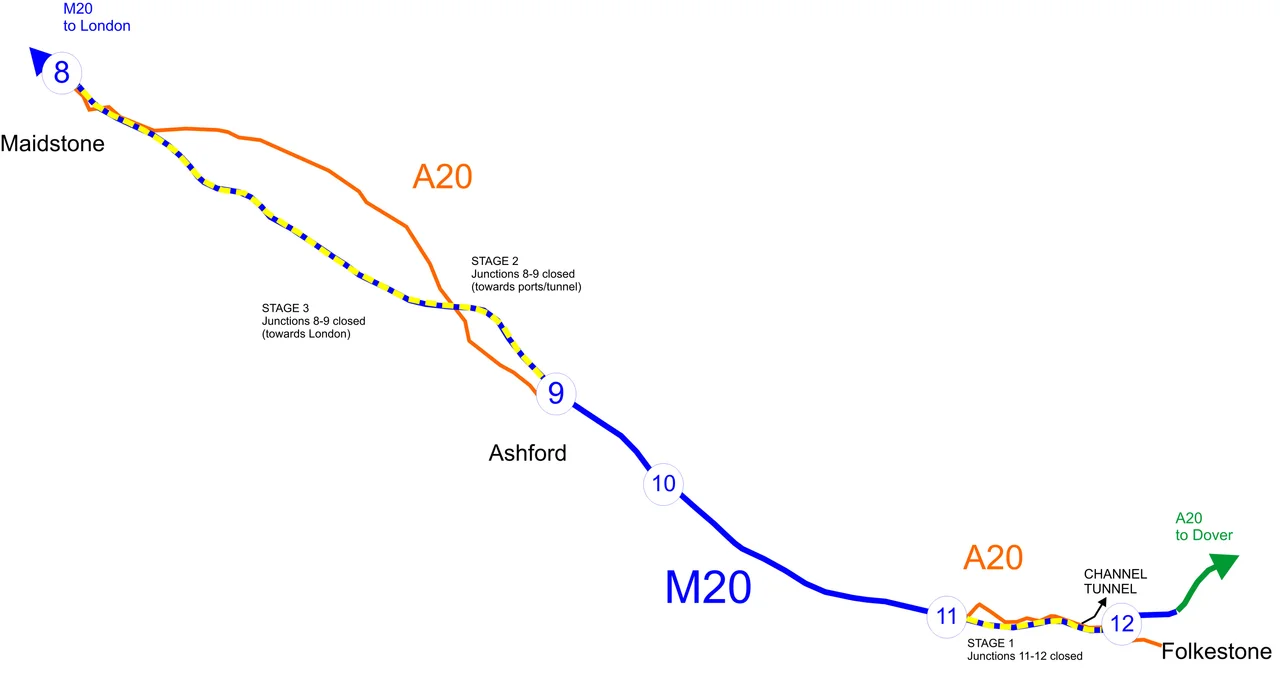
The system had four phases, escalating with the scale of the disruption. Phase 1 closed the coast-bound M20 from Junction 11 at Hythe to Junction 12 at Cheriton - 3.6 miles. Phase 2 added Junction 8 at Maidstone to Junction 9 at Ashford - another 26.5 miles. Phase 3 split the queue, sending Dover-bound traffic onto Manston Airfield while Channel Tunnel traffic kept the M20. Phase 4, used for the first time in June 2015, closed the M20 from Junction 9 all the way through to Junction 12 - more than thirty miles of motorway turned into a linear lorry park. All other traffic was diverted onto the parallel A20 - the old turnpike road from Maidstone to Folkestone, never designed to carry M20-scale volumes - or onto the A2, the historic Roman road to Dover via Canterbury. The procedure was authorised under the Civil Contingencies Act 2004 and coordinated by a multi-agency group called Operation Fennel. Up to three thousand additional parking spaces for freight could be created by stacking the trucks along the carriageways.
2015: The Year of Calais
On 24 June 2015, French employees of MyFerryLink went on strike over the imminent takeover of their company by DFDS. The same summer brought a humanitarian crisis to the Calais ferry terminal: thousands of migrants - many of them refugees from Syria's civil war, others from Sudan, Eritrea, Afghanistan - had gathered in Calais hoping to reach Britain. They tried to climb into lorries, sneak onto Eurotunnel trains, walk through the tunnel itself. Eurotunnel ran extra security; some lost their lives in the attempt. The freight tailbacks at Dover grew. Operation Stack was implemented at Phase 4 for the first time, queuing trucks for thirty miles. It took until 4 July to clear more than 4,600 lorries from the motorway. Damian Collins, MP for Folkestone and Hythe, complained that the problem was now too large for Kent County Council and went to see the Home Secretary, Theresa May. The reality on both sides of the Channel was the same: a transport system never designed to handle this kind of disruption, and a humanitarian situation where people fleeing wars and persecution were being framed in the British press as a traffic problem - rather than as families who needed shelter and a hearing.
Brexit and Brock
By 2018, the planning was no longer about strikes - it was about Brexit. National Highways, then called Highways England, started work in May 2018 on Operation Brock, a contraflow system designed to keep the M20 open in both directions while still being able to queue lorries safely. £30 million was allocated for design, build, and initial operation. Brock uses steel barriers to create a separate lane for stacked freight on the coast-bound carriageway while regular traffic continues on the rest of the motorway, including in the opposite direction. It went live on 28 October 2019. In December 2020, France closed its border with the UK during the COVID-19 pandemic over concerns about a new coronavirus variant. Operation Brock was activated. The M20 stayed mostly open. Operation Stack, in its old form, has not been used since 2019. The Kent County Showground at Detling has been considered as a permanent lorry park. So has Manston Airport, which already serves as an overflow site under Brock. As of 2022, Brock remains the official traffic management plan.
Other Coasts
Dover is not alone. When the Port of Felixstowe closes - which happens whenever winds exceed 45 mph because the cranes can't operate safely - lorries are stacked on the old A45 at Levington. They used to park on the A14 until that was deemed too dangerous. When the Scottish ports of Cairnryan and Stranraer close, lorries are stacked on the closed A751. Britain's freight system runs on tight margins and predictable crossings, and the routes that keep it moving were not built with this volume of articulated trucks in mind. When the system fails - a strike in Calais, a fire in the tunnel, a virus closing a border - the trucks have nowhere else to go. The lorry parks were always supposed to be temporary. They became permanent fixtures of the British road network, written into emergency plans, named like military operations: Stack, Brock, Fennel. Names for the fact that a small country with one big crossing point has, for decades, been one dispute away from grinding to a halt.
From the Air
Operation Stack covered the coast-bound M20 motorway through Kent, centred roughly on 51.09°N, 1.09°E near Cheriton. From the air, the M20 runs southeast from the M25 near Swanley through Maidstone, Ashford, and Folkestone to Dover. Phase 4 closures stretched from Junction 8 at Hollingbourne (51.27°N, 0.62°E) to Junction 12 at Cheriton (51.10°N, 1.13°E) - over 30 miles of motorway visible from cruising altitude as a continuous queue of stationary trucks when active. The parallel A20 and A2 carry diverted traffic. Nearest airport is London Ashford (Lydd) (EGMD); Manston (EGMH) has been used as an overflow lorry park. Best observed at altitude when motorway and the Port of Dover are visible together.
Nearby Stories
- HMS Hermes (1898) 7.3 km away
- Herne Bay Museum and Gallery 8.5 km away
- Benenden School 9.2 km away
- Boulonnais 9.4 km away
- Priestfield Stadium 12 km away
- 1382 Dover Straits Earthquake 17 km away
- Royal Sovereign Lighthouse 21 km away
- Battle of Boulogne 28 km away