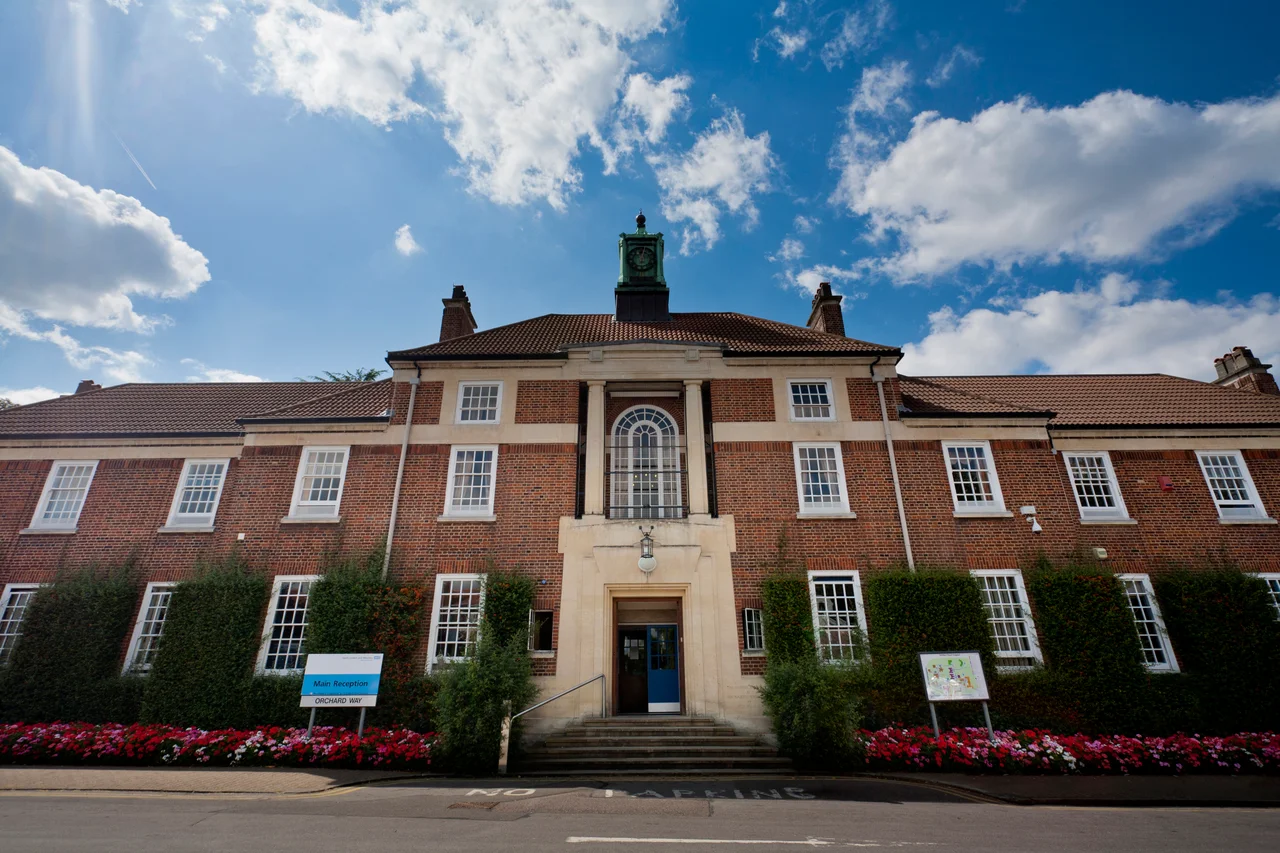

Bethlem Royal Hospital
The word 'bedlam' comes from this place. Not a metaphor, not a coincidence: an actual corruption of Bethlehem, the saint's name on a thirteenth-century London priory that drifted, century by century, into something else entirely. Founded in 1247 as a centre for collecting alms, by 1403 Bethlem held six men described in Latin as 'mente capti' — taken in mind. By the eighteenth century it was selling tickets to watch them. Today, in a quiet wooded campus in Bromley, it is one of the leading specialist mental health hospitals in Britain. Almost eight hundred years of continuous operation. No other psychiatric institution in the world can claim as long, or as troubled, a story.
The Priory at Bishopsgate
Goffredo de Prefetti, the Italian bishop-elect of Bethlehem, founded the Priory of St Mary of Bethlehem just outside London's wall in 1247, on land donated by a former sheriff named Simon FitzMary. The site is where the southeast corner of Liverpool Street Station now stands. It was not a hospital in the modern sense. It was a fundraising house, a place to gather charity for the crusader church in the Holy Land, whose finances had been wrecked by the Khwarazmian sack of Bethlehem three years earlier. The brothers wore a star on their cloaks to mark their allegiance. They sheltered the poor. They had no special mandate to care for the mentally ill, and would not develop one for over a century.
How a Word Was Born
By 1403 the records show 'mente capti' among the inmates, alongside four pairs of manacles, eleven chains, and two sets of stocks. We don't know how those restraints were used, or on whom. But across the next fifty years Bethlem quietly became something it had not been founded to be: a place for housing people the medieval world had no other framework to understand. The nickname 'Bedleem' became 'Bedlam', and the word slid out of the priory's name and into common English to mean uproar, confusion, chaos. By the Jacobean stage it had become a setting for plays — Webster, Middleton, Jonson all used it. The institution had begun to feed an idea of madness, and the idea was feeding back.
The Spectacle at Moorfields
In 1676 Robert Hooke designed a new Bethlem at Moorfields: a vast palatial building, 500 feet wide, with corridors so long that visitors complained their eyes grew tired walking them. The gates were flanked by Caius Gabriel Cibber's stone figures of Melancholy and Raving Madness, both half-naked, one bound in chains. The architecture was meant to advertise charity. What it advertised, in practice, was the inmates. From at least the early 1600s the governors allowed the public to wander through and look. By the eighteenth century, holiday crowds came in their hundreds, paid donations into the poors' box, and watched. The donations averaged £300 a year for half a century. The patients — chained, half-clothed, sometimes starved by corrupt keepers — were the show. We should be clear about what this means: people in genuine mental distress, who had names and families and inner lives, were displayed as entertainment to visitors who came on Easter Monday with the expectation of being amused. The practice was finally curtailed in 1770, requiring a governor's signed ticket. After that, with no public eyes left in the building, the abuses worsened.
James Norris, 1814
Edward Wakefield was a Quaker land agent and reformer who visited the Moorfields Bethlem in the spring of 1814. In the incurable wing he found an American marine named James Norris, fifty-five years old, who had been continuously restrained for roughly a decade in a harness apparatus bolted to a wall. Norris could move only a few inches. Wakefield's testimony to Parliament — combined with reports of similar conditions at York — forced the 1815 Select Committee on Madhouses and helped break open the entire architecture of British asylum care. Thomas Monro, the principal physician (and the third in a four-generation Monro family dynasty at Bethlem) resigned in 1816, accused of 'wanting in humanity' towards his patients. Bethlem's name, once a synonym for chaos, was becoming a synonym for cruelty as well.
Monks Orchard
The hospital moved to a new building at St George's Fields in Southwark in 1815 — that building now houses the Imperial War Museum. In 1930 it moved again, this time south to a wooded estate called Monks Orchard on the borders of Beckenham, West Wickham and Shirley. In 1948 it joined the new National Health Service. In 1999 it merged with the Maudsley Hospital in Camberwell to become part of the South London and Maudsley NHS Foundation Trust, now a leading centre for psychiatric research in partnership with King's College London. The Bethlem Gallery, on site, displays art by current and former patients. The Museum of the Mind opened in 2015 and confronts the institution's history directly, including the spectacle years.
What Remains to Reckon With
Bethlem's modern work is serious and saves lives — the National Psychosis Unit, the Adolescent Unit, anxiety disorders care that helps the top one percent of severely affected patients. But the long history does not vanish because the practice has improved. In 2010, a twenty-three-year-old man named Olaseni Lewis died at the hospital after being held face-down by eleven police officers in prolonged restraint. A coroner's jury found the force used was 'disproportionate and unreasonable' and had contributed to his death. His mother, Ajibola Lewis, had been warned by a nurse not to let him be transferred to Bethlem. The Mental Health Units (Use of Force) Act 2018, known as Seni's Law, requires psychiatric hospitals to record and report how restraint is used. It is named for him. To pass over Monks Orchard from the air is to look down on something the English language remembers in one word and the English state is still learning, slowly and incompletely, how to do better.
From the Air
Bethlem Royal Hospital occupies a wooded site at 51.38N, 0.03W, in the Monks Orchard area of Bromley, southeast London. The hospital sits in low-density parkland between Eden Park, West Wickham and Shirley. Biggin Hill (EGKB) lies about five nautical miles southeast; London City (EGLC) is to the north across the Thames. Heathrow (EGLL) and Gatwick (EGKK) flank London to the west and south. Recommended viewing altitude 1,500-2,500 ft AGL — the campus reads as a green island surrounded by suburban housing, with the older red-brick administration buildings still visible among newer NHS facilities.
Nearby Stories
- Battle of Britain, Northfleet 1.1 km away
- Bayham Old Abbey 5.4 km away
- Catharine Macaulay 6.4 km away
- Hatfield rail crash 8.8 km away
- Chequers 8.9 km away
- Chelmsford Cathedral 10 km away
- Queen Victoria Hospital 13 km away
- Fishbourne Roman Palace 36 km away