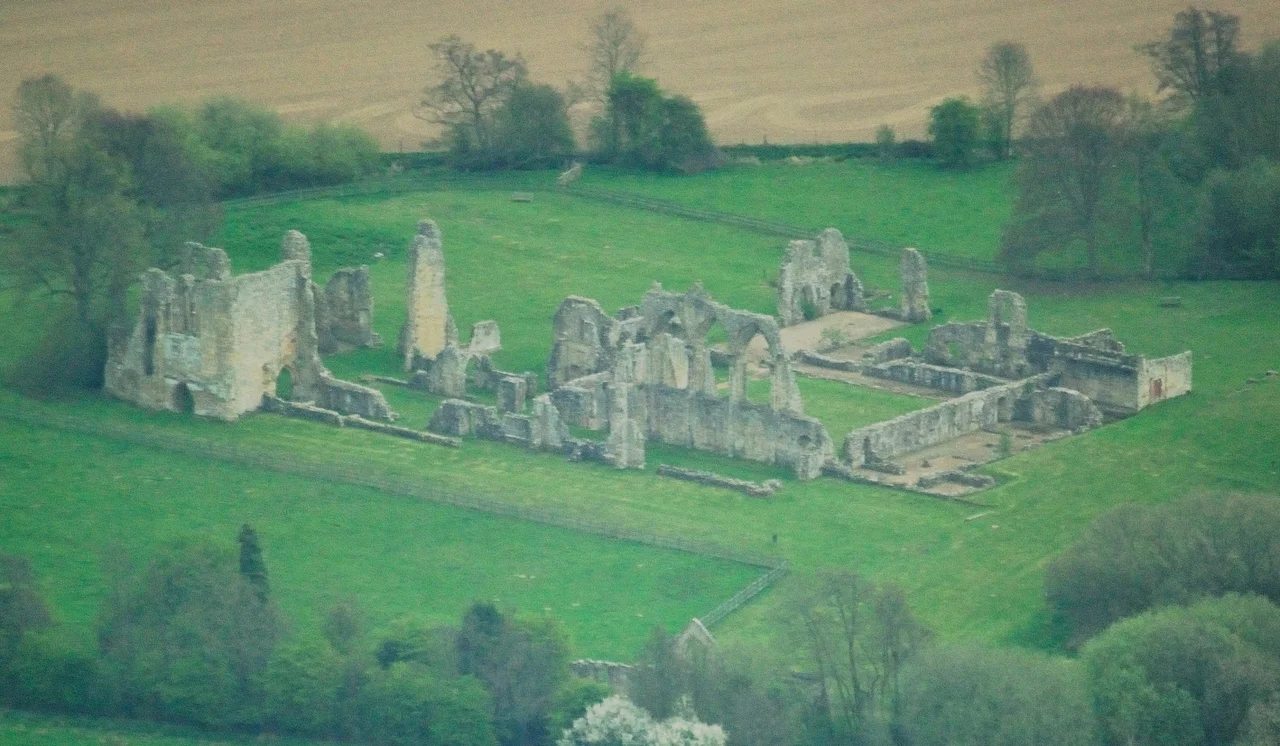

Bayham Old Abbey
Humphry Repton kept the ruins of Bayham Abbey because they were already beautiful. By 1799, when the great landscape gardener arrived to design the new park around Bayham Abbey House, the abbey had been a roofless casualty for nearly three centuries. Cardinal Wolsey suppressed it in 1525. Henry VIII finished the job in 1538. Repton looked at the ivy-covered walls and the three vast window frames of the nave, the carved capitals lying among the grass, and made a decision: alter them slightly, frame them within the new landscape, let them stand as the centerpiece of a picturesque view. The Red Book he produced for the Camden family, one of his most complete surviving plans, bears the inscription Application of Gardening and Architecture united, in the formation of a new place. The abbey became scenery.
A Merger of Two Failures
Bayham was founded around 1208 from the failure of two earlier Premonstratensian monasteries: Otham in Sussex and Brockley in Kent. Both had struggled to maintain themselves, and Robert of Thurnham brought them together in the secluded valley of the River Teise. Premonstratensian canons - white canons, after the colour of their habits - preferred remote locations near running water, and the Teise provided both supply and drainage. The original endowment came from Ralph de Dene, a Norman landowner, but the real generosity came from his daughter Ela de Dene, twice married, who arranged for the Sackville family to take Otham under their protection. The Sackvilles chose Bayham as their family burial site for generations afterward - making the abbey a family chapel as much as a working monastery. The stones were local sandstone, golden when dry, dark when wet.
Augustine's Rule in Its Purity
The Premonstratensian Order was founded by St Norbert in 1120 with one ambition: to keep the Rule of St Augustine without compromise. The white canons combined the solitude of the desert fathers with the active ministry of priests - they were not contemplatives walled off from the world. By the fifteenth century, Bayham's church had been enlarged with new transepts. The quality of the carved stonework was unusually fine for a small provincial house, particularly the three enormous traceried windows of the nave. Pilgrims could approach the abbey through one of two gatehouses, since the site straddled the Kent-Sussex border. The Kentish gate still stands in ruins. No trace has been found of the Sussex one. Stables and barns are presumed but unlocated. The community was always small. The ambition of its building was larger.
Wolsey, Riot, and the Sword
Cardinal Thomas Wolsey wanted Bayham. In 1525, he ordered its suppression as part of his programme to fund his new colleges at Oxford and Ipswich - the same drive that would take down Tonbridge Priory the same year. Local villagers responded with a riot. The 1525 Bayham Abbey riot involved an armed occupation of the buildings, the villagers determined to keep what they considered theirs. The Crown reasserted order. Wolsey took the abbey anyway. Thirteen years later, Henry VIII completed the work begun by his cardinal: Bayham passed to royal control during the wider Dissolution of the Monasteries. Once in royal hands it was leased to Anthony Browne, 1st Viscount Montagu, and eventually sold outright by Elizabeth I. The community of white canons was gone. The buildings stood empty.
The Picturesque Cure
Sir John Pratt bought the estate in 1714. His descendants, the Camden family, lived on it for nearly two and a half centuries. By the time Samuel Hieronymus Grimm sketched the ruins around 1785, they had become a perfect example of what eighteenth-century aesthetics called the picturesque - the ivy-clad, melancholy beauty of decay. Humphry Repton was hired to landscape the new mansion park. He treated the abbey as the central feature of his composition, lightly modifying it to improve the view from the new house. The Camdens later built Bayham Abbey House across the Teise valley in 1872, leaving the old abbey as a landscape feature in their estate. They used the ruined chapel for the burials of their infant children - tiny graves among Premonstratensian stones.
A Ruin Becomes a Monument
In 1961, the Camden family donated the abbey to the state, and it is now maintained by English Heritage. The partial walls still stand. The room layout is still legible. Ornate Romanesque capitals and the great stone window frames of the nave have survived eight centuries of weather. Brief archaeological work in the 1960s produced a published survey but never the full excavation the site deserves. The ruins are a Grade I listed building and a Scheduled Monument - protected against unauthorised change. Visitors today walk through Repton's picturesque composition rather than a working monastery, but the bones beneath the grass remain the bones of Bayham. The Sackville burials. The Augustinian Rule kept in its purity. The white canons who lived here without the world's notice and disappeared without much of its protest.
From the Air
Located at 51.10 degrees N, 0.36 degrees E, on the Kent-East Sussex border near Lamberhurst, in the valley of the River Teise. The ruins appear as a cluster of roofless walls and three large window frames in parkland on the east side of the Teise. Bayham Abbey House (the 1872 mansion) is on the west side of the valley. Nearest airports: London Gatwick (EGKK) twenty-two miles west, Lydd (EGMD) twenty-eight miles southeast. Best viewed at 2,000-3,500 feet on clear days, with the wooded Teise valley as a darker green corridor.
Nearby Stories
- Saltwood Castle 2.8 km away
- Jezreel's Tower 5.4 km away
- Bethlem Royal Hospital 6.2 km away
- Herne Bay Pier 6.7 km away
- Royal Sovereign Lighthouse 11 km away
- Plymouth Brethren 15 km away
- Battle of Boulogne 40 km away
- Fratton Park 75 km away