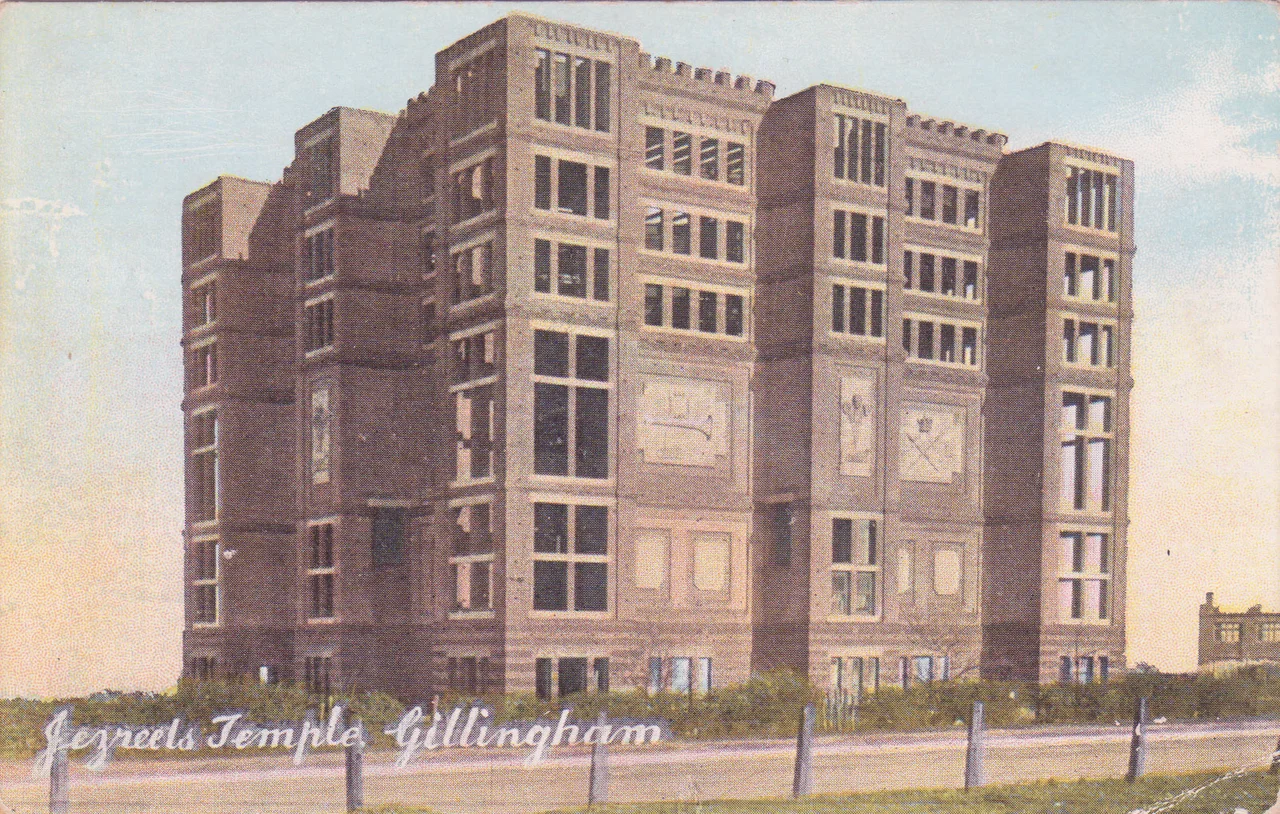

Jezreel's Tower
James Roland White was a soldier of the 16th Regiment of Foot, stationed at Chatham in the summer of 1875, when he picked up the writings of Joanna Southcott - a Devon prophetess who had died in 1814 still insisting the world was about to end. White was a merchant's clerk's son who would later describe himself simply as a bachelor on his marriage certificate. By the time he had finished reading and rewriting Southcott's followers' manuscripts, he was no longer James White at all. He was James Jershom Jezreel, the Messenger of the Lord, and he meant to build a temple in Gillingham, Kent, where the saved would gather to wait out the Last Judgment.
The Flying Roll
The book Jezreel produced was called The Flying Roll, after a passage in the Book of Zechariah. It promised that 144,000 souls - the number named in Revelation - would be sealed and saved when the end came, and that the temple Jezreel was to build would be where the sealing happened. To his followers, this was not theatre. It was scripture. They sold what they owned, they came to Gillingham, and they believed. Some had been respectable shopkeepers in Australia and the American Midwest before they crossed oceans to live in army-town Kent. They were not credulous fools. They were people looking for certainty in a century that had just stopped offering it, and they found a leader who spoke as if certainty were still on the table.
A Cube for the Saved
The temple was designed as a perfect cube - reportedly 144 feet on each side, an echo of those 144,000 souls in Revelation - faced in yellow Gault brick, with a flying roll, a trumpet, and the Prince of Wales feathers embossed across the masonry. It was meant to seat thousands inside a vast assembly hall with no internal supports. The foundations were down by early 1886. Some of the peripheral buildings around it were already occupied by Jezreelites living a communal life under the rising walls. From a distance, the temple looked less like a chapel than like a fortress or a power station; it was, in any case, like nothing else in Kent.
Queen Esther
Jezreel himself died in 1885, before the cube was finished, and leadership passed to his widow, Clarissa. The press called her 'Queen Esther', and not kindly. She was caught between two impossible jobs: keeping the construction going, and keeping fourteen hundred believers fed and housed on a budget that was bleeding out. She economised. She declared the sect would become vegetarian and, in lean stretches, narrowed the daily diet to bread and potatoes. At the same time she was seen riding through Gillingham in a coach-and-pair, dressed in fashionable clothes. Whether that was hypocrisy or the burden of being the visible head of a public-facing church is now hard to judge - but the gap between her followers' bread and her own pair of horses was felt by those followers. The membership began to fall. A legal case brought by a believer who had given everything he owned to the cause accelerated the decline. By the end, fewer than a hundred and sixty Jezreelites remained.
A Tower That Could Not Be Removed
Work on the temple stopped before the roof was completed. For decades afterwards the great unfinished cube sat above the rooftops of Gillingham, partially shrouded, partially open to the sky. Tristram Hillier painted it in 1937 for a Royal Dutch Shell poster series; a copy of that painting still hangs in the Tate. Postcards of the strange yellow building circulated through the early twentieth century, often captioned as a folly or a curiosity, though the people who had pinned their lives on it were still alive when those postcards were printed. Demolition was finally attempted between 1960 and 1961. It took thirteen months. The walls had been built so massively, with so much reinforcement, that an article in Engineering and Technology later called Jezreel's Tower a structure that 'could not be removed' - or at least, not easily.
What Stays Behind
After 1961 the site became, of all things, an electroplating works. Smiths Signs owned it; then L Robinson and Company bought it in the late 1960s and made it the home of the firm now known to plumbers and mechanics everywhere as Jubilee Clips - those small worm-gear hose clamps you find on every garden tap. The last buildings associated with the temple, at the top of Canterbury Street, came down in late 2008. Today there is a Jezreels Road in Gillingham, running close to where the great cube once stood. Nothing of the temple itself survives above ground. What remains is a story about belief that outran resources, about a movement that asked sincere people to give everything for a promise that did not come, and about a building so confident in its own foundation that it took more than a year to break it apart.
From the Air
Coordinates 51.3744 N, 0.5511 E, in Gillingham, Kent, on the high ground above the Medway and Chatham dockyards. The tower itself is long gone, but the site lies near the top of Canterbury Street and the modern Jezreels Road, in the urban grid south of the Chatham naval base. From the air, identify Gillingham by the bend of the River Medway and the now-historic Chatham Dockyard immediately to the west. Recommended viewing altitude 2,000-3,500 feet. Nearest airports: Rochester (EGTO) 4 nm west, Lydd (EGMD) 30 nm south, London Southend (EGMC) 16 nm north across the Thames.
Nearby Stories
- Waltham Abbey Royal Gunpowder Mills 1.6 km away
- Bethlem Royal Hospital 4.4 km away
- Sissinghurst Castle Garden 5.6 km away
- Chelmsford 6.5 km away
- Herne Bay Pier 6.7 km away
- Operation Stack 7.1 km away
- St Osyth's Priory 13 km away
- Plymouth Brethren 24 km away