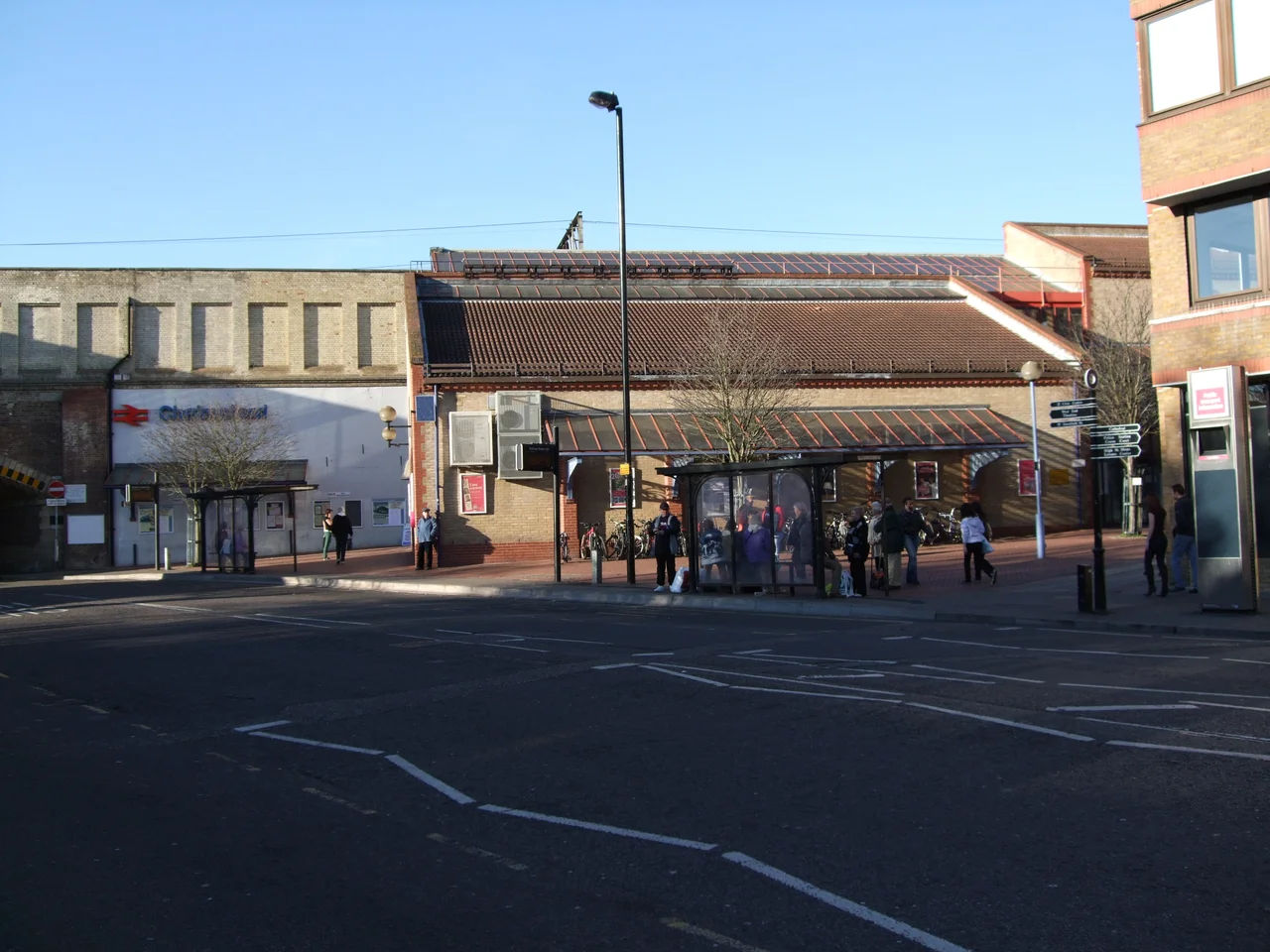

Chelmsford
On the evening of 15 June 1920, the Australian soprano Dame Nellie Melba stepped up to a microphone in a corrugated-iron hut at the back of the Marconi New Street Works. Two 450-foot masts loomed over the Essex skyline. She sang an aria, then "Home, Sweet Home," then the British and French national anthems. Listeners on ships in the Atlantic and in homes across Europe heard her clearly. It was the first official publicised radio broadcast in the United Kingdom, and it happened here - not in London, not in New York, but on the edge of a market town that had been called Caesaromagus by the Romans and Celmeresfort by the men who wrote the Domesday Book.
Caesar's Marketplace
The Romans arrived in AD 60 and built a fort here on Watling Street, where it crossed the River Can. The civilian town that grew around it was given an unusually grand name: Caesaromagus, Caesar's field or Caesar's marketplace. No other town in Britain bore the imperial prefix. The reason has been lost, but one theory holds that Emperor Claudius defeated the last organised British resistance on this site before marching on Camulodunum (modern Colchester) in AD 43. Beneath modern Moulsham lie the remains of the mansio - a Roman post office and traveller's hotel - and beneath the Odeon roundabout sit the ruins of an octagonal temple. In 2025 archaeologists working a former car park uncovered three Roman bodies. The town has never quite stopped being itself.
A Bridge, a Charter, and Witches
Around 1100, Maurice, Bishop of London, ordered a bridge built over the River Can. Traffic that had flowed through nearby Writtle now flowed here, and Chelmsford grew. King John issued a market charter in 1199, and by 1218 the town was the seat of the Essex assizes - the travelling royal courts. For six dark days in July 1381, after he had broken the Peasants' Revolt in London, King Richard II made Chelmsford the seat of his government, signing orders that ranged across the kingdom. Many of the revolt's ringleaders were hanged at Primrose Hill. In the 1640s, Matthew Hopkins, the self-styled Witchfinder General, used Chelmsford's gaol and assize court to send dozens of women - and a few men - to the gallows on charges of witchcraft, sometimes after barbaric forms of interrogation.
The Birthplace of Radio
In 1899, the young Italian inventor Guglielmo Marconi opened his Wireless Telegraph and Signal Company in a converted silk works in Hall Street. It was the first dedicated radio factory in the world, employing about fifty people. By 1912 he had outgrown it, building the purpose-designed New Street Works - 70,000 square feet of clean industrial brick, its iconic water tower visible across the rooftops. Melba's broadcast came in 1920. Two years later, from a wooden shed at Writtle on the edge of town, Marconi's engineers began the world's first regular entertainment broadcasts under the call sign 2MT. Its sister station 2LO in London grew into the BBC. The signs at the city limits still read "The Birthplace of Radio." The claim is contested - other places have rival claims - but on certain technical points, Chelmsford is undeniable.
December 1944, Henry Road
Chelmsford's factories made ball bearings, radar valves and radio equipment for the war. The Luftwaffe came on 14 May 1943, killing over fifty people and leaving nearly a thousand homeless. Worse was still to come. On Tuesday 19 December 1944, just before bedtime, the 367th V2 rocket to strike England fell on Henry Road, a residential street near the Hoffmann ball bearing factory and the Marconi works. There was no warning - V2s travelled faster than sound. Thirty-nine people died. A hundred and thirty-eight were injured, forty-seven seriously. Several houses simply vanished. Six days before Christmas, families learned that their children, parents or neighbours were gone. A memorial in the city cemetery on Writtle Road still marks the names. Hylands Park, on the western edge of town, had served as a prisoner-of-war camp and from 1944 as the headquarters of the Special Air Service.
Cathedral, City, and the Long Reinvention
In 1914, just as Europe stumbled into war, the parish church of St Mary the Virgin was elevated to become Chelmsford Cathedral on the creation of a new Essex diocese. A century later, on the Diamond Jubilee of Elizabeth II in June 2012, Chelmsford received its letters patent as a city. The journey is visible in the streetscape: the medieval flint of the cathedral tower, the Georgian Shire Hall facing the market place, the 1930s civic centre, the redeveloped Marconi site where only the listed water tower and the 1912 facade survive. Marconi's name finally vanished from the city in 2008 when its successors moved to Basildon. Teledyne e2v carries on in Waterhouse Lane, building thermal imagers and radar valves much as English Electric Valve did from 1947. Charles Dickens, visiting in 1835, called Chelmsford "the dullest and most stupid place on earth" - mostly because he could not find a Sunday newspaper. The slight has not been forgotten. But the town that hosted Caesar's marketplace, the first regular wireless broadcasts, and the SAS at its founding has had quite enough of being underestimated.
From the Air
Chelmsford sits at 51.74°N, 0.47°E in central Essex, 31 statute miles northeast of Charing Cross. Recommended viewing altitude is 2,500-4,000 feet. The cathedral spire is the primary landmark in the city centre. Look for the River Chelmer winding east toward Maldon, the surviving Marconi water tower north of the railway station, and Hylands Park on the southwest edge. Nearest airports: London Stansted (EGSS) about 18 nm northwest, North Weald (EGSX) 14 nm west, London Southend (EGMC) 15 nm south. Heathrow and Stansted Class D airspace constrain flight planning - expect to be talking to Stansted approach.
Nearby Stories
- 1996 Docklands Bombing 1.3 km away
- St Osyth's Priory 3.8 km away
- Cooling Castle 5.4 km away
- Clare Priory 6.1 km away
- Ipswich Museum 7.3 km away
- Waltham Abbey Royal Gunpowder Mills 8.3 km away
- Herne Bay Pier 15 km away
- Bourn Windmill 20 km away