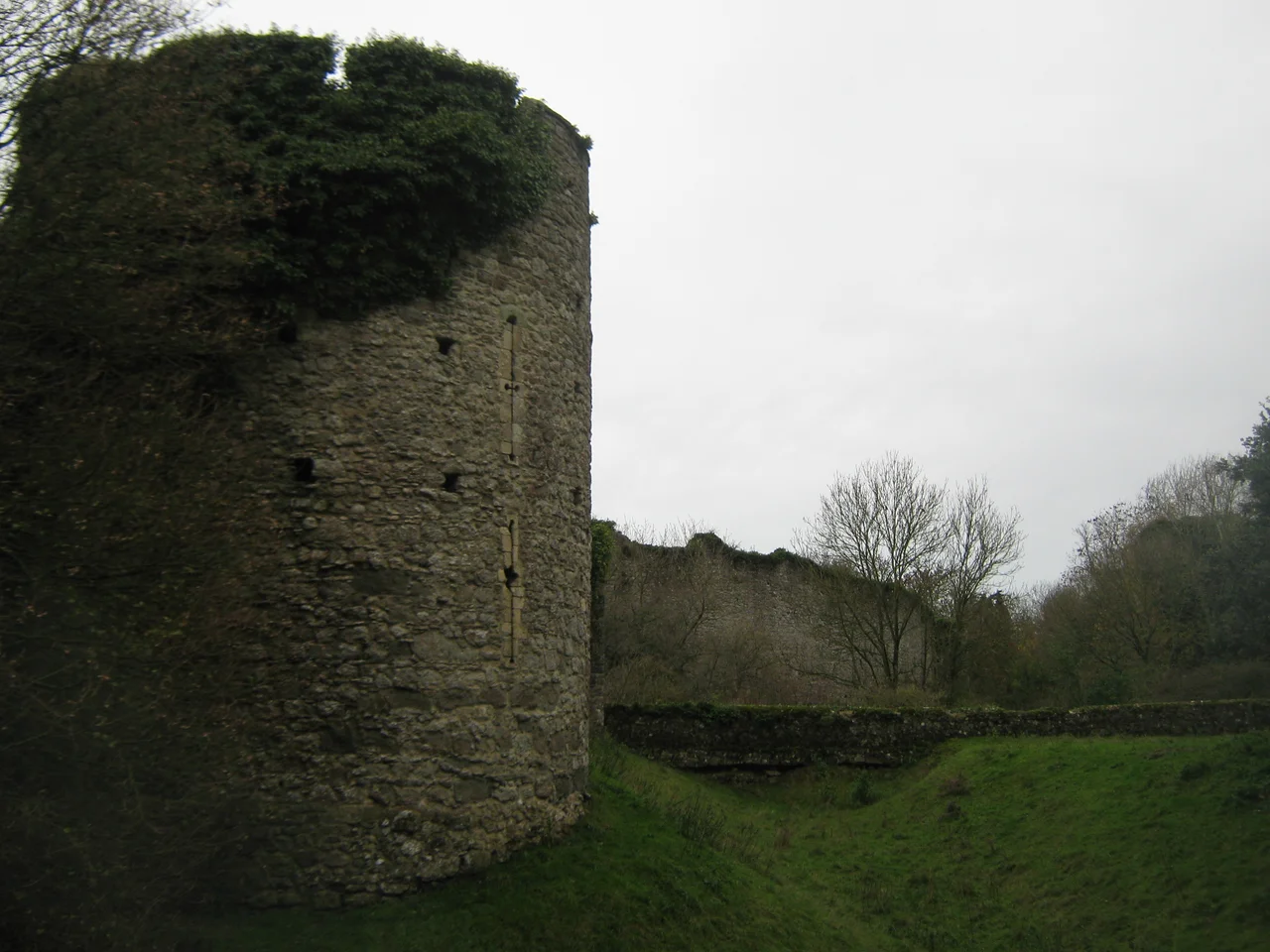

Saltwood Castle
On the evening of 28 December 1170, four knights of the king's household rode through the gatehouse of Saltwood Castle - Reginald Fitzurse, Hugh de Moreville, William de Tracey, Richard le Breton. They had come from Henry II's Christmas court in Normandy, where they had heard the king say something - exactly what is still argued over - that they took as an order to kill Thomas Becket, the Archbishop of Canterbury. They stayed the night at Saltwood, the home of Ranulf de Broc, one of Becket's most committed enemies. The plotting, the planning, the swordpoints sharpened. The next morning they rode the fifteen miles to Canterbury. By that evening Becket was dead on the cathedral pavement, his blood and brains on the stone, and Christendom had a new martyr.
Layers Below the Castle
The hilltop at Saltwood had been occupied long before the Normans. Bronze Age implements and copper ingots turned up in Hayne's Wood in 1874 - evidence that someone had been here when bronze was still cutting-edge technology. Local tradition traces the castle's beginnings to 488 AD, when Aesc, son of Hengist and king of Kent, was supposed to have built a fortification on the site. The first solid documentary appearance is on a charter of King Egbert in 833. In 1026, the manor of Saltwood was granted to the priory of Christ Church in Canterbury. After the Norman Conquest, William the Conqueror gave the castle to the Archbishop of Canterbury, Lanfranc, who let it to Hugo de Montfort under knight's service. The current twelfth-century Norman structure replaced an earlier building, with construction extending across two centuries. For a time, Henry of Essex, constable of England, lived here.
What Becket Wanted
Thomas Becket had asked Henry II to give the castle back to the Church as an ecclesiastical palace. Henry refused. Instead, he gave Saltwood to Ranulf de Broc, one of his loyal barons - and one of Becket's most violent opponents in the long quarrel between the archbishop and the king over whether the Church or the Crown should have jurisdiction over clerics who committed crimes. Becket had spent six years in exile in France because of this dispute. He had returned to Canterbury on 2 December 1170 and immediately excommunicated the bishops who had crowned Henry's son Young Henry as co-king without his permission. Henry, hearing about this at his Christmas court in Bures, lost his temper. According to one account he said: 'What miserable drones and traitors have I nourished and brought up in my household, who let their lord be treated with such shameful contempt by a low-born clerk!' Four knights heard him and rode for Canterbury. Saltwood was their last stop before the cathedral.
The Murder
On the afternoon of 29 December 1170, the four knights rode into Canterbury and confronted Becket in the cathedral. Becket refused to come out and explain himself. He refused to leave. He refused to lift the excommunications. According to eyewitnesses, the knights began to argue with him in the north transept. They had left their weapons outside the cathedral; they had to return to fetch them. When they came back, Becket was praying. Reginald Fitzurse struck the first blow with his sword, knocking off Becket's cap. Becket said, 'For the name of Jesus and the protection of the Church, I am ready to embrace death.' Multiple blows followed. One witness - Becket's clerk Edward Grim, who was wounded trying to shield him - described the crown of Becket's head being severed entirely and his blood and brains spilling across the cathedral floor. The knights rode out. Within three years Becket had been canonised. Within fifty years, his shrine at Canterbury had become one of the great pilgrimage destinations of Christendom - the road from London to Canterbury becoming the Pilgrims' Way of Chaucer's tales. Henry II walked barefoot through Canterbury and was scourged by monks in penance. The four knights were ordered by the pope to serve fourteen years in the Holy Land; all four died within that period.
Earthquake, Restoration, Clark
Saltwood remained Church property until 1540, when Henry VIII forced Archbishop Cranmer to cede it to the Crown during the Dissolution. The castle survived as a residence until 6 April 1580, when the Dover Straits earthquake - the largest known earthquake to affect southern England - made it uninhabitable. It sat ruinous for centuries. In the nineteenth century, restorations began; in the late nineteenth century, an ancestor of the journalist and Conservative politician Bill Deedes bought the castle, and Deedes grew up there. The art historian Kenneth Clark - whose television series Civilisation became one of the BBC's most ambitious cultural undertakings - bought Saltwood in 1953. His son Alan Clark, the politician and famously indiscreet diarist who served as a minister in Margaret Thatcher's government, then made it his home. Alan Clark is buried in the castle grounds. His widow, Jane Clark, still lives there. The castle is a Grade I listed building, privately owned, not generally open to the public. Most of what visitors can see is the gatehouse, the moat, and the surrounding park - a quiet Kentish landscape that gives no hint of the night in 1170 when four men sat at this hearth and decided to commit murder.
From the Air
Saltwood Castle sits at 51.082°N, 1.085°E in Saltwood village, about one mile north of Hythe in Kent. From the air, look for the moated castle complex on a low rise with the village clustered to its south. Canterbury Cathedral, where Becket was murdered, lies about 15 miles (24 km) north-northwest. The castle is privately owned and not generally open to the public; the gatehouse and outer walls are visible from the road. Nearest airport is London Ashford (Lydd) (EGMD) about 18 km southwest; Manston (EGMH) is 28 km north. Best viewed at low altitude from the north, with the surrounding North Downs as a backdrop.
Nearby Stories
- HMS Hermes (1898) 7.3 km away
- Herne Bay Museum and Gallery 8.5 km away
- Benenden School 9.2 km away
- Boulonnais 9.4 km away
- Priestfield Stadium 12 km away
- 1382 Dover Straits Earthquake 17 km away
- Royal Sovereign Lighthouse 21 km away
- Battle of Boulogne 28 km away