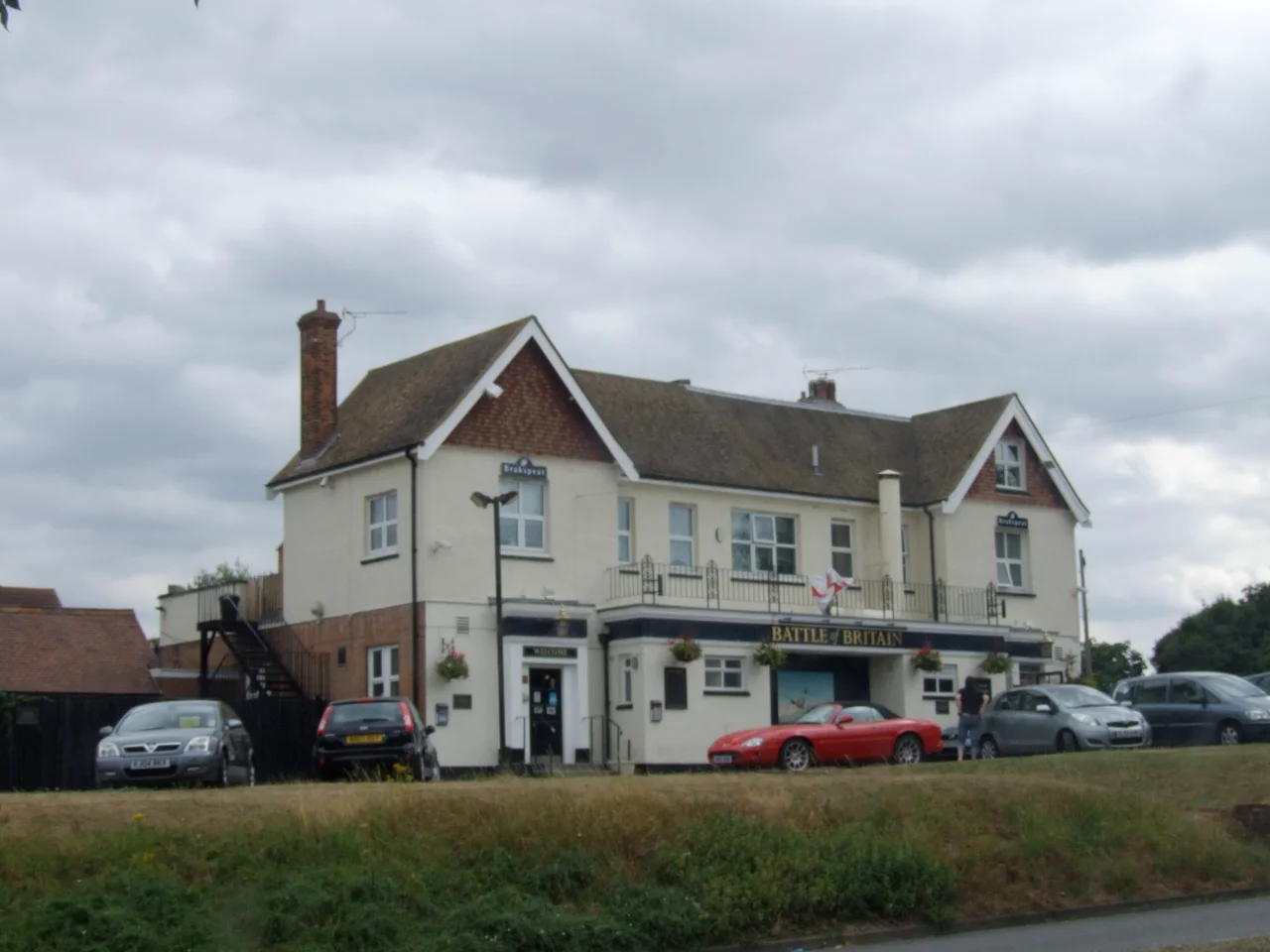

Battle of Britain, Northfleet
In October 2016 a Kent council planning officer admitted, in the local newspaper, that a popular pub had been pulled down "by mistake". The contractors had arrived at the Battle of Britain pub on Coldharbour Road in Northfleet without planning permission and demolished it anyway. The brewery that owned the land said the demolition was carried out by their consultants. The consultants said they had been authorised. By the time anyone in authority intervened, the pub was rubble. CAMRA called it criminal. Pub campaigners demanded it be rebuilt brick by brick, the way the Carlton Tavern in London had been rebuilt in 2015 after a similar illegal demolition. They are still waiting.
Built by the Men Who Won the Battle
The pub began in 1947 as a wooden hut on the former Gravesend airfield - put up by RAF personnel who had served at the wartime base and now needed somewhere to drink, somewhere to remember, somewhere to be together at the strange ordinary distance from the war they had just won. RAF Gravesend had been a key fighter station during the Second World War. It was the first RAF base to operate the American P-51 Mustang fighter, the long-range escort that would prove decisive over Germany. Gravesend had also seen action during the Battle of Britain in 1940, with Hurricane and Spitfire squadrons defending the Thames approaches to London. The hut on Coldharbour Road, named for the battle that had defined that summer, was a memorial in the most informal sense: not a monument, but a place where the men who flew and fixed and fuelled the aircraft could find each other afterwards.
From Hut to Estate Pub
In 1961 the nearby Shears Green House was converted into a permanent pub and renamed the Battle of Britain. It was a large ex-Charringtons estate pub - the kind that grew up alongside Britain's postwar housing developments - with multiple bars, function rooms, a big garden and a children's play area. It was the sort of pub where you might celebrate a christening on Sunday afternoon and a divorce on Tuesday night, where the landlord knew everyone and most of the regulars knew the wartime history that had given the building its name. For seventy years it served as the multi-generational meeting place of its corner of Northfleet. Charity nights. Family gatherings. The slow weekday afternoons of a community pub where retired dockworkers and railway pensioners and young families could share the same room without anyone feeling out of place. It was not the only pub of its kind to close in the 2010s. It was one of the few to close like this.
October 2016
The pub closed suddenly. Within days, Putnam Construction Services arrived on site, acting for the landowners Brakspear brewery and their consultants the Caldecotte Group, and began demolishing the building. No planning permission had been granted. Gravesham Borough Council subsequently refused the developer's retrospective demolition application - too late by then to undo anything. The site was cleared. Local residents gathered, took photographs, wrote to their MP, contacted the press. Within months the cleared ground was the subject of large-scale fly-tipping; in October 2018, two men were fined thousands of pounds for dumping waste at the demolished pub and elsewhere. The phrase "pulled down by mistake", spoken by the Gravesham planning boss to Kent Online in the immediate aftermath, became its own kind of memorial. It was a strange kind of mistake. The wrecking equipment did not show up by accident.
Brick by Brick - Just Not Here
CAMRA, the Campaign for Real Ale, pointed to the recent Carlton Tavern case in London. The Carlton had been illegally demolished in 2015 by developers; following a public inquiry, the developers were ordered to rebuild the pub brick by brick, on the same site, to the original specifications. It was a remarkable precedent. CAMRA argued that Gravesham Borough Council had the same powers and should use them. The council refused. The site was privately owned, they argued, not a listed building, and the cost of compelling a rebuild was not financially viable. In December 2016 the council also refused to designate the Battle of Britain site as a community asset, and declined to issue any wholesale order protecting local pubs. By late 2023 CAMRA was saying publicly that the council had "effectively endorsed the criminal demolition" by taking no enforcement action. The campaigners eventually acknowledged that forcing a reconstruction was unlikely to succeed. The Battle of Britain pub joined the long list of British pubs lost in the 21st century - except that most of those losses were legal.
Squadron Manor
In 2024 Frontier Estates sold the 1.16-acre plot to a care home developer. Planning permission was granted for a 75-bedroom facility named Squadron Manor, being built by Morar Living, scheduled to open in 2026. The name nods to what stood there before - a quiet acknowledgement, in branding rather than substance, of the wartime aviation heritage that gave the pub its name in the first place. The RAF veterans who built the original wooden hut in 1947 are mostly gone now. The dockworkers and railway pensioners who drank there for sixty years have either died or moved on. The pub is rubble; the rubble is gone; what remains is a building site, and soon a care home where elderly residents may include, perhaps, the grandchildren of the men who first carried timber out to this corner of Northfleet to build something that would last. Just not, as it turned out, forever.
From the Air
The site of the demolished Battle of Britain pub is at 51.43°N, 0.35°E on Coldharbour Road in Northfleet, just south of the former Gravesend airfield and east of the present-day Ebbsfleet International station. The area is highly visible from the air: cleared site (now becoming a care home build), with the Thames just to the north and the M2 motorway to the south. Rochester Airport (EGTO) is 5 miles southeast; Biggin Hill (EGKB) is 17 miles west. Best viewed from 1,500-3,000 feet.
Nearby Stories
- Waltham Abbey Royal Gunpowder Mills 1.6 km away
- Bethlem Royal Hospital 4.4 km away
- Sissinghurst Castle Garden 5.6 km away
- Chelmsford 6.5 km away
- Herne Bay Pier 6.7 km away
- Operation Stack 7.1 km away
- St Osyth's Priory 13 km away
- Plymouth Brethren 24 km away