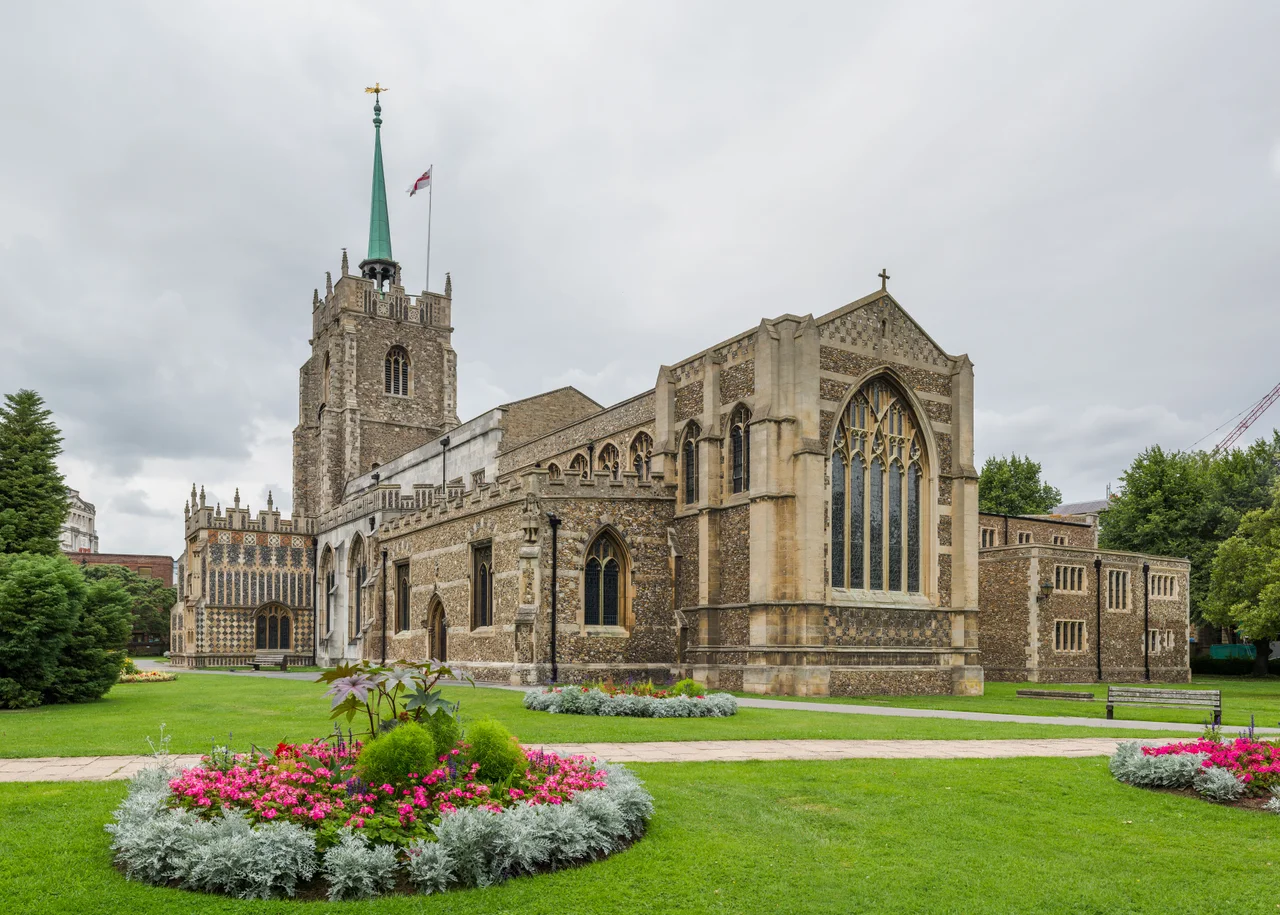

Chelmsford Cathedral
On a Sunday morning in 1626, a Puritan named Thomas Hooker climbed the pulpit of St Mary's parish church in Chelmsford and began to preach. He was the Town Lecturer - a paid teaching post created to put fervent Protestantism into the ears of Essex burghers. Within three years he would be forced into exile in Holland, and within a decade he would be in Massachusetts, then walking west through the wilderness to found Hartford, Connecticut. The pulpit where he stood is gone, but the building survives. Today it is Chelmsford Cathedral, and the man who left it is remembered as one of the founders of American democracy.
A Parish Church Built With the Town
The church of St Mary the Virgin was probably first built around 1200, alongside the new market town the Bishop of London was laying out at a river crossing in central Essex. The current fabric is mostly later. A major rebuild starting around 1520 produced walls of flint rubble, stone and brick, with the late-Perpendicular Gothic vocabulary that English masons had perfected in the final decades before the Reformation. The tower with its spire still rises above the market place, and within it hangs a ring of thirteen bells - twelve cast by John Warner and Sons at Cripplegate in 1913 and dedicated just before the First World War. The tower's stone took centuries to assemble. The bells came in a single year.
The Night the Nave Came Down
On 17 January 1800, after workmen had been digging graves too close to the columns, much of the nave collapsed in the night. There were no casualties, but the parish faced a disaster. The county architect John Johnson was called in. He chose to rebuild in the same Perpendicular spirit, but using a clever Georgian alternative to medieval masonry - Coade stone, a hard-fired ceramic that could be cast into piers and tracery far more cheaply than real freestone. He topped the whole space with a plaster ceiling. The upper chancel was redone again in 1878. The result is a church that looks medieval but isn't, quite. It is something stranger and more honest: a building that has refused to die.
A New Cathedral for a New Diocese
Essex had long been part of the vast Diocese of Rochester, then of St Albans, but by the early twentieth century the suburbs of east London were sprawling toward the Thames marshes and the Church of England needed a closer bishop. In 1914 the Diocese of Chelmsford was created and St Mary's was raised to cathedral status almost overnight. In 1954 the dedication was expanded to include Saint Peter and Saint Cedd - Cedd being the seventh-century Northumbrian missionary who built the small stone chapel of St Peter-on-the-Wall at Bradwell, twenty miles east on the Blackwater coast, where it still stands. The 1983 refurbishment installed new floors, seating, a bishop's throne and a font. The cathedral kept growing into its role.
Hooker's Migration
Thomas Hooker arrived in Chelmsford as Town Lecturer in 1626. His preaching drew crowds. It also drew the suspicion of Archbishop William Laud, who was hunting down Puritan ministers across England. By 1629 Hooker had been forced out; by 1631 he was in Rotterdam; by 1633 he had crossed to Massachusetts. In 1636 he led about a hundred followers and 160 cattle on a two-week march through dense forest from Newtown (modern Cambridge, MA) to the Connecticut River, founding Hartford. The next year he preached the sermon that argued the authority of magistrates should derive from the free consent of the people - language that later shaped the Fundamental Orders of Connecticut. A man pushed out of an Essex pulpit had helped invent something the world would later call democracy.
Bells, Organs, and a Bombed Child
The south porch was extended in 1953 to honour the friendship of the American airmen who had been stationed across Essex during the Second World War - their bombers had taken off from fields all around Chelmsford, and many had not come home. Inside, two pipe organs were installed by Mander Organs in 1994 and 1995, the chancel instrument incorporating older nineteenth-century pipework. The cathedral choir, in a curiously beautiful crossover, sang the choral passages on Talk Talk's 1988 album Spirit of Eden. Visit today and look for Peter Eugene Ball's Christ in Glory above the chancel arch, Mark Cazalet's Tree of Life in the north transept, and Georg Ehrlich's quiet sculpture The Bombed Child - a small, devastating reminder of what the bells were ringing for.
From the Air
Chelmsford Cathedral sits at 51.74°N, 0.47°E in the centre of Chelmsford, Essex - about 30 miles northeast of central London. The spire is the city's most visible landmark; from 2,000-3,000 feet you can pick it out above the Georgian and modern rooftops. The River Chelmer threads east from here toward Maldon and the Blackwater estuary. Nearest airports: London Stansted (EGSS) about 18 nm northwest, North Weald (EGSX) 14 nm west, London Southend (EGMC) 15 nm south. Expect controlled airspace - Stansted approach traffic passes overhead.
Nearby Stories
- 1996 Docklands Bombing 1.3 km away
- St Osyth's Priory 3.8 km away
- Cooling Castle 5.4 km away
- Clare Priory 6.1 km away
- Ipswich Museum 7.3 km away
- Waltham Abbey Royal Gunpowder Mills 8.3 km away
- Herne Bay Pier 15 km away
- Bourn Windmill 20 km away