.jpg)
Houghton Hall
Robert Walpole burned most of the receipts. He later estimated that Houghton Hall had cost him over £200,000 — a sum almost impossible to verify precisely because he had destroyed the documentation. This was partly deliberate opacity, partly characteristic extravagance. Walpole was Britain's first Prime Minister, the dominant political figure of the first half of the 18th century, and a man who treated politics and architecture with the same confident, unapologetic ambition. He laid the first stone at Houghton in May 1722. He hired architects who despised each other — Colen Campbell, James Gibbs, and William Kent were 'not just rivals, but very much disliked each other,' according to the source record — and got from their competing efforts one of the great houses of English Palladianism.
Building the House That Politics Paid For
The hall Walpole commissioned replaced earlier Walpole family houses on the same site, which he had inherited in 1700. The exterior is silver-white stone, restrained and grand — Palladian convention on the facade — but the interiors were another matter. William Kent designed ceilings for the reception areas and ground floor, and the whole effect was described in its own time as extravagant, colourful, and opulent. Gibbs's domes cap the corner towers, replacing the Wilton-style towers that Campbell had originally proposed. The south-west dome is dated 1725, the south-east 1727, the remaining two from 1729 onward — the corners completed slowly as funds and arguments between architects allowed.
In the grounds, landscape designer Charles Bridgeman replaced the formal geometry of intersecting avenues with something more naturalistic: blocks of woodland and parkland, tree-lined vistas aligned on the hall from four directions, 'twisting wilderness paths' that have been maintained ever since. In the course of this redesign, the village of Houghton was demolished and rebuilt at the park gates. Only the medieval Church of St Martin was left in place, and it now stands alone in the park — a small flint building surrounded by parkland, its congregation relocated.
The Norfolk Congress and the Art Collection
Walpole used Houghton the way powerful men of his era used country houses — as a political venue. His Cabinet colleagues gathered each spring for what became known as the Norfolk Congress: three weeks of meetings held in the house's opulent rooms, business conducted amid shooting parties with local gentry that could last for weeks at a time. Royalty visited regularly.
The house was also intended as a permanent home for Walpole's art collection — more than 400 Old Master paintings including works by Van Dyck, Poussin, Rubens, Rembrandt, and Velázquez. The collection did not stay. His grandson, the 3rd Earl of Orford, sold the entire collection to Catherine the Great of Russia in 1779 — it now forms the core of the Hermitage Museum in St Petersburg — a disposal that outraged contemporaries and that Horace Walpole, the statesman's son, described as a family catastrophe. The walls that had held those paintings were left bare.
Inheritances and Losses
When the Walpole line expired in 1797, Houghton passed to the family of Lady Mary, Countess of Cholmondeley — daughter of the first Robert Walpole who had died young in 1731 — and her descendants have held it ever since. The 7th Marquess of Cholmondeley is the current owner.
The house's history since has been one of gradual dispersal and careful preservation. In the early 1990s, Hans Holbein's 'Lady with a Squirrel and a Starling' (1528), which had hung at Houghton since 1780, was sold to the National Gallery for £17 million — a sale made possible by tax incentives for works of national importance. Other pieces have transferred to the Victoria and Albert Museum in lieu of taxes. Jean-Baptiste Oudry's 'White Duck,' stolen in 1990, has never been recovered. There is also a library book: a volume about the Archbishop of Bremen borrowed from Sidney Sussex College, Cambridge in 1667 or 1668, discovered at Houghton in the mid-1950s, and returned 288 years overdue.
The Contemporary Park
Houghton today is as much a venue for contemporary art as it is a historic house. The current Marquess has commissioned several outdoor sculptures for the parkland: Richard Long's circle of Cornish slate, James Turrell's 'Skyspace' — an oak-clad building on stilts whose open roof frames the sky, based on the signature of the current marquis' grandmother Sybil Sassoon — and Anya Gallaccio's marble sarcophagus at the end of a path, with a copper-beech hedge planted in lines that mirror the same signature.
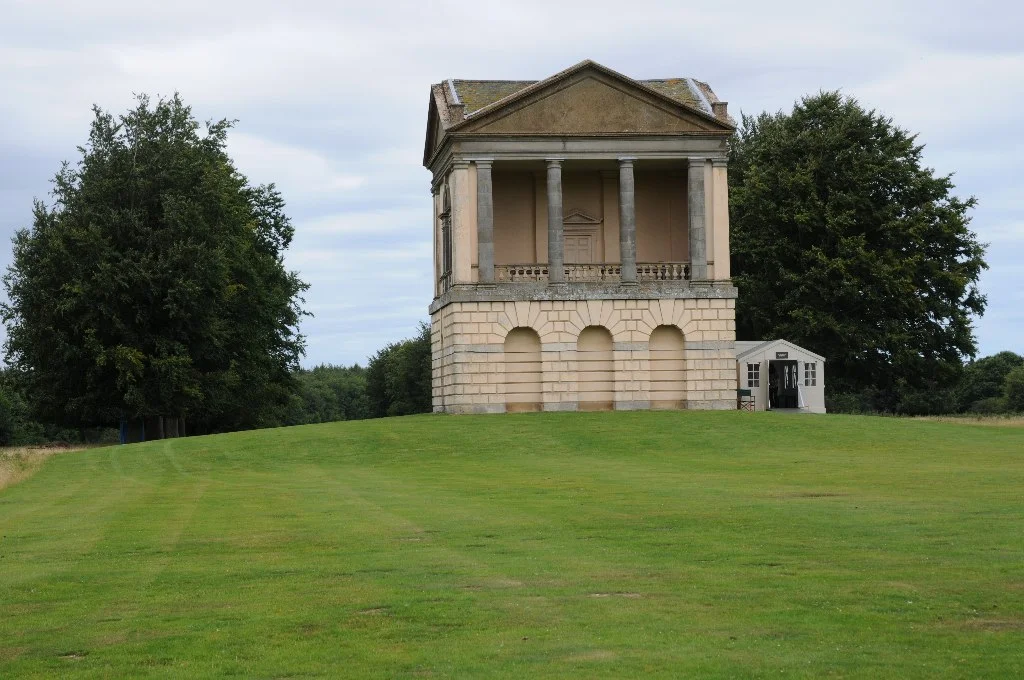
The stable block houses the Cholmondeley Collection of Model Soldiers, begun by the 6th Marquess in 1928 and now containing approximately 20,000 figures. The Houghton International Horse Trials have been held in the park annually in May since 2007. The grade I listed parkland, the folly watertower designed by the Earl of Pembroke in 1731–32, and the solitary medieval church in the middle of the grounds all remain — a layered landscape in which the 18th century and the 21st coexist with minimal friction.
From the Air
Houghton Hall lies at 52.827°N, 0.658°E in northwest Norfolk, approximately 12 km east of King's Lynn. The nearest airports are King's Lynn (EGYL) to the southwest and Norwich International Airport (EGSH) roughly 60 km to the southeast. From the air, the silver-white Palladian block of the hall is visible at the centre of a large park, with tree-lined vistas extending in four directions and the isolated Church of St Martin discernible in the open parkland to the northeast of the house. The watertower folly can also be spotted within the grounds. Best viewed at low altitude on a clear day.
Nearby Stories
- RAF East Kirkby 5.9 km away
- RAF Feltwell 8.6 km away
- RAF Matlaske 10 km away
- Chain Bridge Forge, Spalding 10 km away
- Norfolk Tank Museum 12 km away
- Skegness Lifeboat Station 14 km away
- Connington South Rail Crash 20 km away
- HMS Cobra 39 km away