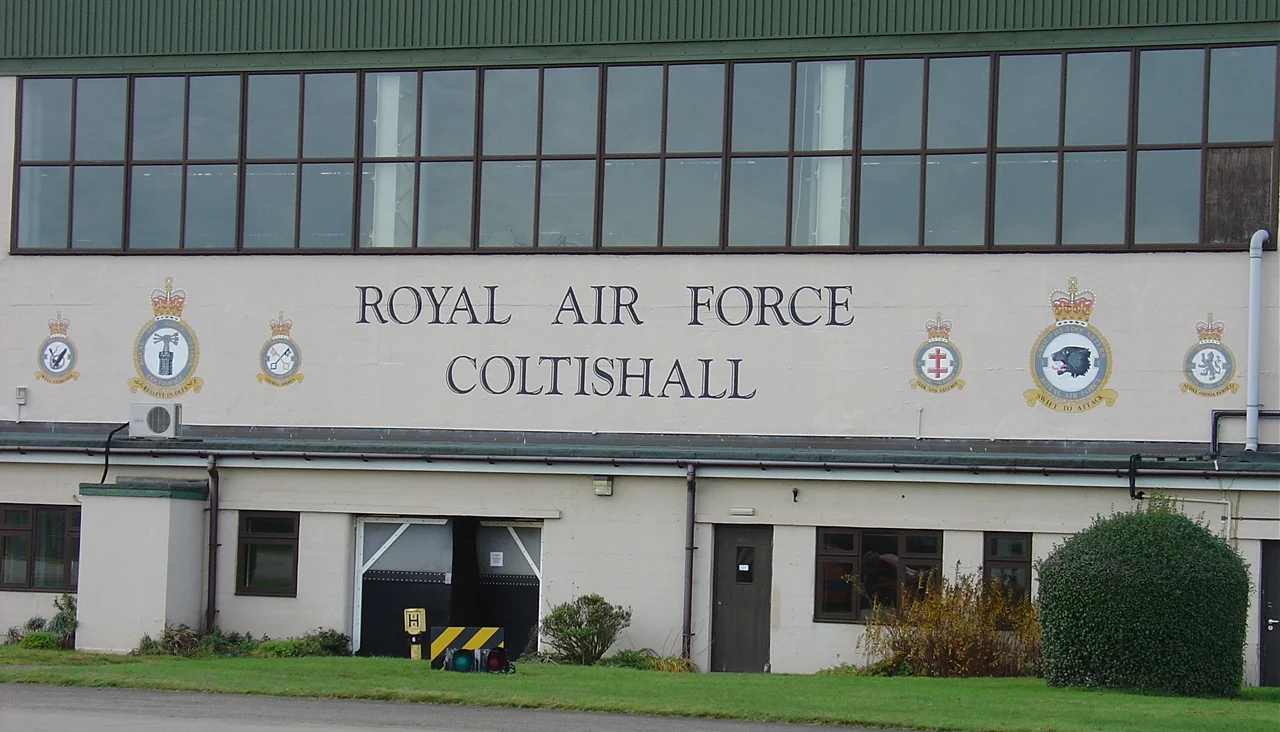

RAF Coltishall
The station motto was Aggressive in Defence — a phrase that suited Coltishall perfectly. From 1939 until 2006, the airfield 10 miles north-northeast of Norwich put fighters into the air for every major conflict and Cold War mission the Royal Air Force faced. Douglas Bader flew Hurricanes from here in 1940. Supersonic English Electric Lightnings scrambled from the same runways in the 1960s. SEPECAT Jaguars deployed to the Gulf War from this base in 1991. When the last Jaguar lifted off on 3 April 2006, it closed a chapter that had begun before the Battle of Britain.
Hurricanes and a Legend
Work began on the airfield — then called Scottow Aerodrome — before the war. It was designed initially as a bomber station, but converted to a fighter base before it entered service. The first aircraft movement was a Bristol Blenheim IV flown by Sergeant RG Bales and Sergeant Barnes. By the Battle of Britain, Coltishall was operating the Hawker Hurricane.
Among the pilots at Coltishall was Douglas Bader, appointed to lead No. 242 Squadron — a mainly Canadian unit that had taken heavy losses in the Battle of France. Bader was credited with restoring the squadron's morale and fighting effectiveness. He became one of the war's most famous airmen, and his memory remained at Coltishall long after: on the final day of the station in 2006, the replica Hurricane that had stood on a roundabout outside Station Headquarters — dedicated to Bader — was transferred to RAF High Wycombe. At the closing ceremony, a solitary Hurricane from the Imperial War Museum at Duxford flew past.
Cold War and the Jaguars
Through the postwar decades, Coltishall was home to de Havilland Mosquitos, Gloster Javelins, and from 1960, the English Electric Lightning — the RAF's first genuinely supersonic interceptor. No. 74 Squadron received the Lightning F.1 at Coltishall in June 1960, making it the first Lightning unit in service. The station also trained Lightning pilots through No. 226 Operational Conversion Unit.
The Lightnings gave way to the SEPECAT Jaguar in 1974, and for three decades the Jaguar defined Coltishall. Nos. 6, 41 and 54 Squadrons all flew from here. In 1991, Jaguar crews from all three squadrons deployed to Muharraq Airfield in Bahrain for Operation Granby — the Gulf War. Through the 1990s, Coltishall Jaguars enforced no-fly zones over Iraq and the Balkans as part of Operations Warden and Deny Flight. The station became, eventually, the last Battle of Britain airfield still operationally active in the RAF, other than Northolt.
After the Jaguars
The decision to close Coltishall came when the Ministry of Defence ruled it would not receive the Eurofighter Typhoon. With no future aircraft type assigned, the station was scheduled to shut by December 2006 but closed a month early and £10 million under budget. The disbandment parade was held on 1 April 2006. The final front-line RAF movement was Jaguar XZ112, piloted by Jim Luke, on 3 April.
The last Jaguar, formally named the Spirit of Coltishall, was transferred to the grounds of Norfolk County Council, dedicated to the memory of all who served at the station. The site was sold to Norfolk County Council for £4 million. Part of it became HM Prison Bure; another section became the Scottow Enterprise Park, covering around 600 acres of former RAF land. A 50-megawatt solar farm was built on the site in 2015 and 2016. Some of the Cold War blast walls — Historic England describes them as 'rare and outstandingly well preserved' — were designated scheduled monuments in 2008. The main guardroom became a heritage centre. The airfield that scrambled fighters for sixty-seven years now generates electricity.
From the Air
Located at 52.75°N, 1.36°E, approximately 16 km north-northeast of Norwich. The former airfield is identifiable from the air by its runway and taxiway outlines, the solar farm covering a large part of the site, and the prison buildings to the north. The nearest airport in active use is Norwich International (EGSH), approximately 16 km to the southwest. The airfield can be clearly seen at 2,000 ft in good visibility; EGSH airspace begins nearby, so check charts before descending.
Nearby Stories
- Houghton Hall 3.1 km away
- Norfolk Tank Museum 7.5 km away
- Weeting Castle 11 km away
- Skegness Lifeboat Station 25 km away
- HMS Cobra 40 km away
- Battle of Lowestoft 79 km away
- SM U-97 101 km away
- Southern Bight 112 km away