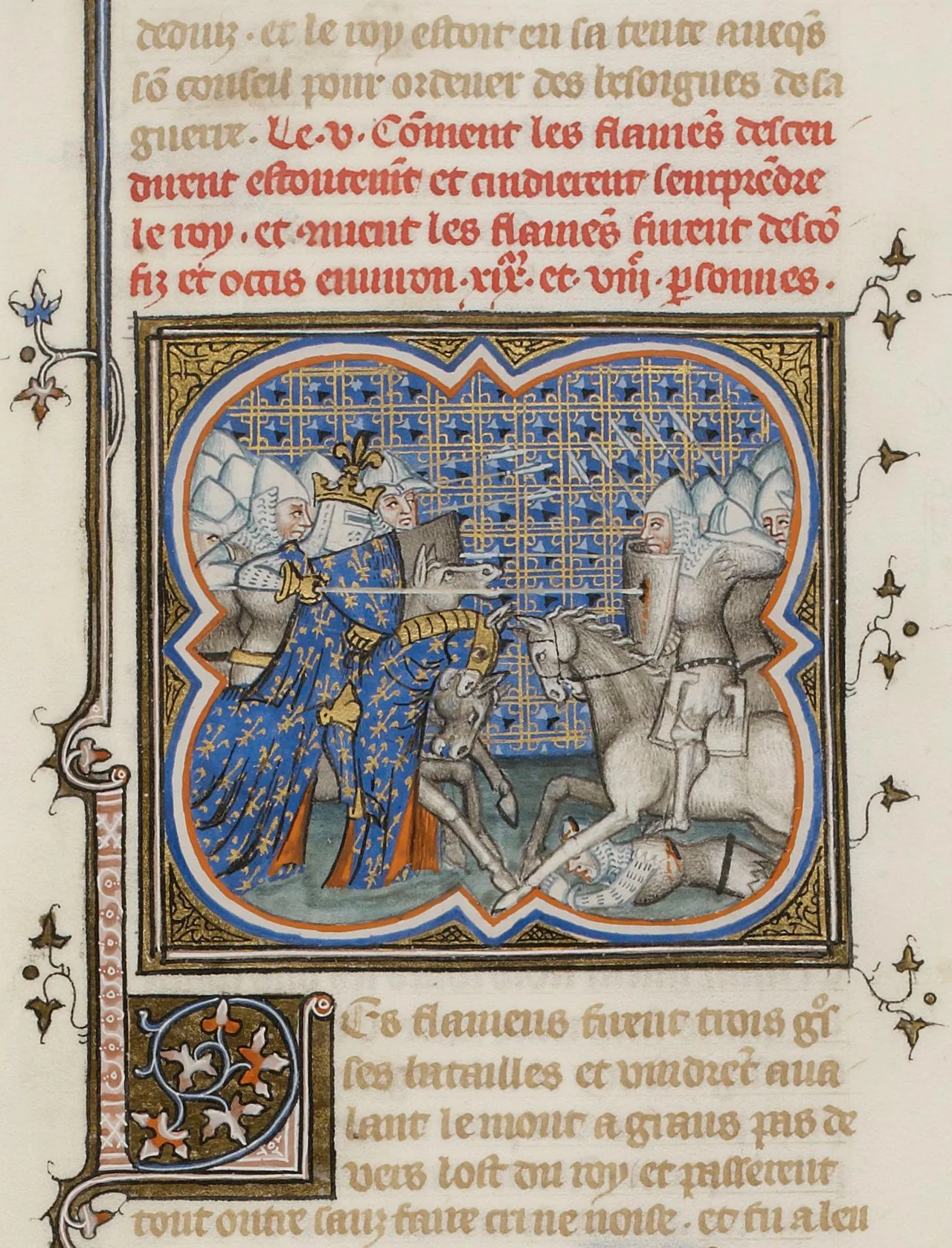
.jpg)
Battle of Cassel (1328)
The royal accountants made an inventory afterwards. Of the 3,185 Flemings killed at Cassel that day, 2,294 had owned property worth seizing for the Crown - houses, fields, looms, a few animals, the small accumulated work of provincial lives. The remaining 891 owned nothing. They had come up Mount Cassel anyway, with their leader Nicolaas Zannekin, a farmer from the village of Lampernisse on the Flemish coast. They were not knights. They were farmers and weavers and brewers from the bailiwicks of Veurne and Bergues and Bailleul and Poperinge, towns whose names today are just dots on the map of French Flanders. For five years they had refused to pay French taxes and they had won every battle they fought - Nieuwpoort, Ypres, Kortrijk. On 23 August 1328 they came down off the hill in fury and met King Philip VI of France in his first major battle as king. By nightfall they were almost all dead, and the rising was over.
Why a Farmer Led an Army
It began with money. The Count of Flanders, Louis I, was collecting taxes on behalf of Charles IV of France - too much tax, on Flemish towns that already chafed at French control. Around 1323, residents of the coastal bailiwicks simply refused to pay. The count threatened reprisals. The people, instead of backing down, rose up. Their leader was a man named Nicolaas Zannekin, of whom history records that he was a wealthy farmer from Lampernisse. Not a knight, not a noble, not a churchman: a propertied countryman who could speak both to peasants and to town magistrates. By 1325 his army had captured Nieuwpoort, Veurne, and Ypres. They took Kortrijk. They took the Count of Flanders himself - actually grabbed him and held him hostage. In February 1326 the King of France had to intervene; the count was released under the Peace of Arques, and the rebellion lapsed into uneasy stalemate. But then the Pope, asked by the king, slapped Flanders with an interdict - denying ordinary Flemings the sacraments and Christian burial. Some priests obeyed, frightened of being killed; some refused. The rebels harassed those who obeyed. The conflict deepened from a tax revolt into a war of small towns against church, count, and king at once.
The Lessons of 1302
Both sides knew the story of the Battle of the Golden Spurs. In 1302, at Courtrai, Flemish town militia armed with pikes - the same weavers and farmers who were now Zannekin's people - had butchered the French aristocracy. So many gilded spurs were collected from dead knights that the chapel where they were hung gave the battle its name. The shame still rankled at the French court a generation later. Philip VI, only crowned in May 1328, saw the Flemish rising as the perfect first test of his kingship: a chance to wipe out the memory of Courtrai and bind the aristocracy of his realm to his throne. He assembled his army at Arras in July. His commanders, with Courtrai in mind, refused to be drawn into another impetuous cavalry charge against pikemen. They would force the Flemings to fight on open ground, on terrain that favoured French heavy cavalry. The French ravaged western Flanders all the way to the gates of Bruges to provoke the rebels into a battle.
Mount Cassel
Cassel is a high hill rising abruptly from the flat lands of French Flanders - one of the few real elevations between Dunkirk and Lille. From its summit you can see for fifty kilometres in clear weather. On 23 August 1328, Zannekin's army was dug in on top, and his men watched the French regiments deploy in the fields below while smoke rose from their burning villages. There is a moment in the chronicles that says more about both sides than anything else. Zannekin sent messengers down to the French to fix the time of the battle - the formal medieval courtesy between knights. Philip's commanders received the messengers with contempt. These were not knights. These were peasants, weavers. The French dismounted, took off their armour, and went to relax in their camp; the battle could wait until they were ready. Zannekin's army learned of the insult, and decided to attack immediately. They came pouring down the hill in a fury and broke the French infantry, who were caught completely by surprise and ran. The next morning the fleeing infantrymen were found at Saint-Omer, twenty kilometres south, regrouped in shame.
Elbow to Elbow
It might have ended in another Courtrai. But Philip VI did something the chroniclers thought remarkable: in a blue tunic embroidered with golden fleurs-de-lis, wearing only a leather coif, he personally rallied his knights and led the counter-charge. The chroniclers said the army had not seen a king fight on horseback like that since Louis IX, a century before. The French cavalry came around the Flemings' flanks and forced them to form a circle - shoulder to shoulder, elbow to elbow, pikes outward. It was a defensive position that prevented retreat. The knights worked through them. Zannekin was killed. The chronicles give the Flemish dead as 3,185 men. The French claimed seventeen dead knights, which is the count of knights, not of all French casualties. The army burned Cassel to the ground. Ypres and Bruges surrendered. Louis I was restored as Count of Flanders. The properties of every Flemish combatant - dead or alive - were confiscated. A third went to the count and Robert of Cassel; the rest went to the Crown. The rising was over. Eight years later, when the Hundred Years' War began, Flanders' towns would rise against the French king again, this time in alliance with Edward III of England. But for one generation - Zannekin's generation - the answer of the French monarchy had been written on the side of a hill: this is what happens to weavers who fight kings.
From the Air
50.8000 N, 2.4872 E, on the slopes of Mont Cassel, the high hill above the town of Cassel in the Nord department. The hill rises to 176 metres, the highest point for many kilometres in any direction, and the view from the top extends to Dunkirk and across the plain of Flanders. The battle was fought on the southern and eastern slopes. Recommended viewing altitude: 2,000 to 4,000 feet to take in the dramatic isolated rise of the hill above the flat country around it. Nearest airport: Calais-Dunkerque (LFAC), 30 km north. Lille (LFQQ) is 50 km east.
Nearby Stories
- Battle of Hondschoote 3.6 km away
- Battle of Mouscron 4.3 km away
- 1921 SNETA Farman Goliath ditching 9.2 km away
- 1933 Imperial Airways Ruysselede Crash 17 km away
- Battle of Ardres 18 km away
- Courrieres Mine Disaster 19 km away
- Marcinelle Mining Disaster 91 km away
- Cléon 148 km away