
Battle of Hondschoote
Jean Nicolas Houchard knew what was coming before he took the command. 'My life is poisoned,' he wrote when he was made head of the French Army of the North in August 1793. 'Everywhere calumny has preceded me.' His predecessor Custine was already in a Paris cell waiting for the guillotine. The Representatives of the National Convention stalked his headquarters with the authority to denounce any general who hesitated. So when Houchard met the Duke of York's Anglo-Hanoverian army on the polders east of Dunkirk in early September, he attacked, won, and lifted the siege of Dunkirk. It was the first major French victory of the Revolutionary Wars on the northern front. Six weeks later he was beheaded for cowardice. The men he had saved would mostly survive him - Bernadotte, Vandamme, Jourdan, the future marshals of Napoleon, all blooded at Hondschoote.
A Cordon Spread Too Thin
While the Duke of York besieged Dunkirk to his north, the cover of his army's open left flank fell to the 76-year-old Hanoverian Marshal Heinrich von Freytag. Freytag was a veteran of the Seven Years' War who believed in the cordon system - a thin line of detachments occupying every village along an extended front. It was a Frederickian solution to a problem Napoleon's generation would teach the world to solve differently. Freytag spread his 14,500 Hessians and Hanoverians across eighteen miles of polder from Poperinge through Wormhout to Houtkerque, with no concentration anywhere. He was experienced. He was also wrong. His trust in linked outposts would prove fatal.
Forty-Five Thousand Republicans
While Freytag spread his cordon, Lazare Carnot in Paris was conjuring an army out of the Levee en Masse. By early September there were 45,800 French at the Cassel entrenched camp alone, fresh recruits and veterans from the Rhine and Moselle fronts pouring north. Houchard had 51,000 men in eight commands stretched over 18 miles facing York's 35,000 - and he had the Committee of Public Safety on his back demanding action. The plan was crude: smash through Freytag's covering line, lift the siege by threatening York's communications, give the Republic the victory it needed. At dawn on 6 September thirty thousand republicans erupted out of their positions and rolled forward through the polders.
Freytag Captured in His Own Retreat
The first day at Hondschoote was confused, soaking, and ferocious. Bambecque held all day against Houchard's column behind the Yser river until a violent rainstorm gave way to an evening assault by a young officer named Bernadotte - the future king of Sweden - whose regiment forded the swollen river and turned the position. Representative Hentz, the political officer attached to the army, refused to let the exhausted French halt for the night: 'Free men were never too tired to fight the slaves of tyrants.' On they pushed to Rexpoede. At eight in the evening Marshal Freytag, retreating in the dark and unaware that the French had taken Rexpoede, rode straight into a French outpost. He was wounded and captured. With him, briefly, was a young Prince Adolphus - the future Duke of Cambridge - who escaped thanks to the daring of his Aide-de-Camp Gerhard von Scharnhorst. Scharnhorst would go on to reform the Prussian army that eventually defeated Napoleon.
Walmoden Holds, Then Breaks
By dawn on 7 September, the Hanoverian command had passed to Count von Wallmoden-Gimborn, who pulled the broken corps back to Hondschoote and dug in: left on the village of Leysele, centre in front of the town, right on the Bergues canal. The ground favoured the defender - hedges and ditches and a single dyke approach where cavalry could not deploy. On the 8th, Houchard threw 22,000 men at it in three columns, holding back another 12,000 to pin York at Dunkirk. For four hours of close-range musketry the French could not break the Hanoverian line. Then Houchard rode out to bring up Colaud's brigade on his right, ordered Jourdan to attack again on the centre. Wallmoden, having lost a third of his force, withdrew toward Furnes in two columns covered by a Hessian battalion and his cavalry.
The Tribunal in Paris
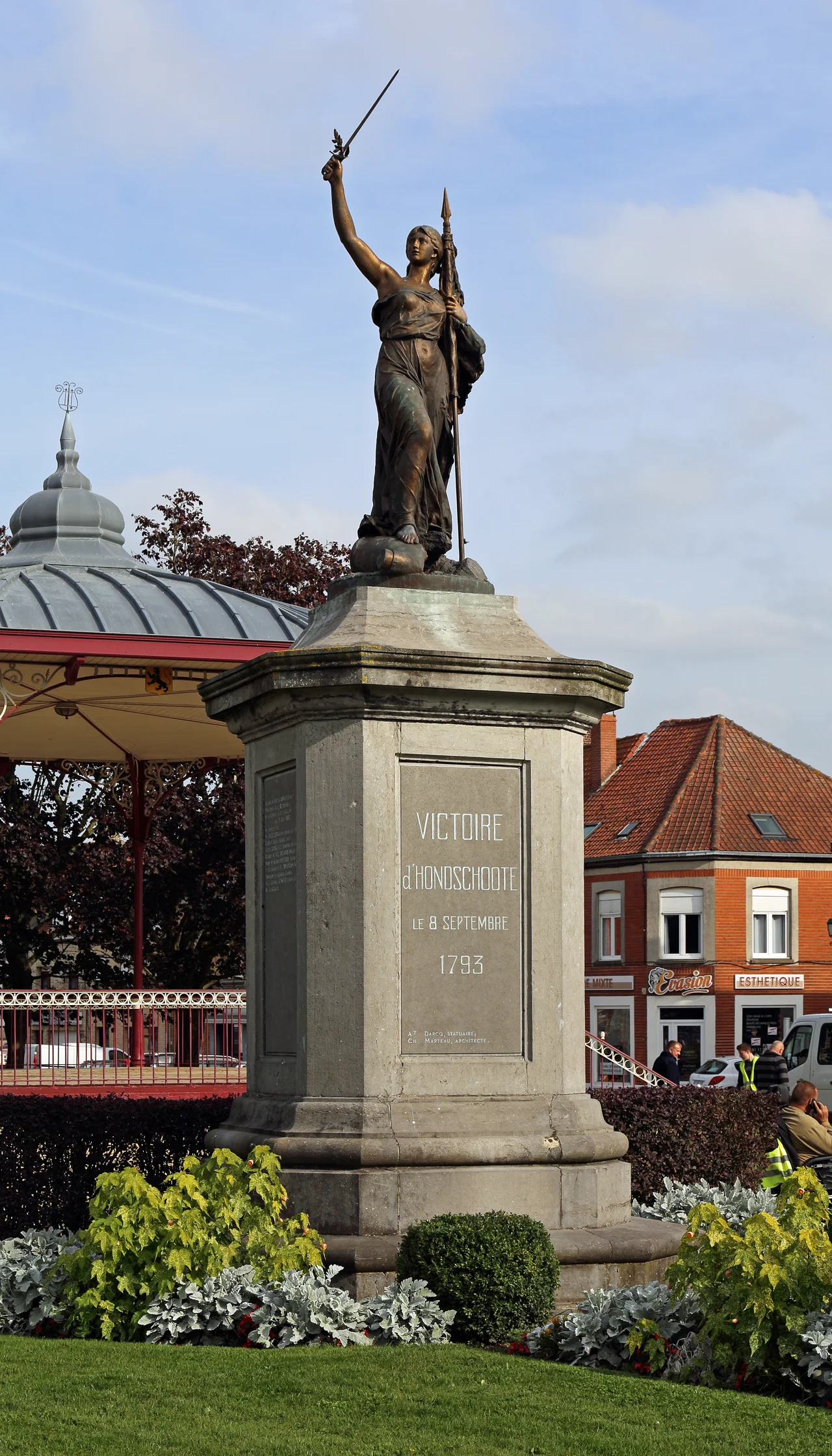
The siege of Dunkirk was over. The Duke of York spiked his abandoned naval guns and slipped away in the dark on the night of 8 September. Houchard could have pursued. He did not - York's rearguard was orderly and his own troops were 'demoralised', as he told the Representatives bluntly: 'I am not a military'. It was the wrong sentence to say in 1793. Within weeks he was arrested for cowardice, tried by the Revolutionary Tribunal, and guillotined on 15 November. The general who had given France its first victory of the Flanders campaign was killed by the same political machine that had demanded the victory. Hondschoote today displays a monument to the battle in its village square - to the soldiers, not to the commander who paid for their triumph with his head.
From the Air
Coordinates 50.98 N, 2.59 E - the battlefield lies in the polder country east of Dunkirk and just south of De Panne, a flat patchwork of canals and small villages within sight of the Belgian frontier. Hondschoote itself sits about 18 km southeast of Dunkirk and 12 km from the coast. The ground is still mostly farmland and meadow. Nearest airports: Ostend-Bruges (EBOS) 25 km northeast, Calais-Dunkerque (LFAC) 30 km west. Watch for low cloud over the polders in autumn.
Nearby Stories
- Port of Zeebrugge 3 km away
- 1921 SNETA Farman Goliath ditching 4.5 km away
- 1382 Dover Straits Earthquake 7.7 km away
- HMS Wakeful (H88) 8.2 km away
- Battle of Mouscron 8.4 km away
- Battle of Cassel (1677) 10 km away
- 1933 Imperial Airways Ruysselede Crash 12 km away
- Boulonnais 26 km away