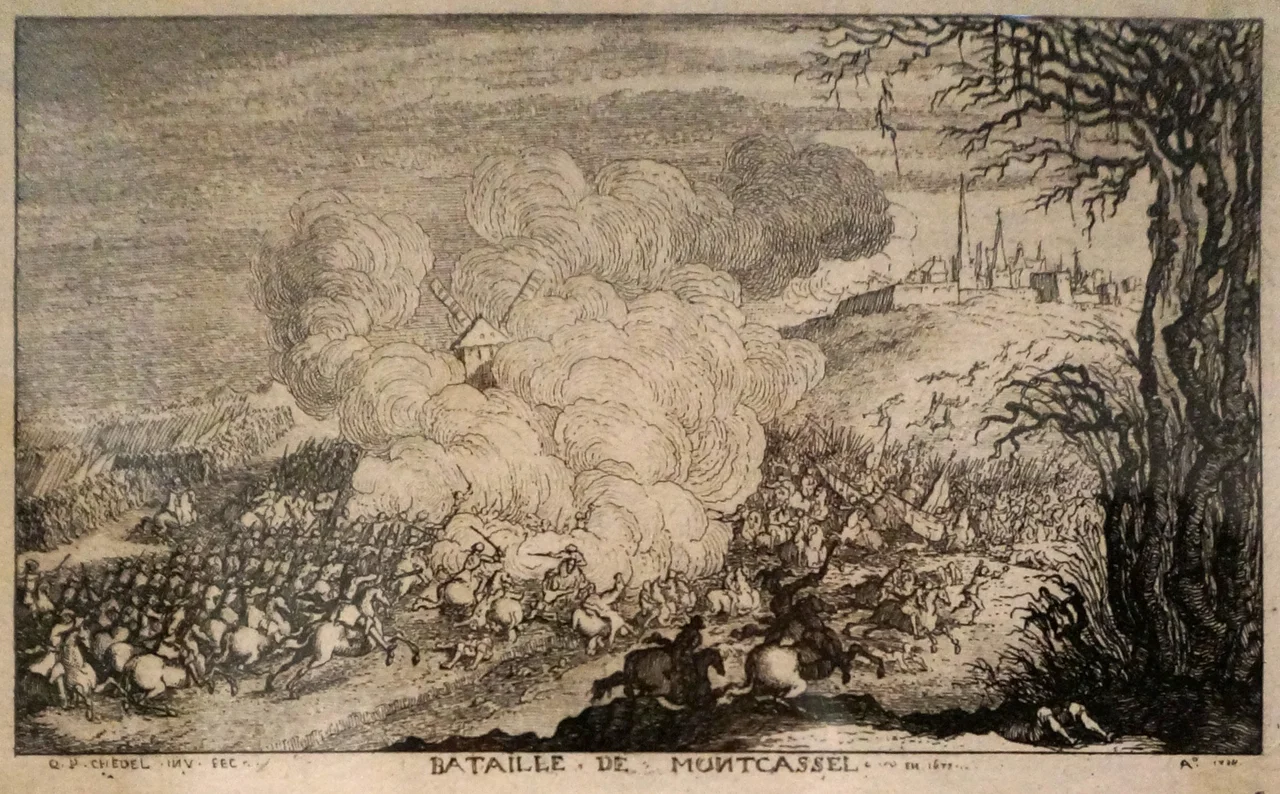

Battle of Cassel (1677)
Philippe of Orléans wore perfume and high heels, collected lovers of both sexes, and ran his household like a glittering opera. On 11 April 1677, on a stream-cut field outside the Flemish hill town of Cassel, the king's younger brother also did something no one quite expected: he led a cavalry charge that broke William of Orange's centre and won one of the most comprehensive French victories of the entire Franco-Dutch War. Louis XIV never forgave him for it.
The stream is called the Peene Becque, and it still slides through Zuytpeene, a village so small a careless commander could miss it. William did. He had crossed one arm of the water before realising there was another, and by then 38 fresh French battalions were marching up from Saint-Omer.
The Iron Border
Louis XIV wanted a frontier he could draw with a ruler. By the start of 1677 his armies already held most of the Spanish Netherlands; what remained was the frontière de fer, the iron border, and it ran through Saint-Omer, Cambrai, and Valenciennes. Take those three, the king reasoned, and the Dutch would have nothing left to fight for. So while peace negotiators argued at Nijmegen, French armies marched a full month before the usual campaigning season. Valenciennes fell on 17 March. Luxembourg turned toward Cambrai, and a smaller force of twelve thousand peeled off under Orléans and the Duc d'Humières to invest Saint-Omer. William of Orange, gathering thirty thousand men at Roosendaal, knew Cambrai was lost. Saint-Omer he might still save.
A Stream and a Mistake
The Dutch-Spanish column reached Mont-Cassel on 9 April. The mountain is not really a mountain - 176 metres above the Flanders plain - but in a country this flat it dominates the horizon, and from its summit you can see Dunkirk on a clear day. Below it, the Peene Becque drifts west through farmland. William planned a surprise attack on the morning of 10 April but could not get his troops across cleanly; he had failed to notice the river's second arm. The lost day was decisive. Luxembourg used it to absorb the reinforcements from Saint-Omer, and by dawn on the 11th the French outnumbered the Allies by more than five thousand.
Monsieur's Charge
The battle opened messily. Humières, on the French right, attacked before his infantry was up and was thrown back across the river by the Prince of Nassau. The Dutch cavalry, pursuing, ran into French artillery, retreated behind Mont-Cassel, and took no further part. Around midday Luxembourg attacked a second time, and the fighting concentrated around a cluster of farm buildings - a slow, grinding infantry struggle that the French eventually won. Then came the moment. In the centre, Prince Georg Friedrich of Waldeck punched a hole through the French line. Orléans - Monsieur, the man court gossips called timid, the brother famously dismissed as ornamental - put himself at the head of his cavalry and led the counter-charge that closed the breach. Around four in the afternoon, with both his flanks crumbling, William ordered the retreat toward Ypres.
The Cost and the Plunder
The numbers were brutal in a way that becomes abstract three centuries later. The French lost between 3,200 and 4,400 dead and wounded. The Dutch and Spanish lost between 7,000 and 8,000, with another 2,500 to 3,000 men taken prisoner. The French had a chance to turn the retreat into a rout, but the army stopped instead to loot the abandoned baggage train - a habit older than gunpowder and harder to break. Cambrai surrendered six days later. Saint-Omer fell on 20 April. The iron border was almost complete.
The Brother Who Was Too Good
Cassel was the first time Philippe of Orléans had commanded a battle from the front line. It was also the last. The story, told by contemporaries and never quite denied, is that Louis XIV grew so jealous of his brother's military celebrity that he refused him another field command for the rest of his life. Monsieur went back to Saint-Cloud and Versailles, to costumes and intrigues and a wife who hated him, and the king kept the glory for himself. The Treaties of Nijmegen in 1678 finalised what Cassel had earned: Saint-Omer, Cassel, Aire, Ypres, Cambrai, Valenciennes and Maubeuge passed permanently to France. Apart from Ypres - given back in 1697 - that border is almost exactly where it still runs today. From the air over Flanders you can see it as a thin agricultural seam where the cadastral grids change angle, the quiet ghost of a brother's one good day.
From the Air
Battlefield centred near Zuytpeene, west of Cassel: 50.80°N, 2.49°E. Best viewed from 3,000-5,000 feet on a clear day, with Mont-Cassel (176 m) the obvious landmark - it is the only real rise between the Flanders plain and the North Sea. Nearest airfields: Lille-Lesquin (LFQQ) 50 km east, Ostend-Bruges (EBOS) 60 km north, Calais-Dunkerque (LFAC) 35 km north-west. Late spring and autumn give the cleanest sightlines; the Peene Becque is hard to spot from altitude but the village of Zuytpeene and the Cassel hill are unmistakable.
Nearby Stories
- Battle of Hondschoote 3.6 km away
- Battle of Mouscron 4.3 km away
- 1921 SNETA Farman Goliath ditching 9.2 km away
- 1933 Imperial Airways Ruysselede Crash 17 km away
- Battle of Ardres 18 km away
- Courrieres Mine Disaster 19 km away
- Marcinelle Mining Disaster 91 km away
- Cléon 148 km away