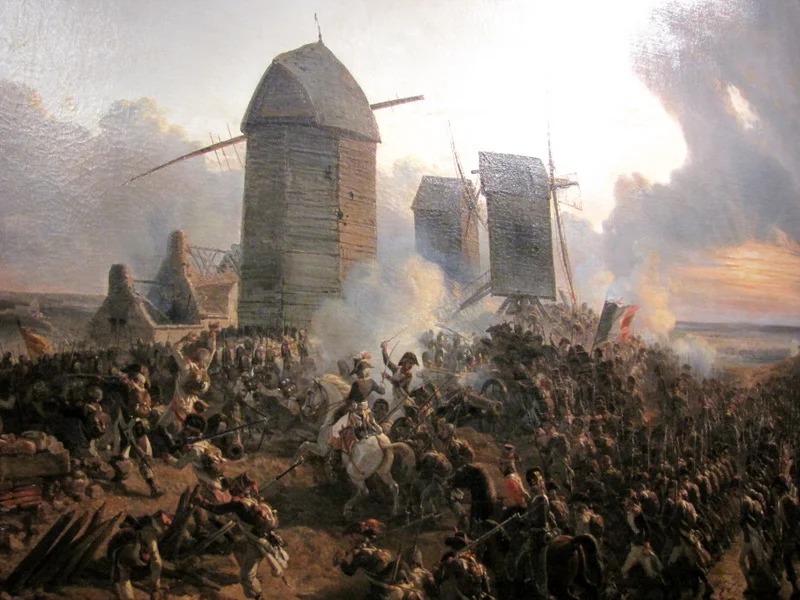

Battle of Mouscron
When Pichegru's plan for the invasion of Flanders was pulled from the pocket of a captured French colonel three days earlier, the Coalition generals knew exactly what was coming. They knew the columns, the targets, the timing. What they did not know, because Pichegru himself probably did not know, was that on the afternoon of 29 April 1794 a thickset infantry general named Joseph Souham would simply decide, on his own authority, to fight a battle that had not been ordered - and would win it. Mouscron sits today as a quiet textile town on the French-Belgian border. For two days in the spring of 1794 it was the place where Austria's defence of the southern Netherlands began to come apart.
A Plan in an Enemy's Pocket
The 1794 Flanders Campaign was supposed to open the road to Paris. Coalition forces - Austrians under Prince Josias of Saxe-Coburg, Hanoverians and British paid contingents, Dutch troops, all told around 150,000 men - pressed the northern French frontier from Dunkirk to Maubeuge. Against them, France fielded 195,000 in two armies under Jean-Charles Pichegru. The French had numbers; the Coalition had drill, discipline, and veterans. On 26 April, at the Battle of Beaumont-en-Cambresis, the Duke of York shattered a French column under René-Bernard Chapuy. Seven thousand Frenchmen fell or were captured, along with forty guns. And when Coalition soldiers searched Chapuy's coat, they found Pichegru's entire campaign plan written out: the Flanders attack, the columns, the objectives. The Coalition knew the punch was coming. They did not, quite, know how to absorb it.
Souham Decides
Pichegru's offensive opened on the Lys River. Moreau's division crossed and laid siege to Menen. Souham's oversized division - nearly 32,000 men, the largest in the army - swept south of the river and seized Courtrai. The Austrian Clerfayt, with about 10,000, struck back at Mouscron on 28 April, recovering the town. Pichegru was absent. He had been absent at Beaumont, too. The army commander had a curious habit of being elsewhere when his troops needed him. Joseph Souham, a former lawyer who had volunteered as a private in 1792 and reached general's rank in eighteen months, did not wait for orders. He pulled Jacques MacDonald's brigade east from the Menen siege lines, summoned Daendels from Courtrai, and concentrated three brigades for a counterstroke. By dawn on the 29th he had 28,000 men in striking distance of Clerfayt's 10,000.
The Long Afternoon
What followed was not elegant. Souham sent his main force at Clerfayt's front while Bertin's brigade swung wide to take the Austrian left and rear. The Austrians, expecting to spend the day preparing their own attack on Menen, were caught half-deployed. And yet they fought. Outnumbered three to one, Clerfayt's troops drove Bertin off, then twice broke up frontal assaults by Daendels and MacDonald. The Hungarian Sztáray Regiment held until it had lost eleven officers and four hundred men. At two in the afternoon Souham went forward himself, MacDonald beside him, and led the third assault in person. French artillery, massed and finally telling, did the rest. Clerfayt's line cracked. The withdrawal became a rout, halted only when the first six battalions of General Erskine's reinforcements came up at Dottignies and stood as rearguard while the wreckage of the corps streamed back to the Scheldt.
The Breakout from Menen
There was a coda. The garrison of Menen was now isolated, and a substantial part of it was French - Royalist emigres of the Loyal Emigrant Battalion who knew that surrender meant the guillotine. On the night of 30 April, under cover of dark, the Hanoverian commander Rudolf von Hammerstein led his men out of the fortress and cut a path north. They took most of their guns with them. The breakout cost the Hanoverians thirty-eight dead and four hundred captured, and the Royalists ninety-two killed, but it succeeded, and even the French called Hammerstein's conduct of the escape "creditable." Souham's victory at Mouscron, meanwhile, had stripped Coalition strategy of its eastern flank. Twelve days later, at the Battle of Courtrai, the French would consolidate what an unauthorized general had begun on a wet field on the Belgian border.
What Remains
Mouscron today straddles a language line and a state line. French is spoken in the cafes; the Wallonia-Flanders border runs through the suburbs; the French frontier is nine kilometres south. The town's modern story is one of textiles and football. But the Lys valley below, with its slow water and pollarded willows, looks much as it did when 28,000 Frenchmen marched across it in muddy spring boots and an Austrian count, unprepared and outnumbered, ordered his veterans into a fight he should have refused. The historian Phipps called Souham's decision "praiseworthy." It was something rarer than that: a junior general thinking faster than his army commander, with thousands of lives on the outcome.
From the Air
Coordinates 50.73 N, 3.22 E - on the French-Belgian frontier, 9 km south of Kortrijk. Nearest airports: Lille-Lesquin (LFQQ) 20 km south-west, Kortrijk-Wevelgem (EBKT) 12 km north-east. From cruising altitude, the flat Lys valley reads as a patchwork of small fields with the Tournai-Kortrijk-Ghent corridor of motorways and canals running through it. The 1794 battlefield lies between Mouscron and the hamlet of Dottignies. Best viewed in clear weather from 8,000-15,000 feet.
Nearby Stories
- Fort Knokke 0.6 km away
- Ghislenghien disaster 4.9 km away
- Flanders 9.7 km away
- Poeke Castle 11 km away
- Reningelst 12 km away
- Courrieres Mine Disaster 32 km away
- Marcinelle Mining Disaster 42 km away
- Royaumont Abbey 148 km away