
Reningelst
There is a meadow on the edge of Reningelst that used to be a castle, and before the meadow was a meadow it was a marshalling yard. From 1915 to 1918 a double set of railway tracks ran across this grass, and the trains that came down them carried men who had a fair chance of dying in the next two weeks. Now there are cows in the field, and a quiet cemetery half a mile away, and almost nothing else to mark what happened. The village has 1,405 people. It calls itself a wielerdorp - a cycling village - and every summer the kermisweek brings bike races that loop through the hop fields. The rest of the year is quiet enough that you can hear bees.
Walk into the cemetery beside Sint-Vedastuskerk and the silence sharpens.
A Castle, A Fire, A Railway
Reningelst's recorded history goes back nearly a thousand years, to a fortified castle built here around 1100 - a wooden keep on a low rise, defending the road between Ypres and the coast. The castle survived war, plague, and reformation. It did not survive Napoleon. On 6 September 1793, General Dominique Vandamme - born in nearby Cassel, no friend of the old order - ordered the castle burned. By the next century there was nothing left of it. So when the British Army needed a flat space to lay rails for its trench logistics in 1915, the old castle meadow was already cleared and waiting. The double track that ran across it became part of the spider web of light railways feeding the Ypres salient with men, shells, food, and stretcher cases.
The Stopover
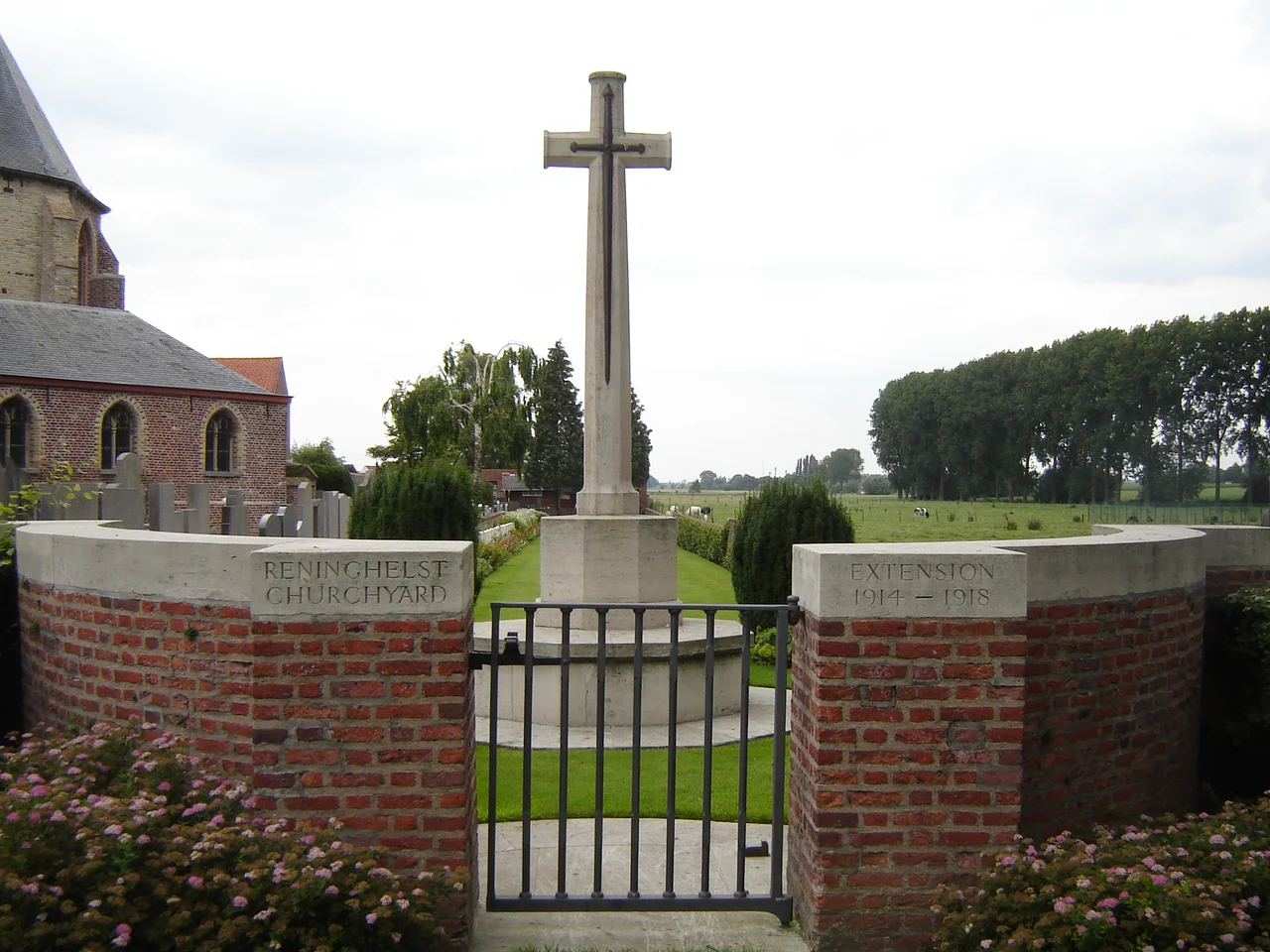
Reningelst sat just far enough behind the lines to be useful. Battalions marching out of Ypres for a rest came through here. Battalions marching back into Ypres for an attack came through here. The village absorbed them - billeting men in barns, in the schoolhouse, in the brewery on the square that made a dark beer called Roökop, Red Head in the local dialect. The estaminets did good business. Some of the soldiers stayed longer than they meant to. Three cemeteries in the parish now hold the men who did not march back out. The Reninghelst Churchyard Cemetery sits beside the old village church and holds the earliest dead. The Reninghelst New Military Cemetery, opened when the churchyard filled, holds the later ones - including a separate plot for men of the Chinese Labour Corps who died here of disease, of injuries from shell-clearing work, of the influenza that swept the rear areas in 1918. Their headstones face east, inscribed in Mandarin, almost five thousand miles from the villages they were recruited from.
The Church That Will Not Stay Down
Sint-Vedastuskerk is the obvious building in Reningelst - a Gothic parish church on the village square, named for Saint Vedast, the sixth-century evangelist of Arras. The current building dates from around 1623, and the date matters because almost nothing about its history is peaceful. In 1568, during the religious wars that broke Flanders, three local priests were murdered in this church. In 1623 it was burned by the Geuzen, Calvinist sea-beggars and rebels who hated Catholic ornament. During the First World War shelling reduced much of the village around it to rubble, but the church survived enough of its frame to be repaired again. Inside, a substantial amount of the wooden interior is genuinely old, kept through every cycle of destruction by parishioners who, like the keikoppen of Poperinge, refused to be told their village did not matter.
Roökop and Comfort
The brewery on the village square stopped making beer in the 1960s. Part of it collapsed into ruin. The rest the village kept as a community building and named, in keeping with the lost beer, Rookop. The cultural centre houses sports clubs and hobby groups now, and amateur theatre, and since 2006 a one-day festival held each summer called Troost van Schoonheid - the Comfort of Beauty. The name is taken from the idea that small towns earn beauty by enduring, and that beauty is its own quiet form of consolation. The festival programmes poetry and chamber music in the old brewery's halls. People come from Ypres and Poperinge and across the French border to listen. It is the kind of gentle thing a place builds once it has decided not to be defined entirely by what was done to it.
What Remains
Piet Chielens grew up in Reningelst, born here in 1956. He runs the In Flanders Fields Museum in Ypres now, and his life's work has been making the war comprehensible to the visitors who arrive in busloads from Britain and Canada and Australia each spring. He had to learn the war from the inside out - from the men who slept in his grandparents' barn on their way to Ypres, from the cemetery at the end of his street, from the elderly farmer who still turned up shell fragments in his fields every plowing. Reningelst is a small village. It is also a small village that has held more grief than most cities, and held it carefully. Stop for an hour. Walk the cycling-village lanes. Find the cemetery beside the church. Read a few of the names.
From the Air
Reningelst at 50.82°N, 2.76°E, a 5 km drive south-east of Poperinge in the gently undulating ground of the Westhoek. Visible from 2,000-3,000 feet as a tight clump of houses around Sint-Vedastuskerk's spire, with three small cemeteries within walking distance of the square. The village sits on the lip of the Heuvelland ridge, the Flemish hills that mark the southern edge of the Ypres salient - Kemmelberg rises 154 m two miles south-east. Nearest airfields: Wevelgem (EBKT) 25 km east, Ostend-Bruges (EBOS) 55 km north, Lille-Lesquin (LFQQ) 50 km south.
Nearby Stories
- Le Paradis Massacre 3.4 km away
- Yser 6 km away
- Brugge Railway Station 6.3 km away
- Battle of Courtrai (1814) 9.5 km away
- Battle of Ardres 9.9 km away
- 2021 English Channel Disaster 18 km away
- Marcinelle Mining Disaster 94 km away
- Cléon 165 km away