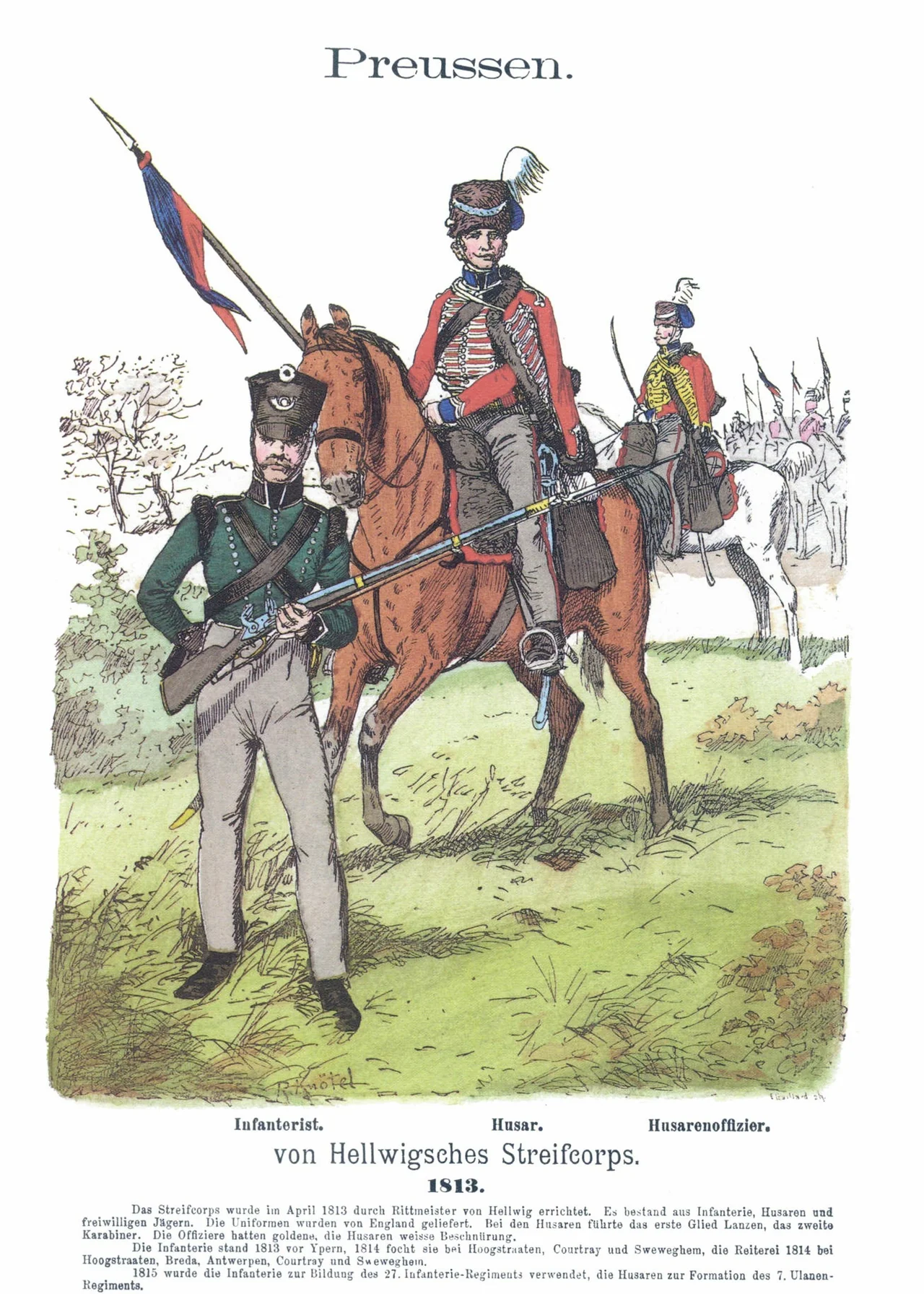

Battle of Courtrai (1814)
While Napoleon was losing France, Nicolas Joseph Maison was busy winning a corner of Belgium. On the morning of 31 March 1814, even as Cossacks were riding through the gates of Paris five hundred kilometres to the south, the French I Corps stood drawn up in battle order outside Kortrijk. Across the fields toward Zwevegem advanced 7,725 Saxons under Johann von Thielmann, most of them green Landwehr conscripts who had never seen a musket fired in anger. The campaign that decided Europe's future was already over. The battle that was about to start did not know it yet.
An Empire on the Edge
By March 1814 Napoleon's grip on Europe had loosened almost to nothing. In the east, Schwarzenberg's Army of Bohemia and Bluecher's Army of Silesia were grinding into north-eastern France. To the north, Bernadotte's Army of the North, with Prussians under Buelow and Russians under Wintzingerode, had liberated the Netherlands, mostly. In Belgium, the French general Nicolas Joseph Maison had been left with the unenviable job of holding the Low Countries with about 11,000 men against perhaps four times that number. Antwerp's massive fortifications held; Brussels was abandoned; Ghent and Kortrijk changed hands as cavalry probed for cracks. Maison was outnumbered, undersupplied, and running out of country. His response was not to dig in but to march - hard, deceptive, faster than his enemies expected.
Maison's Manoeuvre
On 25 March, Maison sortied from Lille with the 4th and 6th Young Guard divisions, Solignac's infantry, Castex's Guard cavalry and 21 guns - in all just over 7,000 men. He brushed aside a Prussian Freikorps at Menen, then sent a brigade racing east to Petegem to make the Coalition think he was after Oudenaarde. The next afternoon, his vanguard appeared before Ghent at two o'clock and surprised the defenders so completely that a brand new Belgian regiment was rounded up in mid-formation. The 200 Don Cossacks of the garrison rode out bravely and were cut to ribbons by the 2nd Guard Lancers. From Ghent, Maison sent a courier to Antwerp with orders for Roguet's division to break out and join him. By 27 March, his small corps had grown to nearly 10,000 foot, 1,360 horse and 35 guns - still outnumbered, but no longer hopelessly so.
Bait and Switch
Maison's gift was for misdirection. He let it leak through Belgian intermediaries that he intended to march on Brussels. The Duke of Saxe-Weimar believed him and shifted Wallmoden's division to Aalst to block the road. The real threat was Thielmann, a Saxon corps commander aggressive enough to cut Maison off from Lille. On 30 March, with Wallmoden chasing shadows in the east, Maison evacuated Ghent and marched south-west along the Leie River toward Kortrijk. Thielmann took the bait. Believing the French were already streaming back toward France in disorder, he raced south to Avelgem to catch what he thought was Solignac's isolated rearguard, summoned Wallmoden to support him from Oudenaarde, and at first light on 31 March pushed forward to Zwevegem.
Saxon Conscripts, French Veterans
What Thielmann found was not a rearguard. It was the entire I Corps, ranged in battle order across his front. Maison saw the Saxon brigades coming up the road from Oudenaarde - one direction, no flanks covered - and immediately ordered Solignac out from Bellegem to strike their left, Barrois from Harelbeke to swing into their right, while Roguet's veterans and Castex's Guard cavalry held the centre. The trap closed slowly. Most of the Saxon force was Landwehr - militia regiments raised the previous autumn, drilled through a Belgian winter, never under fire. They fought as well as they could. Prince Paul of Wuerttemberg pushed his Landwehr columns forward, met four battalions of Roguet's Tirailleurs led by the 10th, and a noisy musketry duel sputtered across the open ground. When Thielmann finally understood what he was facing, he ordered retreat. It was too late.
The Collapse
The Saxon Hussars charged to extricate the 1st Landwehr Regiment, and largely succeeded. But Barrois and Solignac were now closing fast from both flanks. Castex's 2nd Guard Chasseurs hit the Saxon Cuirassiers, threw them back, and rode into the infantry behind. A battalion of the 3rd Landwehr, pinned against a stone wall with nowhere to go, surrendered intact. Soldiers who had been farmers six months earlier scattered across the countryside; some drowned trying to swim the Scheldt at Kerkhove. Estimates of Saxon losses range from about 1,100 to nearly 2,000; French casualties were perhaps 800. Maison turned his guns on Tournai that night to keep his enemies looking the wrong way, then slipped his slow-moving wagon train home to Lille. On 5 April, on the road to Valenciennes, he learned that Paris had fallen six days earlier. Napoleon abdicated the next day. Maison and Thielmann signed an armistice on 7 April. The last battle of the First Empire on Belgian soil had been won by the French, for nothing.
From the Air
Coordinates 50.83 N, 3.27 E - Kortrijk on the Leie River, between Lille and Ghent. Nearest airports: Kortrijk-Wevelgem (EBKT) inside the city, Lille-Lesquin (LFQQ) 25 km south-west, Ostend-Bruges (EBOS) 50 km north-west. The battlefield lay between Zwevegem and Bellegem, ground now covered by suburbs and the Kortrijk ring road. Best viewed in clear weather from 6,000-12,000 feet.
Nearby Stories
- Battle of Beverhoutsveld 2.9 km away
- Battle of Nieuwpoort 5.2 km away
- Westvleteren Brewery 6.4 km away
- Le Paradis Massacre 12 km away
- Aalst, Belgium 13 km away
- Zaamslag Castle 18 km away
- Courrieres Mine Disaster 39 km away
- Belgium 47 km away