_-_Slag_op_het_Beverhoutsveld.png)
Battle of Beverhoutsveld
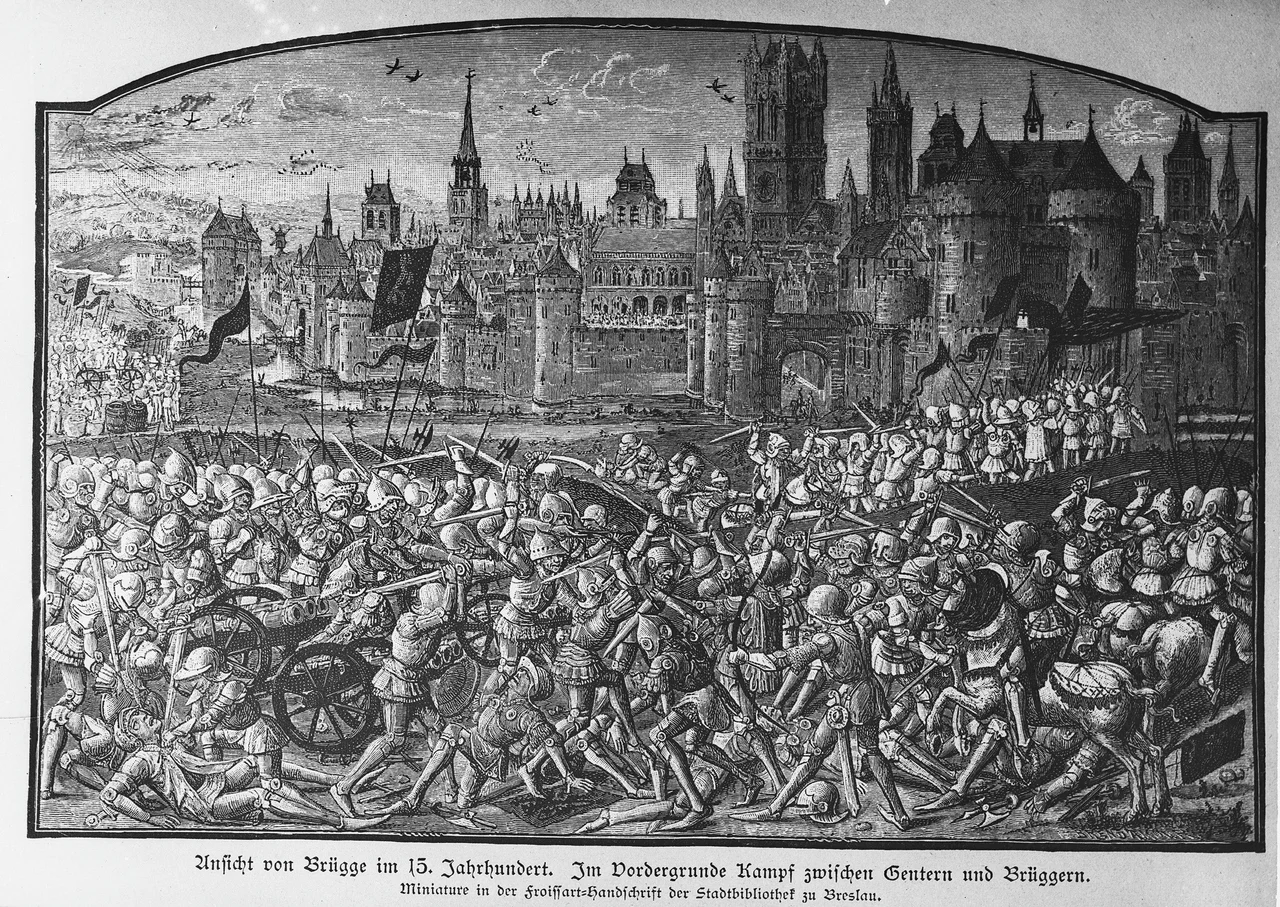
The militia of Bruges that marched out on the morning of 3 May 1382 had been to mass. Specifically, they had been to the annual Procession of the Holy Blood, the most important religious holiday in the city. After the procession the inns and taverns of Bruges had done a roaring trade. Many of the men marching east toward the open field of Beverhoutsveld had stopped at one tavern, then another, then a third, fortifying themselves with the kind of courage that comes out of a tankard. Eight kilometres away, on a flat field between Beernem and Oostkamp, the army of Ghent was waiting for them. Among the things waiting were several hundred small wheeled cannon called ribauldequins. Almost nobody in 1382 had ever fought against massed gunpowder artillery before. By sundown, fewer would want to.
Two Cities at War
The fourteenth-century Flemish economy ran on cloth. Wool came from England, was woven in the great cities of Flanders, and sold across Europe. Ghent and Bruges were the two largest looms in the room, and they cordially despised each other. Ghent's powerful guilds had risen against the Count of Flanders, Louis II - sometimes called Louis of Male - in 1379, demanding privileges and an end to noble interference. Bruges, more conservative and more closely tied to the count's revenues, stayed loyal. Louis blockaded the roads into Ghent to starve it out. After three years of slow strangulation, Ghent was hungry, broke and almost out of options. Its leader was a thin, fiery man named Philip van Artevelde, son of the great Jacob van Artevelde who had led the previous Flemish revolt in the 1340s. Philip had tried negotiation in Tournai. The talks broke down. The only door left open led to Bruges, and through that door was the sea.
Ribauldequins on the Field
Artevelde's army did not march on Bruges directly. They stopped at Beverhoutsveld, an open heath about an hour's march from the city walls, and drew up in a defensive line with the artillery placed on one flank to rake any approaching enemy. The artillery was the surprise. A ribauldequin was a wheeled platform mounting many small barrels - sometimes twelve, sometimes forty - bound together to fire in a single volley. It was the early-medieval ancestor of the machine gun, crude and slow to reload but devastating at the first discharge. Several hundred of these had been assembled by the men of Ghent. Whether the militia of Bruges, marching out to meet them, understood what they were walking toward, the chronicles do not say. They would have heard cannon used in sieges; they had probably never seen artillery used in the open against troops.
The Discipline of Strong Beer
The Bruges contingent came up the road in the late afternoon. They had been fortified, the contemporary accounts agree, by long stops at every inn between the cathedral and the city gates. Their order was poor; their courage was loud. The Ghent line waited. When the Bruges militia came in range, the entire artillery battery opened fire at once. The effect was less in casualties than in noise and confusion: a wall of black smoke, several hundred small balls in the air at once, the screams of struck men, and behind it the hard ranks of Ghent guildsmen now coming forward on the attack. The Bruges line halted, wavered, and broke. Philip van Artevelde's men pursued them all the way back to the city, occupied Bruges that same evening, and chased Count Louis himself, who escaped only by hiding in a poor woman's house overnight and slipping out at dawn for the safety of Rijssel - the town we now call Lille.
A Dragon and a Tower
Legend - and only legend, but the kind of legend Flemish cities cherish - says that the Ghent victors stripped a metal dragon from St Donatian's Cathedral in Bruges and dragged it home to mount on top of their own Belfry tower, where it sits as a triumphal trophy to this day. Whether the dragon really came from Bruges, or from Constantinople via a returned crusader, depends on which medieval chronicler you trust. What is certainly true is that Beverhoutsveld electrified Flanders and beyond. With Bruges fallen, the whole county rose against Count Louis: only Dendermonde and Oudenaarde held loyal. The shockwaves went further. There were uprisings and riots in Holland, in Leuven, in Paris, in Rouen, in Amiens - the same network of weaver-cities, the same resentment against princes, the same flicker of hope that a single armed crowd might change everything.
Six Months to Roosebeke
The hope lasted six months. King Charles VI of France could not allow a successful guildsman's republic in Flanders, not with his own cities watching closely. A royal army marched north. On 27 November 1382, at Westrozebeke - now Roosebeke - the king's knights and crossbows broke the Ghent army utterly. Philip van Artevelde died on the field; the chronicler Froissart says his body was found face down in a heap of his own men. Louis of Male returned to his county, exhausted and old, and died at Saint-Omer in January 1384. The dream of Beverhoutsveld - guild against count, gunpowder against feudal cavalry, city against king - was over for a generation. But it had happened, and it had worked, and the small cannon on their wheels had spoken into European history for the first time. The military historians of later centuries would mark Beverhoutsveld as one of the first battles where gunpowder weaponry decided the outcome. The bigger lesson - the one Ghent and Bruges would relearn the hard way in 1453 and 1488 and beyond - was that the field could be won and the war still lost. A memorial plaque, today, marks the field in the Bibliotheekstraat in Ghent.
From the Air
Coordinates 51.16 N, 3.38 E - flat heath country east of Bruges, between the villages of Beernem, Oostkamp and Assebroek. Nearest airports: Ostend-Bruges (EBOS) 25 km west, Ghent (EBGT) 30 km east. The historic battlefield is now suburban farmland and woodland; the line of the Ghent-Ostend canal cuts through the area immediately to the north. Best viewed in clear weather from 3,000-7,000 feet.
Nearby Stories
- Zaamslag Castle 8.5 km away
- Eastern Scheldt 8.8 km away
- Battle of Nieuwpoort 11 km away
- Westvleteren Brewery 11 km away
- Molenbeek-Ter Erpenbeek 12 km away
- Flanders Field American Cemetery and Memorial 14 km away
- Westhove Castle 15 km away
- Four Days' Battle 42 km away