_-_2_Fases.jpg)
Battle of Nieuwpoort
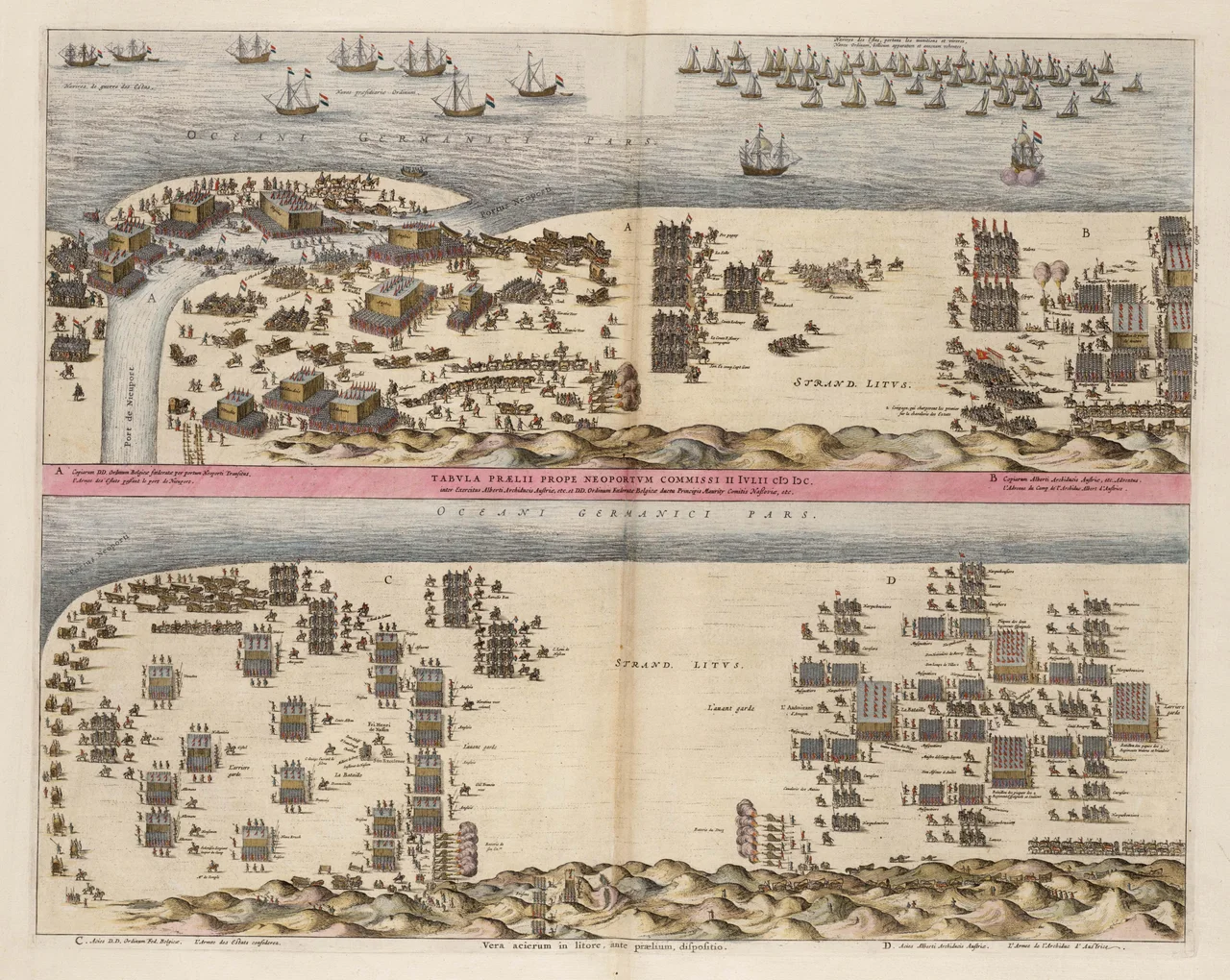
By midday the tide was coming in, and the beach was disappearing. The Spanish army, which had been advancing along the coast in battle order, was forced off the shrinking sand and up the slippery dunes. Maurice of Orange watched from the top of the highest dune and recognised what was being handed to him. His army had spent the morning expecting to be massacred. His cousin Ernst Casimir had just lost six hundred Scots at the Leffinghen bridge. He had no line of retreat except the sea behind him. Now the enemy was climbing into his guns. The Battle of Nieuwpoort, fought on 2 July 1600 in the dunes outside this small Flemish port, was a Dutch Republic against a Habsburg Spain that had ruled the field for a century. It became the first battle in which Spain's tercios were beaten in open ground.
Two Sons of Dynasties
The commanders were thirty-two and forty years old. Maurice, Count of Nassau, was the son of William of Orange, leader of the original Dutch rebellion, and had been fighting since boyhood. In the five years before Nieuwpoort, Maurice had quietly engineered a military revolution. He drilled his men in standardised commands, broke down the heavy old infantry blocks into thinner mobile lines that could deliver rolling musket fire, and kept thorough written records of pay, rations and equipment. The army that walked onto the dunes that morning was the prototype of every modern European force that followed. Archduke Albert of Austria, son of Holy Roman Emperor Maximilian II, ruled the Habsburg Netherlands jointly with his wife Isabella, daughter of Philip II of Spain. He had little battlefield experience. His army was as veteran as Maurice's was new, but it was unpaid. Mutiny had become routine. Several mutinous regiments along the Dutch border had set up small bandit republics of their own. The Archduke rallied some of them for this campaign on the promise of free plunder.
The Dunkirk Plan
The strategic prize was Dunkirk. Spanish corsairs called Dunkirkers used it as a base to prey on Dutch and English shipping, and capturing it would have been worth a great deal politically as well as economically. Two earlier landing attempts in 1594 and 1595 had failed. The new plan was to ship an army from Holland across the Scheldt estuary to Dutch-held Ostend, march south along the coast, take the small port of Nieuwpoort, then push on to Dunkirk. Maurice himself preferred Sluis to the north as a target, closer to the Republic and easier to supply, but the Dutch government overruled the military. By 21 June, Maurice had assembled 12,000 infantry and 2,000 cavalry. On 30 June he marched out of Ostend. On 1 July he arrived in front of Nieuwpoort and sent two thirds of his army across the Yser to blockade the town from the west.
Leffinghen and the Yser
That night Maurice learned that Albert was much closer than expected, marching fast with a field army that would soon cut him off from Ostend. Maurice ordered his cousin Ernst Casimir of Nassau-Dietz to delay the Spanish at the Leffinghen bridge with the Edmonds Scottish regiment, the Van der Noot Dutch regiment, four troops of cavalry and two guns. By the time Ernst arrived, the Spaniards already held the bridge in great strength. They charged. The Scots broke. Over six hundred Scots were killed. Five of their twelve company commanders fell on the field. Two more were executed by the Spanish afterwards, the kind of detail that the records preserve and that armies remember. The Dutch cavalry fled in panic. Ernst Casimir's command effectively ceased to exist. Maurice, hearing this, hurried the bulk of his army back across the Yser to face Albert on the dunes. He had no choice but to give battle. A retreat to the boats with the Spanish army on his back would have been a massacre.
The Dunes at Midday
Maurice posted his best regiments on a stretch of high dunes, guns on both flanks ready to enfilade. The English regiments under Francis Vere, twenty-four companies strong, held the front line. The Spanish reached the beach below at noon. The tide rose. Mutineer regiments in the Spanish vanguard charged up the dunes without orders and were thrown back in disorder. The Spanish light cavalry was routed by Dutch cuirassiers. The Sapena and Avila tercios in the second line attacked the Frisian regiment on the Dutch right and pushed it back hard. Maurice committed his whole second line to stabilise. An Anglo-Dutch fleet moved close inshore and began bombarding the Spanish positions. Maurice sent his cavalry against the Spanish flank, but the third Spanish line held and the Dutch horse retreated with heavy losses.
Push of Pike
On the Dutch left, the English regiments faced the veteran Monroy and Villar tercios, the elite of the Spanish infantry. The English drilled in Maurice's new tactics, keeping a rolling fire, and the Spaniards came up the slope at a steady pace behind a screen of harquebusiers. The fight was even until it came to the push of pike, the clash of long spears at close range, where the tercio formation had been unbeaten for a century. The Spanish drove the English off the top of the hill. Francis Vere called for reinforcements. They did not come in time. The English broke. But the Spanish were exhausted, their pike and musket units mixed in disorder after the climb, and Maurice sent his last reserve of cavalry, three small troops, into their flank. The charge worked beyond hope. The Spanish staggered into a slow retreat. Vere rallied his English companies behind a battery, the third Dutch line finally arrived, and the front began to crumble.
The Cavalry Goes Twice
On the Dutch right, the Archduke committed his third line for one last push. Maurice asked his tired cavalry for one more charge under his cousin Louis. They delivered it. The Spanish cavalry broke and left the field. The infantry, attacked now in both front and flank, gave ground, then broke unit by unit, leaving their guns behind. Spanish losses ran between 2,500 and 4,000 killed and wounded, six hundred prisoners, ninety standards captured. The Scots and Zeeland colours lost at Leffinghen the day before were recaptured. Allied losses were also high, between 1,700 and 2,700 including Leffinghen, and the English under Vere had taken most of the heaviest fighting and lost nearly six hundred men. The garrison in Ostend stayed inactive, which let the Spanish survivors escape into the dunes.
Aftermath
Maurice stayed at Nieuwpoort for fourteen days, then withdrew. The army never reached Dunkirk. The Flemish, whom the Dutch had hoped would rise in support, stayed loyal to the Spanish crown. Strategically the campaign was a failure. Tactically the lesson cut both ways: Maurice's reformed infantry had been pushed off a strong defensive position by traditional Spanish methods, and only his cavalry had saved him from defeat. But the symbolic weight was enormous. A Spanish field army had been driven from the ground, a rare event in 1600, and Maurice's new system of drill and small-unit musket fire had been tested in earnest against the best infantry in Europe. Spanish observers took notes and began increasing their own light cavalry. News of the victory reached England, where Elizabeth I called Vere the worthiest captain of our time. Isabella, in Brussels, took news of the defeat hard, then was relieved that her husband had escaped the rout.
From the Air
The battle was fought in the dunes a short distance west of Nieuwpoort, at approximately 51.1558 N, 2.7383 E. The terrain has changed but the coastline runs the same line; the dune belt and adjacent beach at low tide remain visible features. The Yser River reaches the sea at Nieuwpoort. Modern airports in the vicinity are Ostend-Bruges (EBOS) about 17 km northeast and Lille-Lesquin (LFQQ) 75 km south. Recommended viewing altitude 2,000 to 4,000 feet. A Prince Maurice memorial stands in Nieuwpoort. North Sea fog can move in quickly off the coast.
Nearby Stories
- Bruges Public Library 5.3 km away
- Westhoek 8.9 km away
- 1382 Dover Straits Earthquake 14 km away
- Battle of Ardres 16 km away
- Battle of Courtrai (1814) 18 km away
- Westhove Castle 26 km away
- Four Days' Battle 35 km away
- Battle of the Gabbard 55 km away