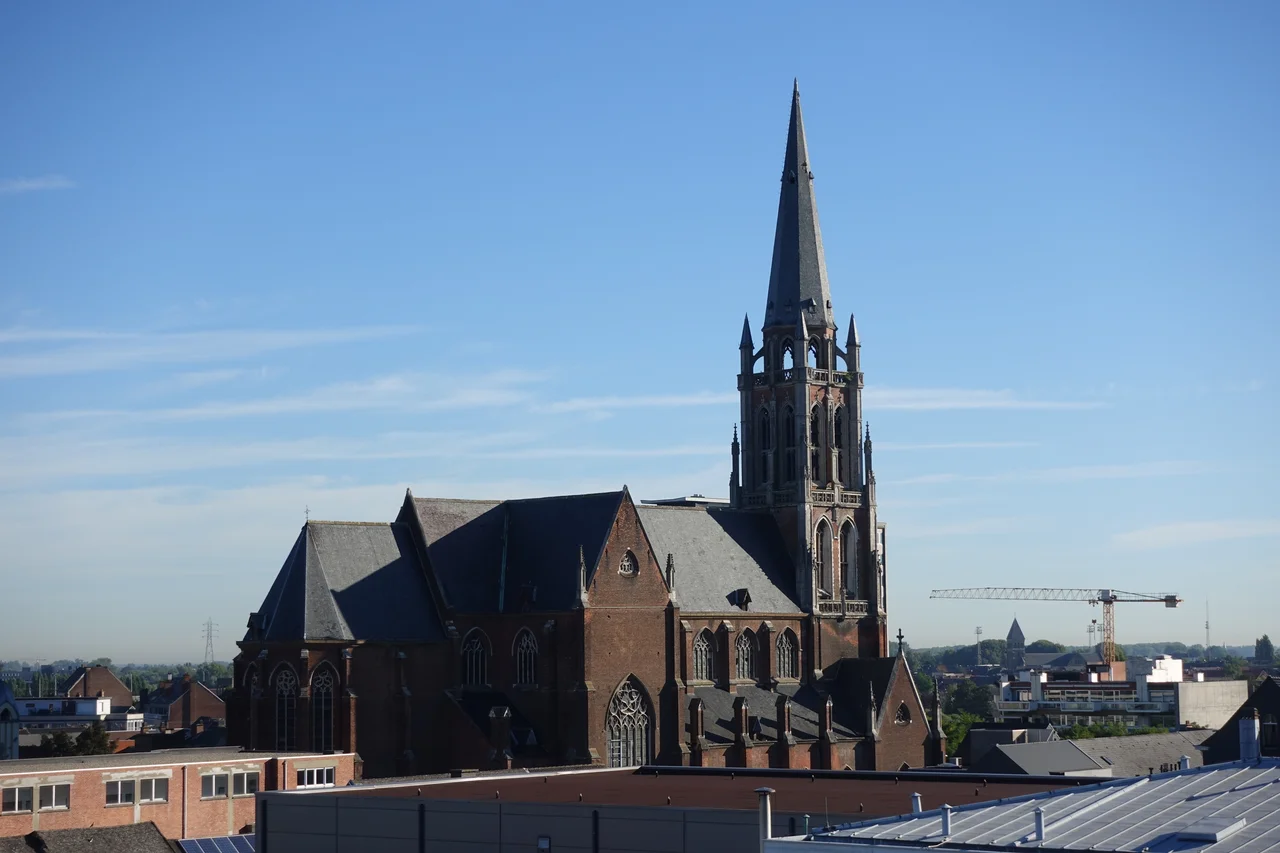

Aalst, Belgium
Locals call it Oilsjt, not Aalst, and locals will tell you the difference matters. The town sits on the Dender River about thirty kilometers northwest of Brussels, close enough to feel the capital's pull and far enough to keep its own accent, its own bread, and a folkloric feud with Dendermonde that has run, on and off, since the Middle Ages. Ninety thousand people live here. Most of them, if you ask, would rather talk about the carnival than the politics, and that itself is a long story.
A Printer Before Almost Anyone
In 1473, a citizen of Aalst named Dirk Martens set up a printing shop. This was twenty years after Gutenberg, a generation before most of Europe had reckoned with movable type. Martens printed Latin scholars, classical texts, and at least one book by Christopher Columbus, the kind of catalogue that put a small Flemish river town briefly at the intellectual edge of the continent. He later became a professor at the Old University of Leuven, but Aalst was where the press first ran. Walk the Grote Markt today and you can stand near the spot. The town has not forgotten him. He shares the square with a 15th-century Gothic belfry, rebuilt after fire took almost everything in 1360, and a reminder that small towns sometimes carry outsized weight in the long arc of how Europe learned to read.
The Weavers' Town
For centuries, Aalst was a weavers' town. The road from Bruges to Cologne crossed the Dender here, and the river itself moved cloth and grain and grievance through Flanders into the Holy Roman Empire and back. The weavers' guild ran much of the prosperity. The town was rich, then ruined, then rich again, depending on which army had taken which fort that year. The Eighty Years' War cost it dearly. Marshal Turenne took it for France in 1667. It changed hands so many times that by 1830, when Belgium finally became Belgium, Aalst had spent nearly eight centuries under one foreign banner or another - Spanish, German, French, Dutch. The 20th century brought factories that still produce textiles, footwear, and the machines that make them. The countryside grows hops, which keep the old breweries running. The cut flowers travel.
Carnival, and the UNESCO Question
Aalst Carnival is the centerpiece of the local year. For three days before Lent the town becomes a riot of color, satire, and giants - the floats lampoon politicians, religion, royalty, the press, anything and anyone in the news. In 2010, UNESCO added the carnival to the Representative List of the Intangible Cultural Heritage of Humanity. Nine years later, the relationship ended. The 2019 parade included floats that depicted Orthodox Jews with hooked noses standing on sacks of gold coins - imagery drawing from a long, painful tradition of antisemitic caricature. The international response was swift. Israel's ambassador and Jewish organizations condemned the floats. UNESCO signaled it would review the inscription. In December 2019, anticipating that review, Aalst's mayor Christoph D'Haese pre-emptively requested removal from the list. It was the first time any community had ever made such a request. The 2020 parade included further antisemitic imagery; Belgium's then-prime minister Sophie Wilmès called the parade an internal affair, while UNIA, Belgium's equality body, reported that no criminal offences had been committed. The dispute is unresolved in the broader sense. Aalst kept its carnival. It lost a designation. Many Jewish observers lost something less easy to name.
Aalst on Film
Aalst has been the set for more screen work than a town this size usually sees. Stijn Coninx's 1992 film Daens, about the Catholic priest and social reformer Adolf Daens, was set here and earned an Oscar nomination for Best Foreign Language Film. Coninx returned in 2018 with Niet Schieten, based on the final attributed crime of the so-called Brabant killers - a still-unsolved spree of robberies and murders in 1980s Belgium - committed in an Aalst supermarket in 1985. The Belgian police drama 13 Geboden was shot here, and the historical bandit series Thieves of the Wood is set in and around the town. There is a pattern in this. Aalst keeps drawing storytellers interested in the friction between ordinary life and the cracks that run underneath it.
What You See From Above
From cruising altitude, Aalst reads as a compact knot of streets clustered against the Dender, with the belfry catching light when the sun is low. The Molenbeek-Ter Erpenbeek runs in from the southwest. Brussels glows on the horizon to the east-southeast; Ghent to the northwest. The villages of the larger municipality - Hofstade, Erembodegem, Moorsel, Baardegem - spread outward into farmland and hop fields. In late February or early March, if you happen to overfly during carnival weekend, the town center is the brightest thing for miles.
From the Air
Aalst sits at 50.94°N, 4.04°E on the Dender River, roughly 30 km northwest of Brussels in East Flanders. Brussels Airport (EBBR) is 25 km east; Antwerp International (EBAW) lies about 35 km north. Cruise low to mid altitudes give a clean view of the Dender corridor running northeast toward Dendermonde and the confluence with the Scheldt. The medieval belfry on the Grote Markt is the most reliable visual landmark; the town center is otherwise easy to lose against the surrounding farmland. Visibility in winter is often hampered by low stratus typical of Flanders.
Nearby Stories
- Hof van Cleve 1.7 km away
- Sint-Niklaas 6.8 km away
- Great Beguinage, Leuven 9 km away
- Battle of Beverhoutsveld 9.4 km away
- Westmalle Abbey 16 km away
- Belgium 35 km away
- Courrieres Mine Disaster 50 km away
- Fort Jeanne d'Arc 199 km away