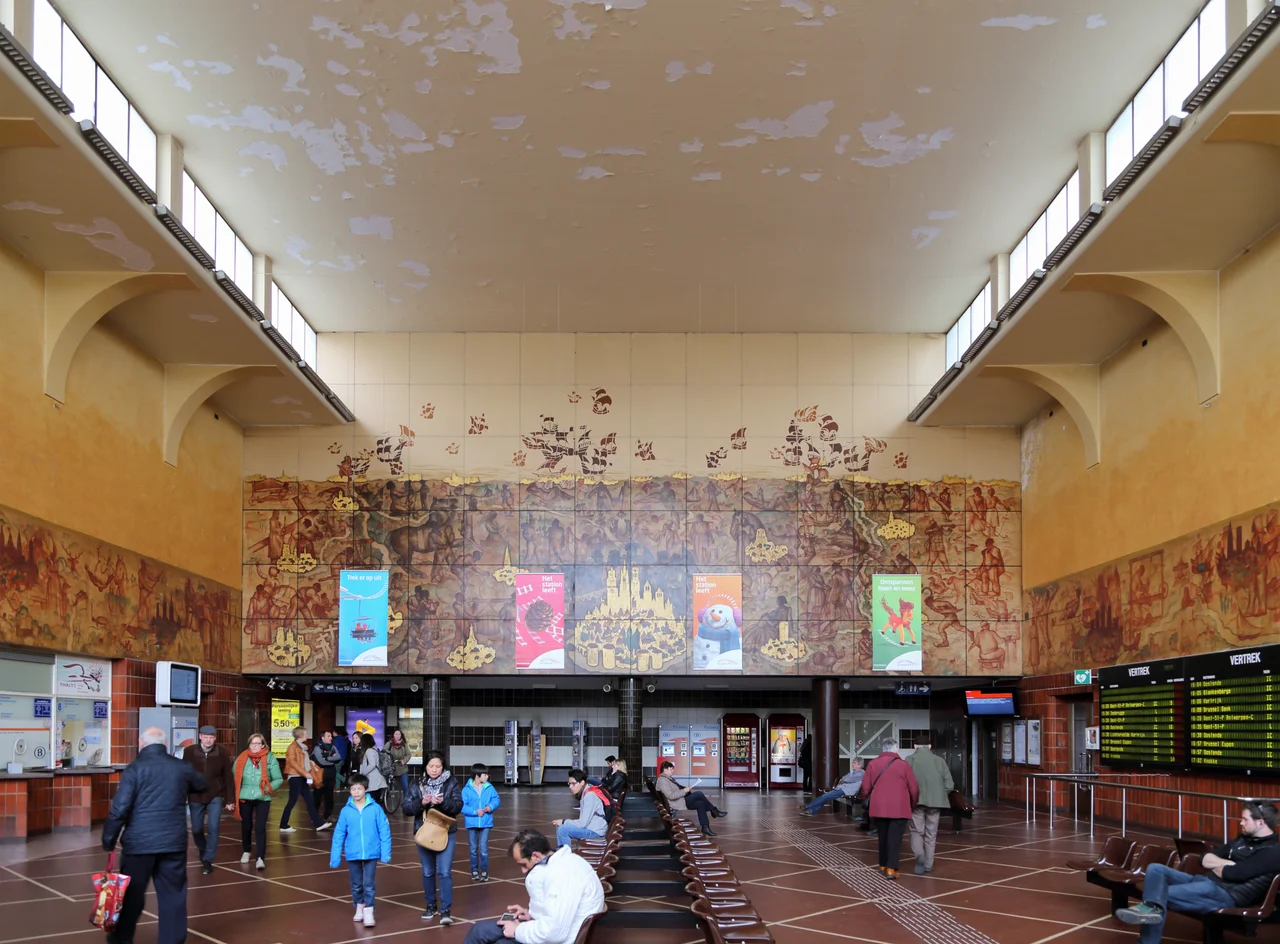

Brugge Railway Station
In 1879, a perfectly serviceable railway station was demolished in the middle of Bruges, packed onto carts, and trundled south to the town of Ronse for reassembly. The job took several years. When the workers finally stepped back to admire their reconstructed building, they noticed something unusual. The front of the station was facing the tracks, and the back was facing the street. They had rebuilt the entire thing backwards. The station still stands in Ronse today, still pointed the wrong way, a permanent monument to the perils of moving large buildings without an instruction manual.
When the Royals Came to Bruges
The railway reached Bruges on 12 August 1838, and the inaugural train carried King Leopold I and Queen Louise-Marie. The line ran from Ghent to Bruges, passing right through the medieval walls and stopping at 't Zand, the broad open square inside the old city. A few weeks later a second line opened westward to Ostend, connecting Bruges to the North Sea coast for the first time by rail. For six years the trains came and went with no real station building - passengers waited in the open or in temporary shelters. Then in 1844, the architect Auguste Payen built a proper station house on 't Zand. By the standards of mid-century Belgium, this was a serious piece of civic architecture. By the standards of Bruges's growing passenger volumes, it was already too small.
The Backwards Station
By 1879 the original building had to go, and Bruges did something only Belgium could really do: rather than demolish it, the city offered the dismantled building to Ronse, eighty kilometers south, which needed a railway station of its own. Workers numbered the stones, loaded them, and rebuilt them in their new home. Somewhere in the process the orientation was lost. The Ronse station stands today with its main facade aimed at the tracks instead of the town - architecturally elegant for arriving travellers, architecturally baffling for everyone else. Back in Bruges, Joseph Schadde designed a replacement station that opened in 1886 on the same 't Zand square. It was bigger, busier, and stylistically very late nineteenth century, with high gables and decorative ironwork.
The Wars That Pushed the Station Out
By 1910 it was clear that a railway running through the historic core of Bruges was going to choke the medieval city forever. Engineers began surveying a new alignment that would loop around the southern edge of the old walls, leaving the inner city for pedestrians and cyclists. Then the First World War began and the work stopped. Decades passed. Construction finally resumed in the late 1920s and the new alignment was completed in 1936. The current station building, designed by the brothers Josse and Maurice Van Kriekinge in the modernist International Style, opened in 1939. The 1886 Schadde station was left behind on 't Zand, derelict, all through the Second World War. It was finally demolished in 1948, more than a decade after the trains had stopped calling there.
One of the Busiest Doors in Belgium
Today Brugge station is the tenth-busiest in the country - and given how small Bruges itself is, that ranking says everything about how many day-trippers come for the canals and the chocolate shops. A renovation that began in 2004 widened the passenger tunnel beneath the platforms by twelve meters and added escalators and lifts; the work finished in May 2009. Behind the station an underground garage holds 800 cars and a thousand bicycles - this is Flanders, after all. Intercity trains thread Brugge into a national web that reaches Brussels, Antwerp, Liege, and the Belgian Airport, while local services run north to the port at Zeebrugge. Between 1998 and 2015 a daily Thalys high-speed train tied Brugge directly to Paris in under three hours, until the route was finally cut for lack of business. The trains here are not glamorous. They simply work, the way Belgian railways have for nearly two centuries.
From the Air
Brugge railway station sits at 51.20°N, 3.22°E on the southern edge of historic Bruges, just outside the line of the old medieval canal. From the air the station's curving track curves and platform fans are easy to spot south of the compact red-roofed city center. The Belfry of Bruges to the north makes an unmistakable visual anchor. Nearest airports are Ostend-Bruges International (EBOS) approximately 25 km west and Brussels (EBBR) roughly 90 km east-southeast. The terrain is flat polder country and the area is rarely turbulent except in coastal westerlies.
Nearby Stories
- Zaamslag Castle 8.5 km away
- Eastern Scheldt 8.8 km away
- Battle of Nieuwpoort 11 km away
- Westvleteren Brewery 11 km away
- Molenbeek-Ter Erpenbeek 12 km away
- Flanders Field American Cemetery and Memorial 14 km away
- Westhove Castle 15 km away
- Four Days' Battle 42 km away