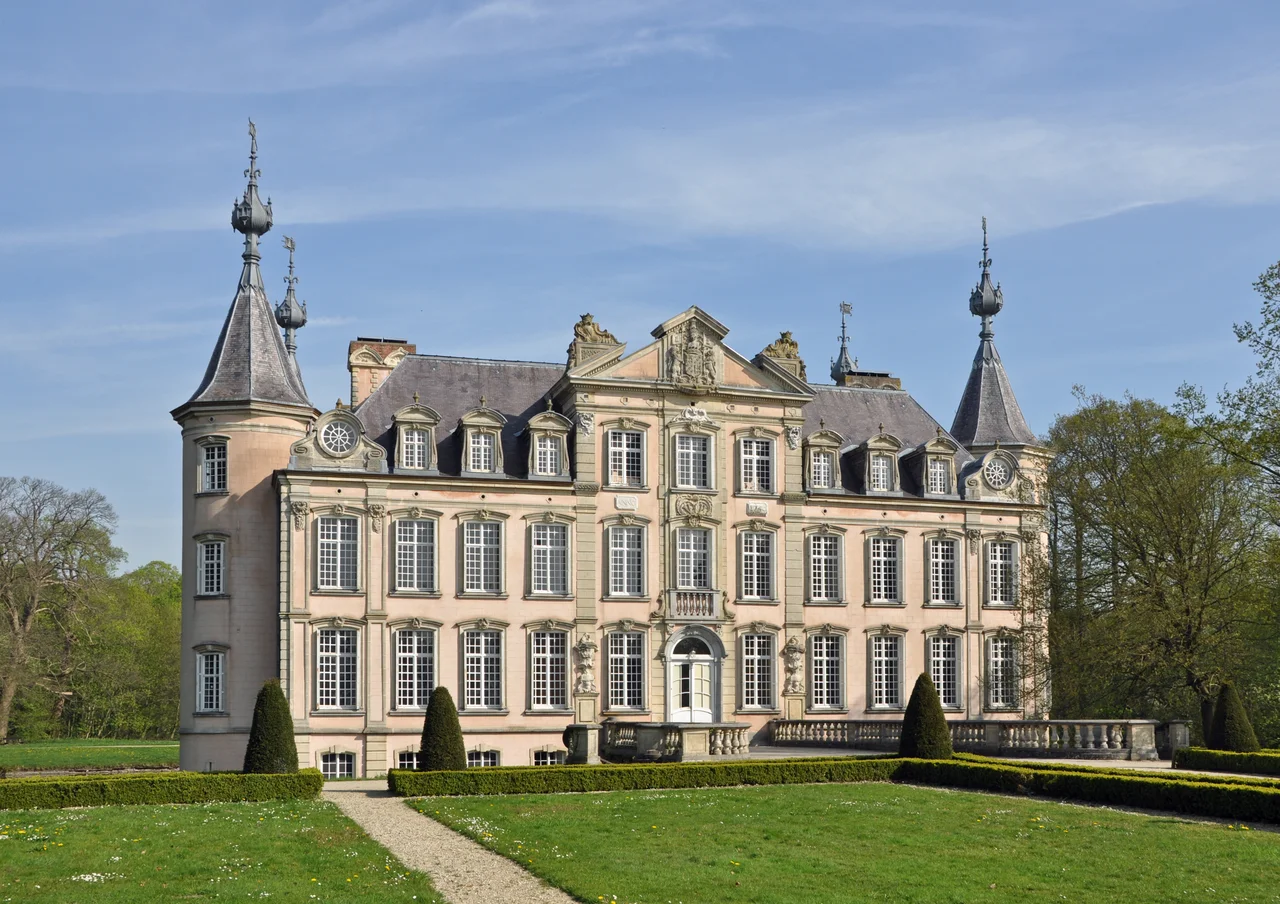

Poeke Castle
On 5 July 1452, Philip the Good of Burgundy retook the castle at Poeke, lined the captured Ghent militia against the walls, and had them executed. Then he ordered the castle pulled down stone by stone. A century later somebody started rebuilding. They were still rebuilding three centuries after that. What you see today at Poeke - the dreamy neoclassical block reflected in its moat, the formal French parterres turned English landscape garden - is essentially a Victorian fantasy from the 1870s, layered over a medieval ghost. That makes Poeke unusually honest about what a Flemish castle really is: a place that keeps becoming whichever castle its owner can afford.
The Fort That Could Not Stay Standing
Poeke first appears in the written record in 1139, when there was already a fortification of some kind here in the boggy farmland between Bruges and Ghent. The lords of Poeke were vassals of the Counts of Flanders, and they intermarried into the count's family - Anastasia van Oultre, the second wife of Eulaard III, later remarried Robert of Flanders, the illegitimate son of Count Louis II. Eulaard II of Poeke died at the Battle of Beverhoutsveld in 1382, killed trying to stop the Ghent militia that had already overrun his fort. That set the pattern. For the next four hundred years Poeke would be taken, burnt, sold, and slowly rebuilt by whoever had married into it next.
Philip's Reprisal
The 1452 destruction was the worst of it. Ghent had risen against Philip the Good of Burgundy in a long, bloody tax revolt, and the militia had seized Poeke as part of their swing through the Flemish countryside. When Philip's army rolled it back, he made an example of the place. The garrison was put to death, the towers thrown down, the rubble left as a warning. Reconstruction took the better part of a century. The lordship changed hands - the de Mastaing family inherited it through distant cousinage, sold it on to Philibert Delrye in 1588, and finally to the Preudhomme d'Hailly family in 1597. The Preudhommes added rooms, repaired walls, and ran out of money repeatedly.
The Eighteenth-Century Rebuild
Charles Florent Idesbald de Preudhomme d'Hailly, who carried so many titles that his stationery must have struggled - Burgrave of Nieuwpoort, Oombergen, Sint-Lievens-Esse and Schoonbergen, Baron of Poeke, lord of Neuville, Kanegem and Velaine - tackled the castle between 1743 and 1752. He gave Poeke the neoclassical bones it more or less still wears: a tall central block with wings, set on an island ringed by water, accessible by bridges fore and aft. Then the French Revolutionary armies swept north in 1791 and the family had to start over again. The castle was rebuilt yet again at the very end of the eighteenth century, a French neoclassical confection set down where the medieval keep used to be.
Baron Pycke's English Reverie
In 1872 Baron Victor Pycke de Peteghem, of Oudenaarde, bought the estate. He had three years to live and a Belle Epoque vision he could not wait to begin. The third storey of the castle was lifted into a steeper roof, the interior gutted and remade in nineteenth-century taste, the rigid French parterre garden swept away and replaced with an English landscape garden of curved paths, picturesque clumps of trees, and broad sweeping lawns. Hardly any architectural element predates his 1872-1875 reworking; the medieval and Burgundian and Habsburg layers survive only in the moat plan and the floor plates. When Pycke died, his daughter Baroness Ines became the last resident. In 1951 she left the entire fifty-six-hectare estate to a Catholic charity that ran summer camps for poor children. After she died in 1955, the kids took over.
What Remains
In 1977 the municipality of Aalter bought the castle. It is now used for weddings, civic ceremonies, and cultural events. The 56-hectare park around it has been a protected landscape since 1978 - centuries-old beeches, the broad reflecting moat, lawns rolling away to the village edge. In 2012 the BBC and HBO filmed scenes of Parade's End here, with Benedict Cumberbatch and Rebecca Hall walking the halls Baron Pycke remade. There is no admission to the castle interior except by event, but the park is open daily, and on a still afternoon the long bridges across the water carry you over a moat that has been keeping the world out of Poeke since 1139. The reflections in the water are the oldest part.
From the Air
Poeke Castle sits at 51.04 degrees north, 3.45 degrees east, in the village of Poeke in the municipality of Aalter, East Flanders. Elevation is 15 metres above sea level. The castle and its moat appear as a square water-bordered island in a heavily wooded park, surrounded by flat agricultural land. Ghent (Sint-Pieters) is fifteen nautical miles east; Bruges twenty nautical miles west. Ostend-Bruges Airport (EBOS) and Kortrijk-Wevelgem (EBKT) are the nearest fields. The Flemish lowland here is uniformly flat and low - expect easy contour-flying weather but persistent winter haze.
Nearby Stories
- Battle of Sluis (1603) 3.1 km away
- 1989 Belgium MiG-23 Crash 5 km away
- HMS Wakeful (H88) 8.4 km away
- Nieuwpoort, Belgium 8.4 km away
- Lokeren 9 km away
- Baarland Castle 9.1 km away
- Ghislenghien disaster 15 km away
- Battle of Cassel (1677) 23 km away