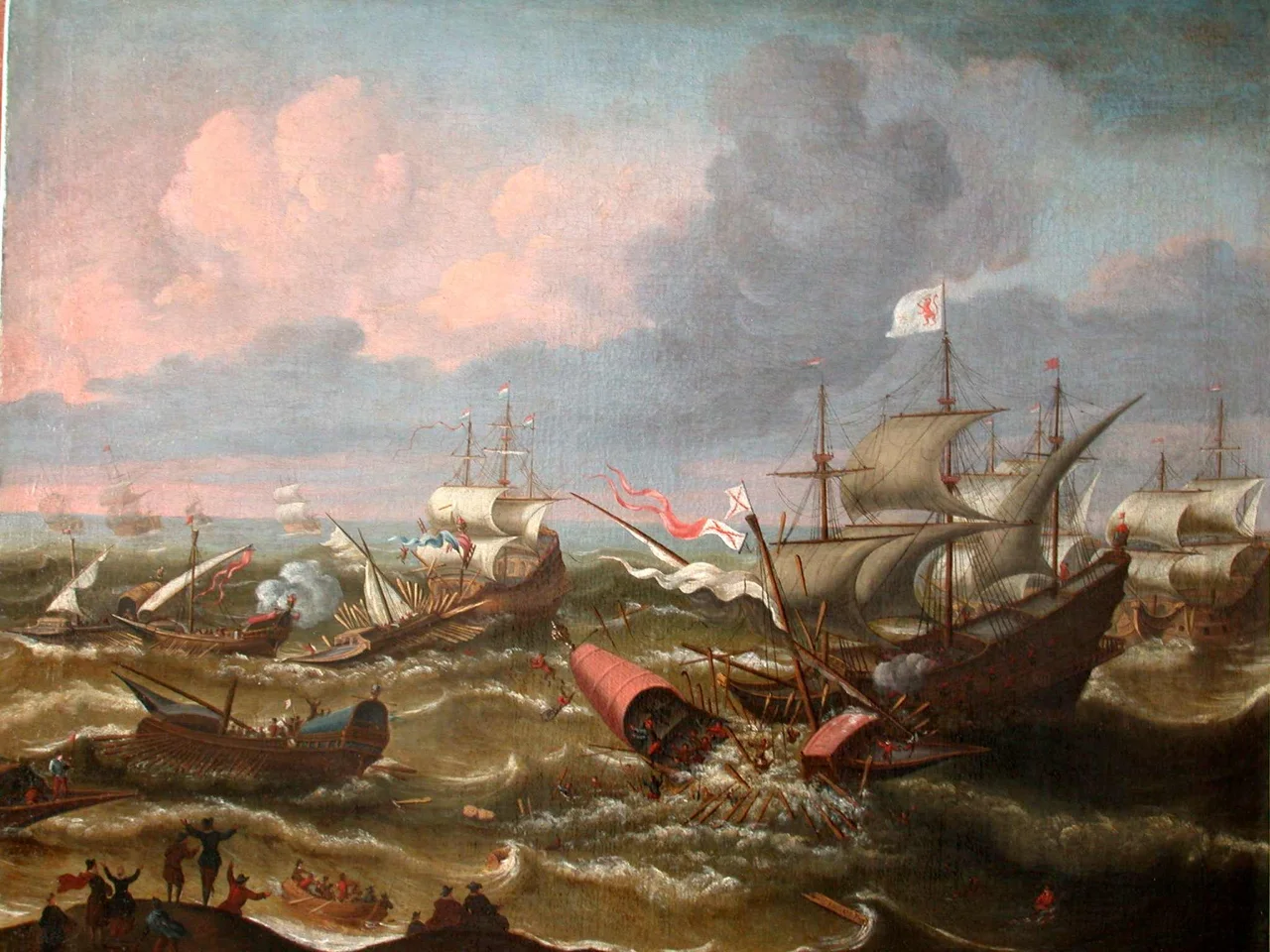

Battle of Sluis (1603)
Federico Spinola had a theory. In an age when wind-powered galleons ruled the open seas, he believed Spain could break the Dutch revolt with the kind of ship Mediterranean fleets had used since Lepanto: long, low galleys driven by oars and chained men. The Zeeland coast was full of shoals and lazy currents where wind ships ran aground. An oar-driven hull could go where a galleon could not. King Philip III gave him six galleys to prove it. By the morning of 26 May 1603, off the silting port of Sluis, the theory was about to be tested for the last time in northern European waters.
An Italian Idea for Flemish Water
Federico was the younger brother of Ambrogio Spinola, the celebrated Genoese general. Federico's career was less luminous and more obsessive. He spent years convincing Madrid that galleys, those antique Mediterranean weapons, could be retooled for Dutch waters. He even pitched Philip III on conquering England with an armada of them; the king mercifully declined and gave him six instead. Spinola began as a privateer out of Sluis, raiding Dutch and English merchantmen until the States of Holland and West Friesland answered with their own oar-powered ships: a Red Galley built at Vlaardingen in 1598, a thirty-meter Black Galley built at Dordrecht in 1600. The northern shoals briefly hosted their own miniature naval arms race in a ship type the rest of Europe was abandoning.
Fifteen Hundred Men in Chains
In 1602 Spinola tried to ferry eight new galleys from Portugal to Flanders. Each carried up to 250 oarsmen, most of them slaves chained to their benches. An English squadron of twelve ships caught him at the mouth of the Tagus and sank two. He pushed on with the survivors. In the Strait of Dover an Anglo-Dutch flotilla sank two more. Two limped to Nieuwpoort. One was seized by the French at Calais. Only Spinola's own galley, the San Luis, reached Dunkirk. Behind the strategic story sits the human one: fifteen hundred men spent that summer chained to oars in a war that meant nothing to them, drowning in shackles when the galleys went down. The galley fleet that finally assembled at Sluis de Knokke in 1603 carried thousands more like them.
Two Hours Off the Coast
On 26 May, Spinola seized a windless morning that pinned the main Zeeland fleet at Vlissingen and rowed out with eight galleys and four light frigates to break Joos de Moor's small blockading squadron. He formed his ships into a crescent and split them into two groups of four. Galley tactics had not changed in centuries: slide the long bow over the enemy rail, fire the two heavy bow cannon at close range, then board with sword and pistol. Two Spanish galleys rammed the Black Galley under Captain Jacob Michielsz Wip. The rams had little effect, but the boarding parties came on hard. Wip's gunners answered with well-aimed cannon shots, then the fight collapsed into the close-quarters brutality the Mediterranean knew best: blades on a swaying deck, smoke, and screaming. Wip was killed. Lieutenant Commander Hart took over the Black Galley's defense and held.
When the Wind Came Back
After an hour the wind shifted. Admiral Willem de Zoete, lord of Haultain, got the Zealand fleet out of Vlissingen at last and bore down on the engagement. Spinola, mortally wounded, ordered withdrawal. His battered galleys limped back to Sluis. Joos de Moor and his captain Pieterssen both survived their wounds. The Dutch had lost 47 men. The Spanish probably lost several hundred. The States General handed out gold chains of honor and shipped eleven tons of beer to the crews. Two paintings preserve the action: one possibly by Cornelis Vroom, hanging today in the Scheepvaartmuseum in Amsterdam, and one by Andries Eertveld still on display in the bell tower of Sluis itself.
The Last Galleys of the North
This was the only naval battle of the Eighty Years' War in which both sides fielded galleys, and it was effectively the last serious galley engagement north of the Mediterranean. The following year Dutch troops captured Sluis itself, ending its run as a Spanish privateer base. The galleys lost their use almost overnight. Even in the Mediterranean, the agile sailing frigates were already replacing the oared warship that had ruled inshore combat since antiquity. Federico Spinola died in pursuit of a doctrine that died with him. His brother Ambrogio went on to capture Ostend the following year and become one of the most respected generals of the age. The chained oarsmen who survived the action returned to chains. Nothing in the historical record suggests that anyone, on either side, considered freeing them.
From the Air
Located at 51.33 degrees north, 3.38 degrees east, off the coast where Sluis (then a working port, now silted seven kilometers inland) faced the open sea. Best viewed from 4,000 to 6,000 feet to see the Sluis-Cadzand-Vlissingen triangle and the broad Western Scheldt the Dutch fleet used to maneuver. Nearest airports: Midden-Zeeland (EHMZ) 25 km north on Walcheren, Ostend-Bruges (EBOS) 25 km southwest, Antwerp (EBAW) 65 km east. The shallows that gave Spinola's galleys their edge are now buoyed shipping channels for Antwerp-bound cargo vessels.
Nearby Stories
- Baarland Castle 1.6 km away
- Nieuwpoort, Belgium 5 km away
- HMS Wakeful (H88) 7.5 km away
- 1933 Imperial Airways Ruysselede Crash 8.2 km away
- Lokeren 10 km away
- Toren van Goedereede 17 km away
- Haamstede Castle 28 km away
- Four Days' Battle 31 km away