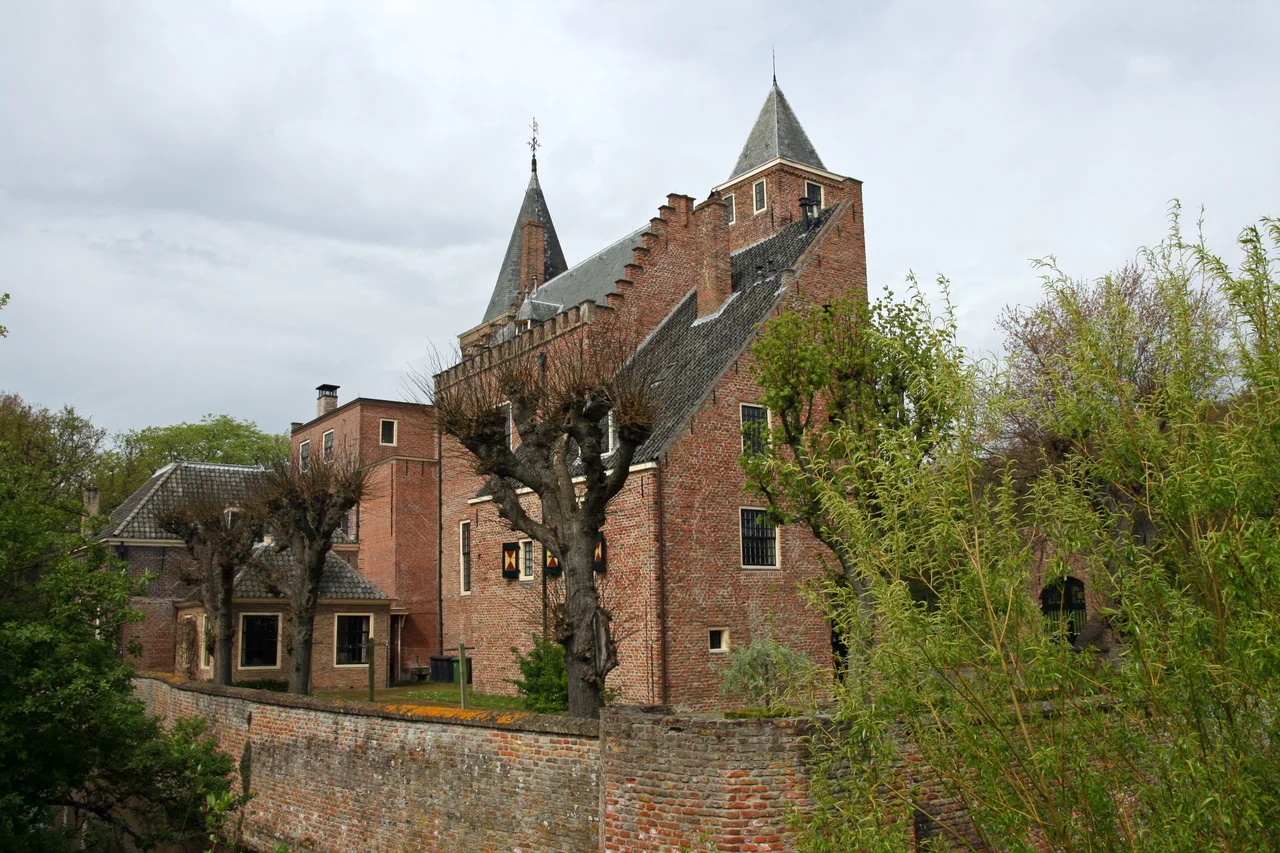

Haamstede Castle
The trowels hit something they did not expect. In 1964, archaeologists digging east of the keep at Haamstede uncovered tuff stone, then a small tuff wall, then bodies - skeletons laid east to west, hands at their sides, buried before the year 1100. By the time the dig was finished, twenty-nine of them had emerged from the sandy soil of Schouwen. None of them were Vikings. Centuries before any lord raised a brick tower on this spot, someone was burying their dead here, beneath the dune grass and the wheeling gulls.
A Tower Made for Surviving
What rose above those forgotten graves in the second half of the thirteenth century was an unusual building for the Low Countries: a Turmburg, a tower castle. Most Dutch lords surrounded their keeps with curtain walls and outer defences; the keep was a last resort. Haamstede's builders did the opposite. They made the tower itself the refuge, twelve and a half meters by nearly nine, walls of red brick laid in Flemish bond, basement reachable only by descending from the floor above. If attackers got over the gatehouse and across the bailey, the family climbed inside the keep and waited. A portcullis dropped through grooves in the stone of a small gate building bolted directly to the tower. The basement could be sealed off entirely. Tower castles like this are rare in the Netherlands - cousins at Groesbeek, Geijsteren, and Ter Leede are all gone. Haamstede survives.
Burned by Celebration
In February 1525, news arrived from northern Italy: the Holy Roman Emperor Charles V had crushed the French at the Battle of Pavia. Schouwen-Duiveland celebrated. Tar barrels were set blazing on the walls of the castle - by then expanded into a far larger second castle, four times the size of the original tower, complete with thick cannon-pierced walls and a heavy round tower jutting into the moat. Sparks drifted onto something flammable. Nobody noticed in time. The whole castle burned. When archaeologists came back in 1964, they found scorch marks on the thirteenth-century keep, where the fire had reached down through more than two centuries of additions. The bigger castle never came back. Only the old tower, with its impossibly thick walls, was worth rebuilding.
Witte and the Long Hand of the Counts
The names that ran through the deeds of Haamstede sound like a list of medieval intrigues, because that is what they are. In 1299 John I, Count of Holland, gave the castle to his dear brother Witte - bastard of Count Floris V, born around 1280, later celebrated in nineteenth-century legend for supposedly beating the Flemish in 1304 (a story now treated with caution). Witte's son Floris was killed near Warns in 1345. The Burgundian courtier and bibliophile Louis de Gruuthuse bought the castle in 1456 and probably built the larger fortress that the tar barrels would consume. His descendants ended up on the Spanish side of the Eighty Years' War; the States of Zeeland confiscated Haamstede in 1583. The poet and army captain Jacob van den Eynde took it on in 1609, and gave the castle the silhouette it largely keeps today.
Owls and Nature Reserve
In 1981 the castle passed to Natuurmonumenten, the Dutch nature conservation society. The family that had lived there retained the right to keep doing so. Around the keep, oak and beech woods spread across former parkland, and the moat reflects whatever Schouwen's wide skies happen to be showing. The grounds are now a sanctuary for owls, and on a still evening you might hear tawny calls echoing off brickwork that has been standing for over seven hundred years. A short walk south, the dunes drop down to the long beaches of the North Sea coast, where holidaymakers in Burgh-Haamstede have no idea that the quiet wood-fringed castle behind them is built on someone's Carolingian-era cemetery.
From the Air
Coordinates 51.6975°N, 3.7417°E, on the western tip of Schouwen-Duiveland, Zeeland. View from 1,500-2,500 ft AGL for the best sense of the castle's wooded island within its moat, with the Brouwersdam to the north and the Oosterscheldekering visible to the south. Nearest field is Midden-Zeeland (EHMZ) about 30 km south; Rotterdam The Hague (EHRD) lies 60 km northeast. Coastal weather: strong westerlies, frequent low stratus off the North Sea.
Nearby Stories
- Battle of Walcheren Causeway 0.9 km away
- Sugar Factory Zeeland 4.1 km away
- Dutch Republic 6.6 km away
- Calandbrug 15 km away
- Southern Bight 22 km away
- HMS Cressy 24 km away
- HMS Wakeful (H88) 34 km away
- Four Days' Battle 53 km away