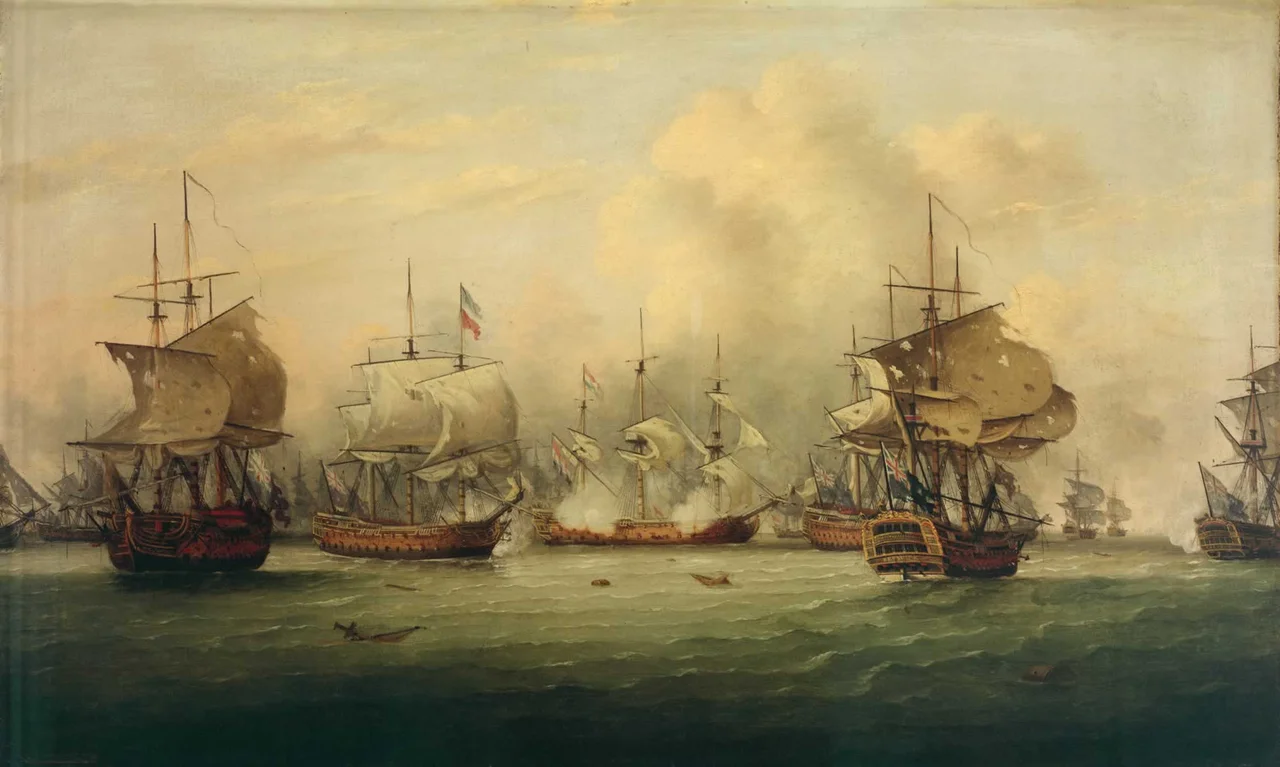

Dutch Republic
About one and a half million people. That is roughly how many lived in the Dutch Republic at its height, fewer than fill modern Munich. With that population, perched on reclaimed land below sea level, the seven United Provinces somehow ran a worldwide network of trading posts from Manhattan to Nagasaki, fought England in four naval wars, financed roughly forty percent of Britain's national debt at one point, and produced Rembrandt, Vermeer, Spinoza, Huygens, and the world's first stock exchange. The Republic was a confederation that had not really meant to become one. In 1581, the seven provinces signed the Act of Abjuration, declaring they would no longer recognize Philip II of Spain. They tried to find a new monarch. Henry III of France said no. Elizabeth I sent a governor-general instead. When the experiment failed, they shrugged, kept the alliance, and in 1588 simply carried on without a king. They would carry on, more or less, for two centuries.
A Confederation Held Together by Money
There was no Dutch nation in the modern sense. Groningen, Friesland, Overijssel, Guelders, Utrecht, Holland, and Zeeland each kept their own laws, their own taxes, and their own jealousies. They met as the States General in The Hague, where the wealthiest province, Holland, paid most of the bills and therefore won most of the arguments. Each province appointed a stadtholder, an executive officer, and over time those positions concentrated in the House of Orange. The Orangists wanted a strong central leader. The Republicans, led by powerful merchant-regents, wanted localism, trade, and peace. They fought constantly, sometimes violently. Twice the Republic abolished the stadtholdership altogether and tried being a true republic. Once it ended in the lynching of Johan de Witt and his brother by an Orangist mob in 1672. Self-government, here, was not a tidy theory.
Tolerance as a Business Strategy
Amsterdam in 1650 was not tolerant because the regents were noble. It was tolerant because tolerance paid. The city needed labour, capital, and brains, and it imported all three by leaving people more or less alone. Portuguese and Spanish Jews fleeing the Inquisition arrived in large numbers; one of them, Baruch Spinoza, would shake European philosophy. Huguenots displaced by Louis XIV came north. Antwerp Protestants, English Dissenters including the Pilgrim Fathers, and German Lutherans came too. In Amsterdam in the 17th and 18th centuries, nearly half of first-generation residents were born outside the Netherlands. The city built churches for almost every faith, including, eventually, a quiet chapel in the Beguinhof for Catholics. The wealthy Sephardim were welcomed openly. The poor Ashkenazim were vetted and, if they became dependent on the city, encouraged to move on. This was not idealism. It was a working system that other states copied, badly, a century later.
The Golden Age
The wealth that came in through Amsterdam's harbour funded one of the most extraordinary cultural flowerings in European history. Rembrandt painted The Night Watch for a militia company. Vermeer worked quietly in Delft producing fewer than forty surviving paintings, including the Girl with a Pearl Earring now in the Mauritshuis. Christiaan Huygens described centrifugal force and built the first practical pendulum clock. Antonie van Leeuwenhoek, a draper from Delft with no formal scientific training, ground his own lenses and was the first human to see bacteria. Hugo Grotius wrote the foundational text of international law while in exile. The Dutch East India Company became the first multinational corporation and the first to issue stock. None of this was inevitable. It happened because a small, soggy, argumentative confederation made room for it.
The Long Decline
By the 18th century the lead was shrinking. Britain and France caught up, built their own merchant fleets, traded directly rather than through Dutch middlemen. Dutch capital still mattered, but it increasingly funded other countries' growth rather than its own. The Fourth Anglo-Dutch War (1780-1784) was a disaster; the French historian Braudel called it the moment that sounded the knell of Dutch greatness. Patriot revolutionaries, inspired by the Americans, tried to remake the system in the 1780s. A Prussian army crushed them. A French army, eight years later, finished the job: in January 1795, the French invaded, the stadtholder William V fled to England in a fishing boat, and the Batavian Republic was proclaimed in Amsterdam. The world's first modern republic ended quietly, replaced by another.
What the Republic Left Behind
The Dutch Republic did not survive, but its inventions did. Limited-liability joint-stock companies, a public stock exchange, central banking, marine insurance, the modern newspaper, and the legal idea that the seas belong to no one all trace back here. So does the political idea that a state can be run by a federation of mutually suspicious provinces and still hold together for two centuries. The Hague still hosts the international courts that grew out of that tradition. Amsterdam still trades. The polders the Republic drained still keep half the country from drowning. Walk through any old Dutch city and the merchants' houses are still standing, narrow and tall, leaning slightly toward the canal, built by people who believed that if you got the bookkeeping right, the rest would follow.
From the Air
The Dutch Republic was centered on the Randstad provinces in the western Netherlands, roughly 52.06 N, 4.30 E. From cruise altitude in clear weather you can pick out the green chequerboard of the polders, the long straight lines of dikes and canals, and the dense urban cores of Amsterdam, The Hague, Rotterdam, and Utrecht clustered within a 60 km radius. Nearest airports: Rotterdam The Hague (EHRD), Amsterdam Schiphol (EHAM), Eindhoven (EHEH). Visibility along the coast varies; sea mist common in autumn and spring.
Nearby Stories
- Woerden Train Disaster 2.5 km away
- Ransdorp 5 km away
- Barendrecht 9.6 km away
- 1973 Dutch Grand Prix 10 km away
- Dussen Castle 14 km away
- Moermond Castle 15 km away
- HMS Cressy 20 km away
- Hollandse Kust West Offshore Wind Farm 34 km away