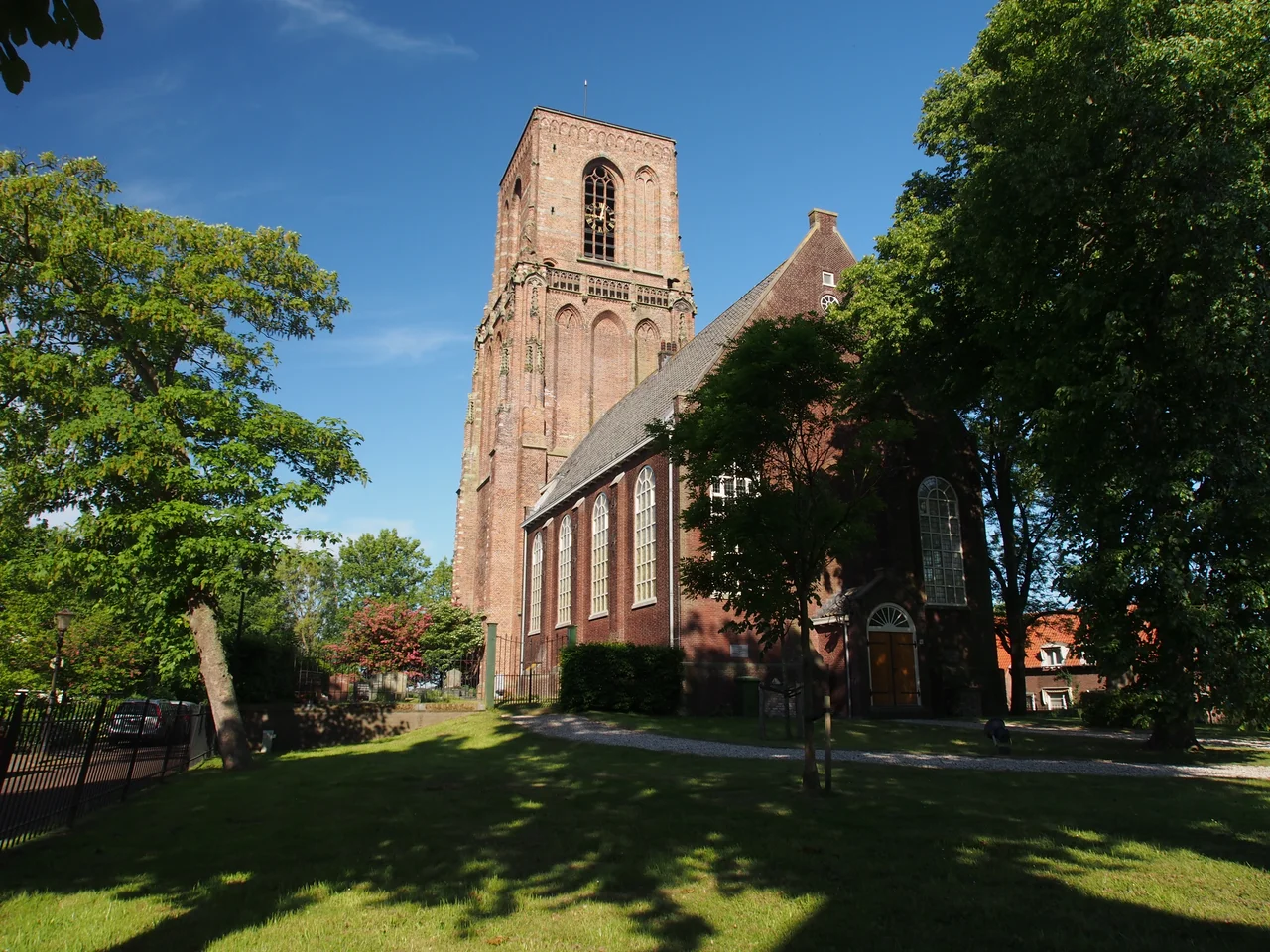

Ransdorp
Rembrandt drew the church tower at Ransdorp at least twice. He wasn't there for the architecture. His common-law partner, Geertje Dircx, had been born in the village, and her brother Pieter lived there still. So the painter rowed or walked the seven kilometers out from Amsterdam, sat among the cows and the polder ditches, and made quick studies in pen and brown ink of the strangest tower in North Holland. The drawing now hangs at the Rijksmuseum. It shows what every visitor still sees today: a tower that looks unfinished, because it is. The masons stopped, four and a half centuries ago, and never came back.
The Tower That Wouldn't Grow
Construction on the Ransdorpertoren began sometime between 1502 and 1542, to a design by the master mason Jan Poyt. The intent was ambitious: a soaring late-Gothic belfry to crown the parish church of a village that, at the time, was rich enough to dream big. The plans were not modest. The walls were laid more than two meters thick, brick and sandstone keyed together for a tower meant to climb high above the flat horizon. Then the money ran out. The masonry stopped at around 32 meters, the roof was put on, and that was that. What was supposed to be a slender Gothic spire became a squat brick column, square and stubborn, more like a fortress keep than a church tower. The village kept using it for everything: bells, prison cell, fire-engine storage, strongroom, lookout. The unfinished tower turned out to be useful in ways no architect plans for.
Geertje's Village
Rembrandt's connection to Ransdorp came through Geertje Dircx, the widow he hired as a wet nurse for his infant son Titus after Saskia's death in 1642 and who became his partner for several years. Geertje was born in Edam. The relationship ended bitterly, with lawsuits and confinement, but during the years it lasted, Rembrandt knew this village. He sketched its tower around 1650, again later. In one drawing, the tower stands above a low huddle of houses, the cows in the foreground exaggerated by the painter's eye, the great brick shaft rising too short and too thick to be elegant and somehow, in his hand, becoming so. The church and tower remain in their original setting today, surrounded by the same flat fields that filled the edges of Rembrandt's page.
A Village on a Made Hill
Ransdorp sits on a terp, a man-made mound raised above the waterlogged peat of Waterland centuries before the great drainage projects tamed the landscape. The village existed by 1373, when a church on this spot was first described in writing. Through the long centuries of dike-building, polder-draining and reclamation, Ransdorp stayed small. In 1840 it held 292 people in 44 houses. Today it holds about 245. The dense cluster of wooden farmhouses and brick gables is so well preserved that an unusual number of its buildings are listed as Rijksmonumenten, national heritage monuments. Walking down the Dorpsweg, the village street, you pass canals on one side and timber facades on the other, the same scene a seventeenth-century traveler would have recognized minus the cars and the cyclists.
Independent Until It Wasn't
Ransdorp ran its own affairs for a long time. As a separate municipality it administered itself and the neighboring villages of Durgerdam, Holysloot and Schellingwoude, a tiny rural republic on the doorstep of one of Europe's great cities. That ended in 1921, when Amsterdam absorbed the lot. The reason was infrastructure. The city government wanted the dikes, roads and drainage of the surrounding villages maintained to urban standards, and the easiest way to do that was to swallow them whole. So Ransdorp became part of Amsterdam, formally a piece of the Amsterdam-Noord borough, even though anyone arriving from the city center across the IJ feels they have entered a different country. The fields begin, the silence begins, and the city, somehow, ends.
Cows, Cameras, and Pole-Vaulting
The village now lives on dairy farming and visitors. Cyclists pedal out from Amsterdam-Noord for an afternoon, follow the dikes through Durgerdam and Holysloot, and stop in Ransdorp's small square to look up at the tower. Reality television has discovered the place: The Amazing Race filmed contestants performing fierljeppen here, the traditional Frisian sport of vaulting a canal with a long pole, in both 2007 and 2012. A Chinese show staged a goose-herding task in the village in 2016, and an Israeli series came for more pole-vaulting in 2020. The producers keep coming for the same reason Rembrandt did. The tower is still there, the cows are still there, and the horizon, four hundred years on, still belongs to the polder.
From the Air
Located at 52.39N, 4.99E, about 7 km northeast of Amsterdam Centraal in the Landelijk Noord district. From the air at 1,000-2,000 feet AGL, look for the distinctive stubby brick tower rising from a cluster of green pasture northeast of the IJmeer. Schiphol (EHAM) is roughly 18 km southwest. Lelystad (EHLE) lies about 33 km east-southeast across the IJmeer; Hilversum (EHHV) about 28 km southeast. The web of polder ditches and the silver line of the IJsselmeer make orientation simple in clear weather.
Nearby Stories
- 2008 Vintage Yachting Games 4.4 km away
- Museum Het Leids Wevershuis 7.2 km away
- Vechtstreek 8 km away
- 1973 Dutch Grand Prix 9.3 km away
- Lowlands Festival 10 km away
- HNLMS Johan Maurits van Nassau (1932) 11 km away
- Lemmer 13 km away
- Hoge Veluwe National Park 18 km away